In the world of industrial automation and smart systems, the ability to detect the presence or absence of an object without physical contact is fundamental. Among the various technologies enabling this capability, M-type proximity sensors stand out for their reliability, versatility, and widespread use. These sensors, often simply called inductive proximity sensors, operate on the principle of electromagnetic induction to detect metallic targets. Their designation "M-type" typically refers to their standard cylindrical metal housing, which offers robustness for demanding industrial environments.
The core working principle of an M-type proximity sensor is elegantly simple yet highly effective. The sensor contains an oscillator circuit that generates a high-frequency electromagnetic field at its active face. When a metallic object enters this field, eddy currents are induced on the surface of the metal. These currents draw energy from the oscillator, causing a change in its amplitude. An evaluation circuit within the sensor monitors this amplitude change. Once the change exceeds a predefined threshold—indicating the target is within the specified sensing range—the sensor's output state switches. This output is typically a solid-state switch (like an NPN or PNP transistor) that can control a load such as a relay, PLC input, or indicator lamp. The entire process is contactless, wear-free, and extremely fast, allowing for detection rates into the thousands of operations per second.
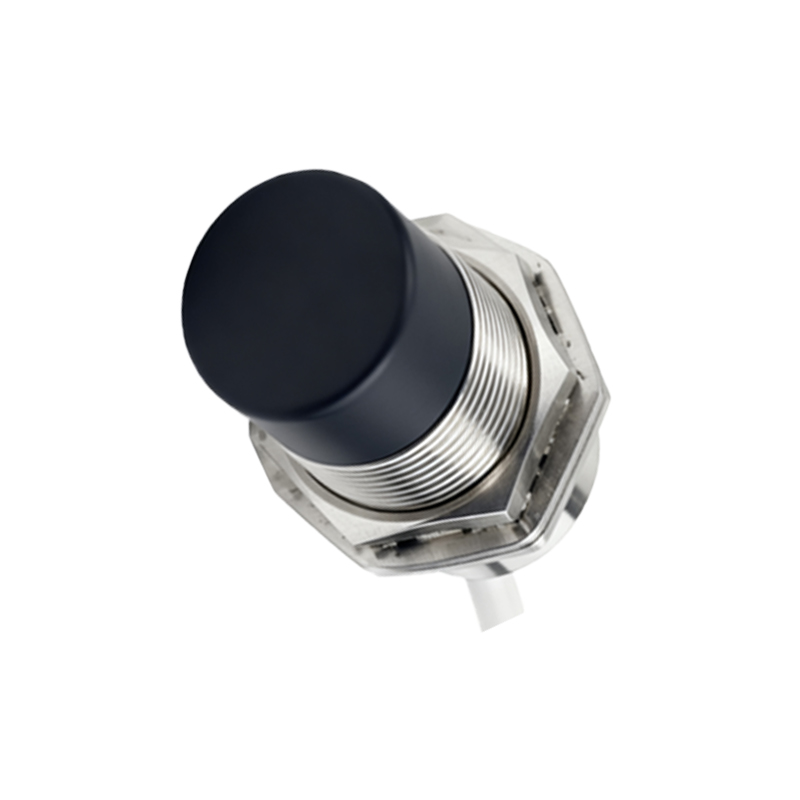
One of the most significant advantages of M-type sensors is their resilience. Encased in a stainless steel or nickel-plated brass housing, they are inherently protected against physical impacts, dust, and coolants. Many models boast high Ingress Protection (IP) ratings, such as IP67 or IP68, making them suitable for use in washdown areas or outdoor applications. They are largely immune to environmental factors like ambient light, oil films, or dirt that could plague optical sensors. Their sensing range, while limited compared to some technologies (typically from 1 to 40 mm for standard models), is precise and stable, unaffected by the surface color or texture of the target—only its metallic composition and size matter.
The applications for M-type proximity sensors are vast and span nearly every industry. In automotive manufacturing, they count gears on a production line or verify the presence of engine blocks. In packaging machinery, they detect the position of metal lids or cans. They are indispensable in material handling for pallet detection, in metalworking for tool breakage detection, and in assembly lines for verifying component placement. A common use case is as an end-of-travel limit switch for cylinders or slides, providing a reliable digital signal when a pneumatic or hydraulic actuator has fully extended or retracted.

Selecting the right M-type sensor requires careful consideration of several parameters. First, the sensing distance must be chosen with a safety margin; the nominal range is defined for a standard mild steel target. For other metals like aluminum or copper, the effective range is reduced and must be factored in. The size of the sensor body, commonly ranging from M4 to M30 diameters, must fit the mechanical constraints of the installation. The electrical output type (NPN sinking or PNP sourcing) must match the control system's input card specifications. Other critical features include the output configuration (normally open or normally closed), the supply voltage (commonly 10-30V DC), and whether a built-in LED status indicator is needed for diagnostics. For harsh environments, special models with extended temperature ranges or enhanced chemical resistance are available.
Installation and wiring are generally straightforward. The sensor is threaded into a mounting bracket or directly into a machine frame. It's crucial to ensure that no other metal objects are within the lateral or rear sensing zones, as this could cause false triggering. Adequate clearance around the sensor head, as specified in the datasheet, is essential for reliable operation. When wiring, attention must be paid to polarity for DC models, and load devices should not exceed the sensor's maximum switching current.
While M-type sensors are exceptionally durable, understanding their limitations ensures optimal performance. They can only detect metals, with ferrous metals like iron and steel providing the longest range. Non-ferrous metals reduce the sensing distance. They cannot differentiate between different metals at the same distance. Very thin metallic foils or small targets may not be detectable if they do not perturb the electromagnetic field sufficiently. In applications with extreme high-frequency welding or powerful motors, electromagnetic interference could potentially cause issues, necessitating shielded cables or physical separation.
In conclusion, the M-type proximity sensor remains a cornerstone of modern industrial sensing. Its combination of simple physics, rugged construction, and consistent performance makes it a go-to solution for millions of position detection tasks globally. By understanding its operating principles, key specifications, and application guidelines, engineers and technicians can effectively integrate these robust devices to enhance machine reliability, safety, and automation efficiency. Their continued evolution, including miniaturization and the integration of IO-Link for digital communication and