Hall effect proximity sensors are solid-state devices that detect the presence or absence of a target object without physical contact. Their operation is based on the fundamental Hall effect, discovered by Edwin Hall in 1879. This principle states that when a current-carrying conductor or semiconductor is placed in a perpendicular magnetic field, a voltage difference, known as the Hall voltage, is generated across the material. This voltage is transverse to both the electric current and the magnetic field.
A Hall effect proximity sensor integrates several key components into a single package. At its core is a thin rectangular piece of semiconductor material, typically made from gallium arsenide (GaAs), indium arsenide (InAs), or silicon (Si). This element is called the Hall element or Hall plate. Constant current is applied to this element through two opposing terminals. Two other terminals, placed perpendicular to the current flow, are used to measure the output Hall voltage.
In a typical non-switching or analog state, with no target present, the Hall element is exposed only to the earth's ambient magnetic field, which is too weak to generate a significant output voltage. The sensor's output in this state is near zero. The critical component that enables proximity detection is a permanent magnet, which is either integrated into the sensor housing or is part of the target object itself.
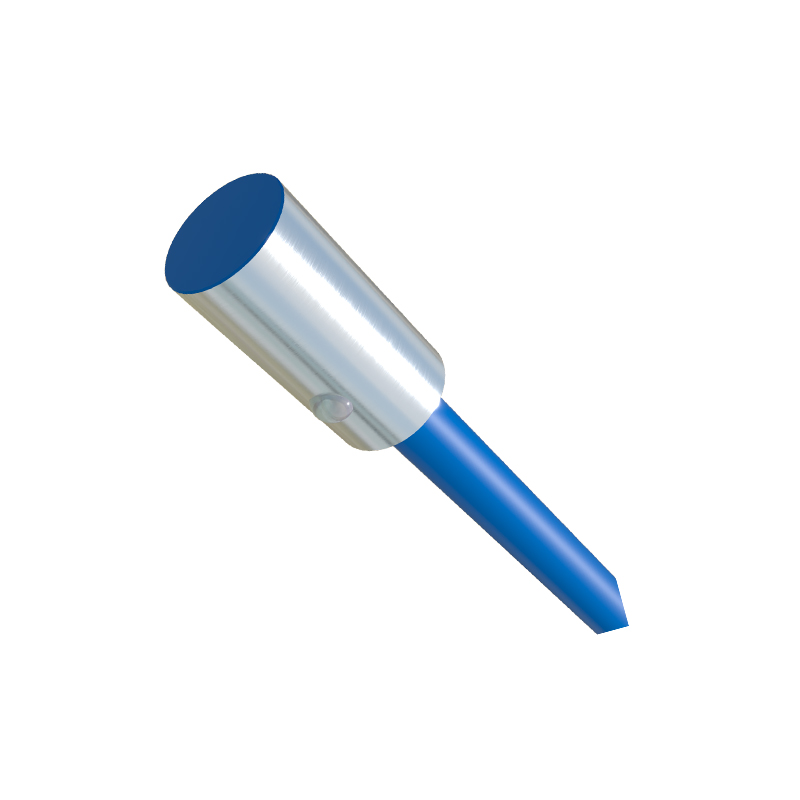
When a ferromagnetic target (like a piece of iron or steel) or a permanent magnet enters the sensor's detection range, it interacts with and concentrates the magnetic field from the sensor's internal magnet. This intensified magnetic flux lines pass perpendicularly through the Hall element. According to the Hall effect, this action induces a measurable Hall voltage across the sensing terminals. The magnitude of this voltage is directly proportional to the strength of the magnetic flux passing through the element.
For digital switching applications, which constitute the majority of proximity sensing uses, this analog Hall voltage is not used directly. Instead, it is fed into an integrated signal conditioning circuit within the sensor package. This circuitry typically includes an amplifier to boost the weak Hall signal, a Schmitt trigger to provide a clean, sharp switching action with hysteresis, and a voltage regulator. The hysteresis function is crucial; it prevents output oscillation or "chatter" when the target is at the precise switching point by creating a small difference between the turn-on and turn-off thresholds.
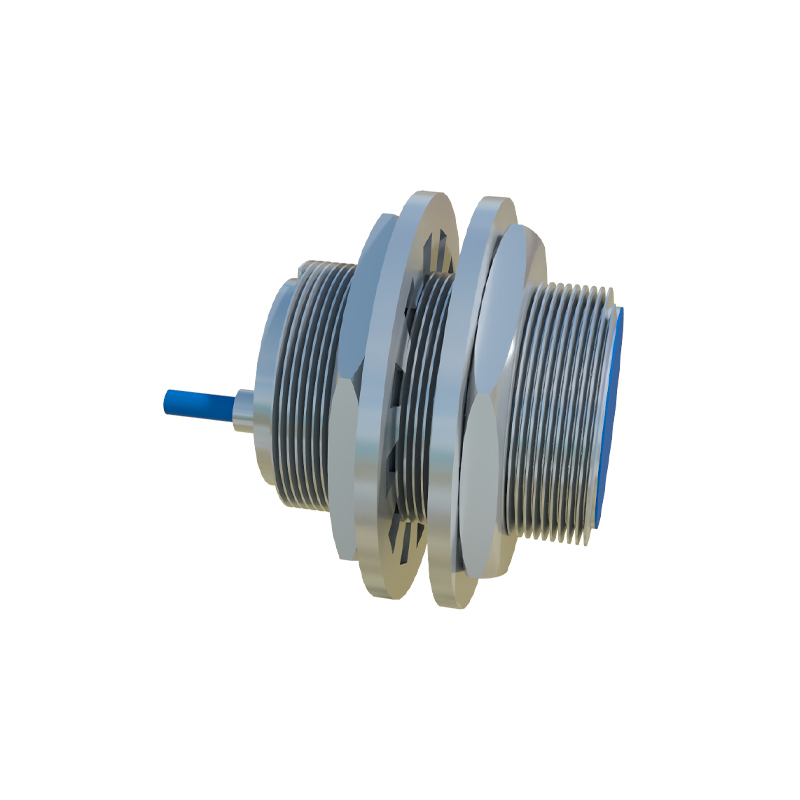
Once the amplified Hall voltage exceeds the predefined threshold of the Schmitt trigger, the sensor's solid-state output switch changes state. In a 3-wire DC sensor, this is usually an NPN or PNP transistor. The output switches either from OFF to ON (sourcing or sinking current) or from ON to OFF, providing a clear digital signal to a programmable logic controller (PLC), counter, or other control system. The sensing distance, or operating point, is determined by the strength of the magnet and the sensitivity of the Hall element and its circuitry. The release point, where the output switches back, occurs when the target moves away and the magnetic field weakens below the lower hysteresis threshold.
Hall effect sensors offer distinct advantages. They are true solid-state devices with no moving parts, leading to exceptionally long life, high reliability, and immunity to contact bounce. They can operate at very high switching frequencies, often in the range of 100 kHz, because the response time depends on electronic switching, not mechanical movement. They are also capable of detecting static magnetic fields, meaning they can sense a stationary target. Furthermore, they are largely unaffected by environmental factors like dust, oil, moisture, or vibrations that plague optical or mechanical switches.
However, their operation has specific dependencies. The sensing capability is intrinsically tied to magnetic fields. They primarily detect ferrous metals or permanent magnets. Non-ferrous metals like aluminum or copper, unless specially designed for eddy current-based Hall sensors, are generally not detectable with standard versions. The sensing distance is also relatively short compared to some inductive or capacitive sensors and can be influenced by external magnetic fields.
In practical applications, Hall effect proximity sensors are ubiquitous. They are used for position sensing in automotive systems (e.g., crankshaft and camshaft position, seat belt latches, brake pedal position), in industrial automation for counting, limit switching, and speed detection on gear teeth, and in consumer electronics for detecting flip/slide phone covers or laptop lid closure. Their non-contact, wear-free operation makes them ideal for demanding and high-cycle applications where durability and precision are paramount.