Forget the pristine data sheets. After twenty years of wrestling with air curtains in slaughterhouses, chemical washdowns, and foundries, I'm here to talk about what really happens when the rubber meets the road—or rather, when the flap sensor meets the relentless blast of an industrial air curtain.
Let's start with Experience Corrections. The advertised "millions of cycles" and IP67 ratings are a starting point, not a guarantee. The primary deviation isn't in the sensor's micro-switch itself, but in the flap material and pivot bearing. Theoretical models assume a uniform, laminar airflow. In reality, high-velocity, turbulent air from a curtain causes high-frequency, low-amplitude flutter in the flap that datasheets never account for. This flutter, not the full opening/closing cycle, is the true killer. It leads to material fatigue at the hinge and accelerated wear in the bearing. I've seen nylon flaps develop stress cracks at the pivot within 6 months in freezer applications (-25°C), not from cold, but from embrittlement combined with this micro-vibration. The "operating life" is often dictated by this mechanical wear, not the electrical life of the switch. A 24V DC sensor might be rated for 1A, but the inrush current from the solenoid valve or contactor coil it typically controls can spike significantly higher during a cold start, leading to premature contact pitting if not properly derated or buffered with an intermediate relay.
Now, the Boundary Conditions. This is where failures become predictable, and you must avoid these scenarios.
1. Horizontal Airflow Contamination: Never install a pendulum-style flap sensor where it can be exposed to consistent cross-drafts from forklift traffic, open doors, or HVAC vents. A steady 2 m/s crosswind can hold the flap perpetually open or closed, providing a false signal while completely defeating the purpose of the air curtain's barrier. The sensor becomes blind to the curtain's actual operation.
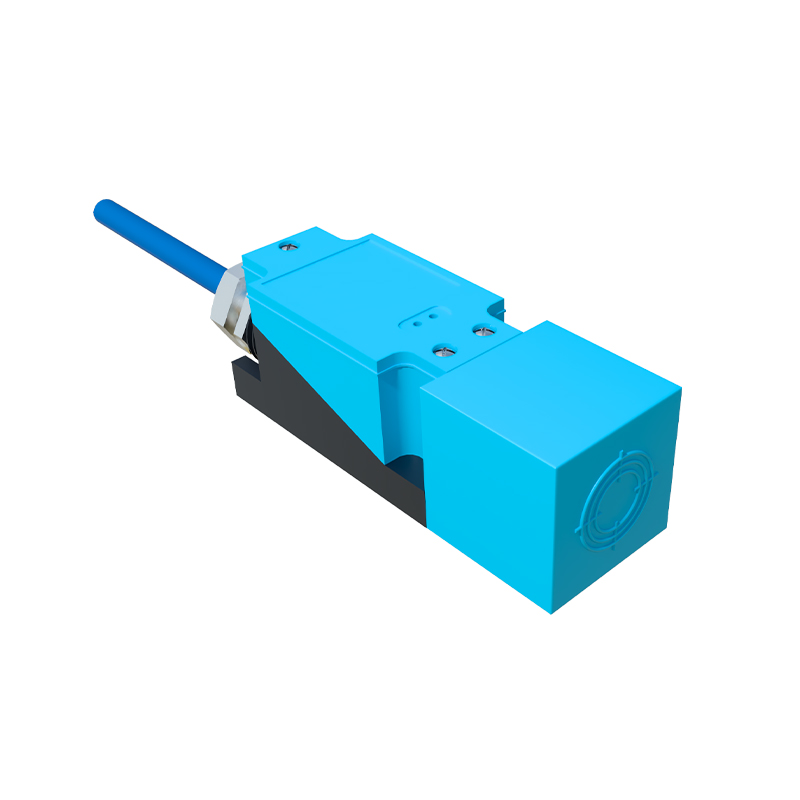
2. High-Pressure Washdown with Certain Chemicals: While IP69K might suggest suitability, alkaline or acidic cleaning agents are the silent assassins. They seep into the bearing, wash away lubrication, and leave residues that cement the flap in place. More critically, they can migrate along the wire conduit, corroding terminals from the inside out. A sensor surviving the spray often fails from terminal corrosion weeks later.

3. Dust with Adhesive Properties: Flour, powdered sugar, certain polymer dusts. These don't just coat the flap; they form a cohesive layer that progressively increases the flap's mass and stiffness. The increased moment of inertia means the airflow can no longer reliably displace it, leading to a failed "open" signal. The failure is gradual and insidious.
4. Applications Requiring "Instant" Off Delay: If your control logic requires the air curtain to run for precisely 10 seconds after the door closes, forget using the mechanical flap's return as your timer. Air turbulence can keep it oscillating for 3-5 seconds, making precise timing impossible. In these cases, a separate, clean timer circuit triggered by the initial flap movement is non-negotiable.
Finally, the Counter-Intuitive Conclusions.
1. A "Failed Closed" Sensor is Often Safer Than a "Failed Open" One. Industry instinct is to shut down on failure. However, if the sensor fails in the "door closed" position (flap stuck down), the air curtain stops running, exposing the doorway. A failure in the "door open" position (flap stuck up) keeps the curtain running unnecessarily, wasting energy but maintaining the barrier. In high-traffic, climate-critical environments (e.g., cold storage), designing the failsafe to default to the "run" state on sensor failure can be the more risk-averse, albeit less efficient, choice.
2. The Most Reliable Mounting Orientation is Often Not Vertical. Mounting the sensor with its pivot axis perfectly vertical seems logical. However, in environments with heavy particulate fallout (sawdust, grain dust), mounting it with a 15-20 degree forward tilt ensures that debris slides off the flap rather than accumulating on its upper horizontal surface, which directly impacts the pivot torque required for movement.
3. Redundancy Increases Complexity, Not Always Reliability. Installing two sensors in series for "redundancy" is a common request. In practice, this doubles the mechanical points of failure (two flaps, two bearings) and the likelihood of one being jammed by debris. True reliability gains come not from duplication, but from selecting a sensor with a sealed, over-molded pivot bearing and a flap material specifically chosen for the