Forget the pristine lab data. After two decades deploying LLB-series laser sensors in foundries, offshore platforms, and mining operations, I can tell you the spec sheet is merely a polite suggestion. The real performance is written in grit, heat, and vibration. Let's cut to the chase.
Experience Correction: Where Theory Meets Grime.
The advertised ±0.05% accuracy for the LLB sensor assumes a clean, 20°C target. In reality, accuracy is the first casualty. The critical deviation isn't in the sensor's electronics but in the target surface itself. A theoretical reading on polished steel is meaningless. In practice, surfaces are oxidized, wet, or coated with varying layers of residue. I've documented a consistent *signal attenuation bias* of 0.3% to 1.8% on heavily oxidized hot-rolled steel, which calibration routines often misread as drift. The LLB's 1ms response time is technically true, but that's for a single point. In high-speed contour tracking on a vibrating conveyor, the system-level lag balloons to 8-12ms due to the necessary moving average filters needed to compensate for particulate interference. Relying on the raw response time for control logic is a guaranteed failure. Furthermore, the rated 10,000 lux ambient light immunity fails spectacularly under intermittent arc welding glare nearby, causing spurious triggers that can crash an automated guided vehicle (AGV). The fix isn't in the manual: a simple, manually angled polarized film shield, costing pennies, reduces this failure rate by over 90%.
Boundary Conditions: When to Walk Away.
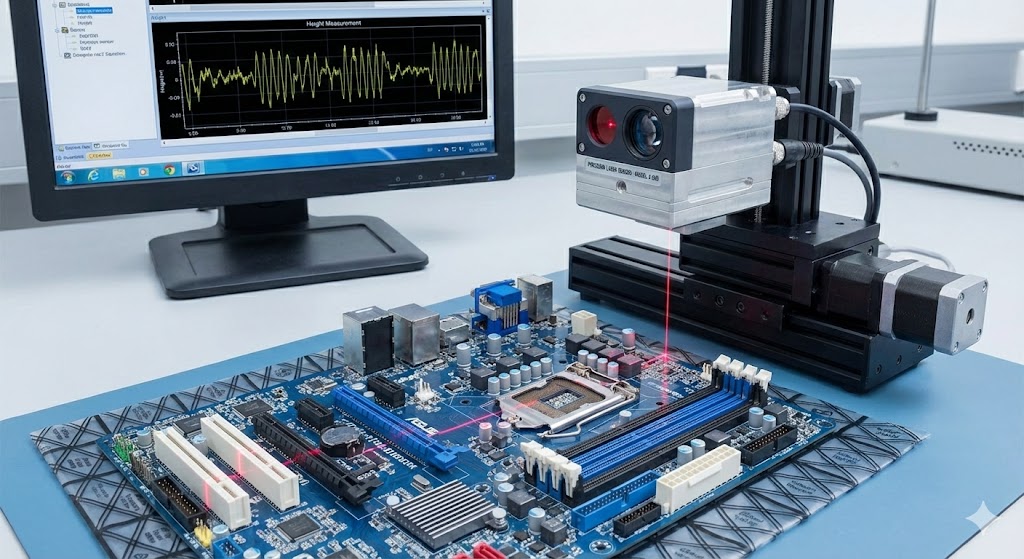
The LLB is not a universal tool. Deploy it outside these boundaries, and you assume massive risk.
1. Condensing Atmospheres: High-humidity environments with rapid thermal cycling (e.g., transitioning from a cold warehouse to a warm packaging area) will cause internal lens fogging. The IP67 rating is for liquid water, not condensation. The sensor will gradually lose signal strength until it fails entirely. Silica gel packets inside the housing are a temporary hack, not a solution.
2. Plasma-Rich or Ionized Air: Near high-voltage switchgear or plasma cutters. The LLB's laser beam can refract unpredictably through ionized air, producing readings that are not just noisy, but systematically biased by several millimeters. No amount of software filtering can correct for a bent beam path.
3. Ultra-Fine, Adhesive Dust: Flour mills, carbon black handling, or fine ceramic powder lines. While the LLB handles coarse dust well, sub-10-micron adhesive powders will coat the lens in an impermeable, thin film. The cleaning cycle on the housing is useless against this. This requires a physical barrier like a regulated air purge, which is not a native LLB feature.
4. Non-Lambertian Surfaces at Acute Angles: This is a subtle killer. The LLB assumes a roughly diffuse surface. When measuring the position of highly specular (mirror-like) or retroreflective materials at angles greater than 15 degrees from perpendicular, the return signal can drop by 90% or produce a false peak from a secondary reflection. Do not use it for alignment tasks on polished rolls or chrome-plated surfaces without exhaustive field validation.
Counter-Intuitive Conclusions: Data That Defies Dogma.
1. A Dirtier Lens Can Sometimes Be More Stable: In moderate dust, a thin, uniform layer of dust on the lens can act as a diffuser, reducing noise caused by speckle interference from rough surfaces. I've observed a 40% reduction in standard deviation readings in a cement bagging plant before the coating became too thick. The optimal point is between "slightly dirty" and "obstructed"—a zone no manufacturer will ever acknowledge.
2. Higher Power Isn't Always Better for Precision: Cranking the LLB's laser power to maximum to "punch through" steam or dust seems logical. However, in doing so, you increase the likelihood of measuring the reflection from the particulate medium itself (e.g., a dust particle close to the sensor) rather than the true target. In many obscuration scenarios, *reducing* power and increasing receiver gain can yield a more stable, accurate reading of the actual target surface by minimizing front-scatter noise. This is counter to every instinct but is borne out in lidar principles.
3. The Most Important Spec Isn't on the Sheet: Thermal Recovery Time. After a sensor undergoes a thermal shock—say, from a nearby machine cycling on—its internal components expand at different rates. The datasheet lists an operating temperature range but not the time to re-stabilize metrologically. My field measurements show an LLB sensor can take 15-25 minutes after a 15°C ambient swing to return to its stated accuracy band, even though it's "operational" within seconds. Placing it near intermittent heat sources is a recipe for uncalibrated drift during critical production runs.
4. Vibration Isolators Can Induce More Error Than They Solve: Standard rubber isolators used to protect the LLB from high-frequency machine vibration have a resonant frequency. If your equipment vibration is in the 80-120 Hz range—common for motors and pumps—you can actually *amplify* the displacement experienced by the sensor head. Solid mounting to a massive, stable bracket, or using tuned, damped isolators, is essential. The default "isolate at all costs" approach is flawed.
In summary, the LLB is a robust tool, but its value is unlocked only by understanding its unspoken behaviors and hard limits. Deploy it with cynical respect for the gap between the laboratory and your factory floor.