In the world of industrial automation and precision engineering, the ability to detect the presence, absence, or position of an object without physical contact is paramount. Among the various technologies that enable this capability, the gap proximity sensor stands out for its specific and critical applications. But what exactly is it, and how does it function within complex systems?
At its core, a gap proximity sensor is a type of non-contact sensor designed to detect the presence of a metallic target by sensing the change in the magnetic field across a defined air gap. Unlike standard inductive proximity sensors that detect a target approaching the sensing face, a gap sensor is specifically constructed to monitor the size of a gap or the passing of a target through a slot. Its typical physical form consists of two separate components: a sensor head (which contains the oscillator and detection circuit) and a target or actuator, often a metal piece like a ferrous vane or tab. These two parts are mounted opposite each other with a precise air gap between them. The sensor detects when this gap is closed (the target enters the slot) or opened.
The working principle is based on electromagnetic induction. The sensor head generates a high-frequency oscillating electromagnetic field. When a metallic target enters the gap between the sensor head and its counterpart, it interacts with this magnetic field. The presence of the metal causes eddy currents to form on the target's surface, which in turn dampens or alters the oscillation in the sensor's coil. The sensor's built-in circuitry monitors this change. A significant drop in the oscillation amplitude is interpreted as a "target present" state, signaling that the gap has been bridged. When the target moves away, the oscillation resumes, and the sensor returns to a "target absent" state. This binary signal is then sent to a controller like a PLC (Programmable Logic Controller).
The unique "through-beam" style detection of a gap sensor offers distinct advantages. It provides extremely high positional accuracy and repeatability because the switching point is precisely defined by the geometry of the target entering the fixed gap. It is largely immune to environmental factors like dust, oil, coolant mist, or vibrations that might plague other optical or capacitive sensors, as long as these contaminants do not physically bridge the gap with conductive material. Furthermore, it can detect very fast-moving targets, making it ideal for high-speed counting or synchronization tasks.
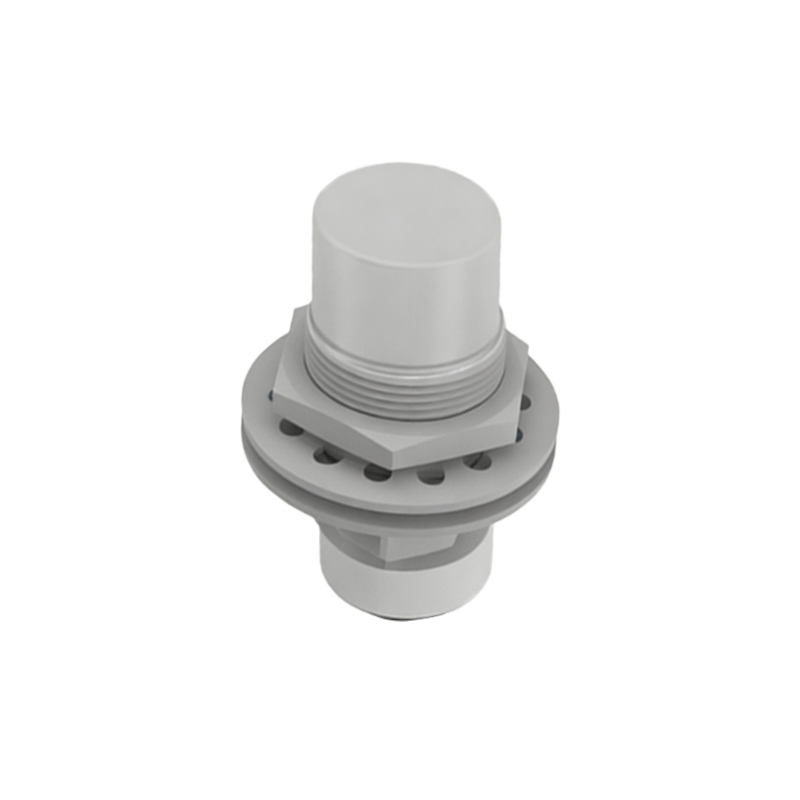
Where are these sensors commonly deployed? Their applications are vital in sectors demanding rigorous timing and position verification. A classic example is in rotary encoding and speed measurement on motor shafts or conveyor systems. A slotted disk or a gear is mounted on the rotating shaft, and the gap sensor is positioned so its teeth or slots pass through the sensor's gap. Each pass generates a pulse, allowing for precise speed calculation, direction detection, or angular position determination. They are also extensively used for registration mark detection in printing and packaging machinery, ensuring that cuts or prints occur at the exact correct position on a moving web. In automated assembly lines, they verify the correct placement of components or the opening and closing of safety guards and doors.
When selecting a gap proximity sensor, several key specifications must be considered. The gap width is the most critical, defining the maximum distance between the sensor face and the target for reliable operation. The target material is also important; while most are optimized for ferrous metals like iron and steel, some are designed for non-ferrous metals like aluminum or copper, though detection distances may be shorter. The switching frequency dictates how fast the sensor can respond to targets passing through the gap, a crucial factor for high-speed applications. Physical size, output type (PNP/NPN, analog), and environmental protection ratings (IP67 for dust and water resistance) are other vital selection criteria.
In summary, a gap proximity sensor is a robust, precise, and reliable workhorse in motion control and position sensing. Its specialized design for through-slot detection makes it indispensable for applications requiring accurate event timing, speed monitoring, and position verification in challenging industrial environments. By providing a consistent, non-contact signal based on a physical gap, it forms a fundamental link between mechanical movement and electronic control, ensuring processes run smoothly, safely, and efficiently.