Many people are surprised to learn that a typical laser sensor does not produce a visible beam of light. This common misconception likely stems from popular media portrayals of lasers as bright, colorful rays. In reality, most industrial and commercial laser sensors operate with infrared or other non-visible wavelengths. Understanding why this is the case requires a look into the fundamental principles of laser sensing technology, its applications, and the practical reasons behind the choice of invisible light.
At its core, a laser sensor is a device that uses laser light to detect, measure, or identify objects. The term "laser" stands for Light Amplification by Stimulated Emission of Radiation. The key component is the emitted light, which is coherent, monochromatic, and highly directional. However, the "light" in question is not necessarily within the visible spectrum, which humans see as colors ranging from violet to red. The visible spectrum is only a tiny portion of the entire electromagnetic spectrum. Many practical laser sensors utilize wavelengths just beyond the visible red light, in the infrared range, or sometimes in the ultraviolet range.
There are several compelling reasons for using non-visible laser light in sensors. First and foremost is safety. Visible laser beams, especially those powerful enough for sensing over distances or through various media, can pose a significant hazard to human eyesight. Infrared lasers, while still potentially dangerous if mishandled, do not trigger the blink reflex, but their primary safety advantage in many applications is that they simply are not a visual distraction. In factory automation, for instance, where dozens of sensors may be operating, visible beams would create a chaotic and potentially blinding environment for workers.
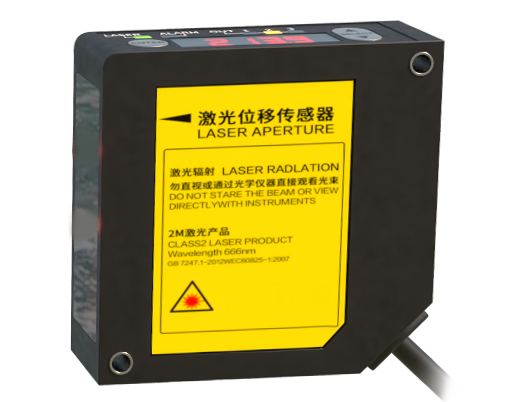
Secondly, non-visible light, particularly infrared, is less susceptible to interference from ambient visible light. A sensor operating in a busy warehouse or on a sunny outdoor production line needs to distinguish its own signal from the background noise of sunlight, room lights, or other equipment. An infrared laser provides a clean, distinct signal that filtering electronics can easily isolate from common visible light sources. This leads to higher reliability, accuracy, and signal-to-noise ratio.
Furthermore, the choice of wavelength is often dictated by the application and the target material. Different materials reflect, absorb, or scatter different wavelengths of light in unique ways. For example, certain plastics or fabrics that are transparent or translucent to visible light may be opaque to a specific infrared wavelength, making them ideal for detection. In precision distance measurement (like laser rangefinders) or vibration analysis, the specific properties of infrared light can offer more consistent results with various surface types compared to visible light.
The functionality of a laser sensor is typically based on one of a few principles: triangulation, time-of-flight, or laser Doppler vibrometry. In a triangulation sensor, the laser dot (invisible to us) hits an object, and the reflected light is seen at an angle by a receiver. The position on the receiver's sensor indicates distance. A time-of-flight sensor measures the minute time delay between emitting a laser pulse and receiving its reflection to calculate distance. In all these methods, the receiver is a specialized photodetector tuned to the specific wavelength of the laser emitter—a wavelength it is designed to see perfectly, even if human eyes cannot.
It is also worth noting that some laser sensors do incorporate a faint red or green aiming beam. This is usually a secondary, low-power visible laser used solely for initial alignment and setup to help technicians position the sensor correctly. Once aligned, the primary, powerful non-visible laser takes over for the actual sensing operation. This aiming beam is a convenience feature and not the main functional laser.
From barcode scanners at grocery checkouts to the complex LiDAR systems in autonomous vehicles, from precision manufacturing to medical diagnostics, invisible laser sensors are ubiquitous. They work silently and unseen, ensuring processes are efficient, accurate, and safe. Their "invisibility" is not a flaw but a deliberate and sophisticated design choice tailored for performance, reliability, and integration into our world without visual intrusion.
So, the next time you see a sleek sensor on a production line or a discreet device on a vehicle, remember that it is likely actively emitting a beam of light. It is a beam engineered for a machine to see, not for human eyes, performing its duty with invisible precision. This hidden nature is a testament to the advanced engineering that focuses on substance and function over visible spectacle.