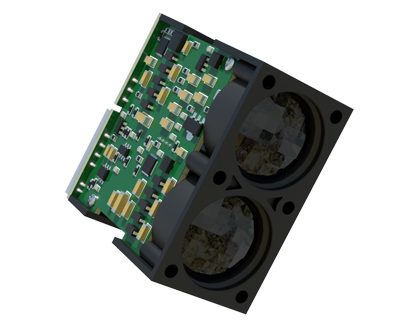
Laser sensors represent a pivotal category within the smart sensor ecosystem, transforming how machines perceive and interact with the physical world. Unlike simple photoelectric switches, modern smart laser sensors integrate advanced optics, high-speed processors, and sophisticated algorithms to deliver precise, reliable, and context-aware measurements. Their core principle involves emitting a focused beam of coherent light—the laser—towards a target. The sensor then analyzes the properties of the reflected light, such as its time-of-flight, triangulation angle, or phase shift, to calculate critical parameters like distance, position, height, or presence with micron-level accuracy.
The intelligence embedded in these devices elevates them beyond mere measurement tools. A key feature is their ability for self-monitoring and diagnostics. They can detect lens contamination, signal degradation, or misalignment, triggering maintenance alerts before a process fails. This predictive capability is fundamental to Industry 4.0 and smart factory initiatives, minimizing unplanned downtime. Furthermore, integrated processors allow for real-time data conditioning. The sensor can perform tasks like averaging, peak/valley detection, and window comparators internally, sending only processed, actionable data to the central PLC or control system. This reduces network load and system complexity.
Connectivity is another hallmark of smart laser sensors. They increasingly support industrial communication protocols like IO-Link, which enables bidirectional data exchange. Through IO-Link, users can remotely configure parameters—such as measurement windows, response times, and output logic—directly from the control room. This flexibility allows for rapid product changeovers in manufacturing lines. The sensor can also transmit its health status, operating temperature, and detailed process values, providing a comprehensive view of the machine's condition.
Applications for smart laser sensors are vast and growing. In automated manufacturing, they are indispensable for precise dimensional gauging, ensuring components like engine pistons or semiconductor wafers meet strict tolerances. They guide robotic arms in pick-and-place operations by accurately locating objects on fast-moving conveyor belts. In logistics, they measure parcel dimensions for automated sorting and volumetric pricing. Beyond industry, they enable advanced driver-assistance systems (ADAS) in vehicles, forming the basis of LiDAR for obstacle detection and adaptive cruise control. Even in consumer electronics, miniature laser sensors facilitate autofocus in smartphone cameras and enable gesture recognition.
When selecting a laser sensor, several technical specifications demand attention. The measuring range defines the minimum and maximum distances over which the sensor guarantees its stated accuracy. Resolution indicates the smallest detectable change in distance, crucial for high-precision tasks. The spot size, determined by the laser's wavelength and optics, affects measurement stability on uneven or textured surfaces; a smaller spot allows for more precise targeting. Response time, often in the microsecond range, determines how quickly the sensor can update its output, which is critical for high-speed production lines. Environmental ratings for temperature, humidity, and vibration resistance ensure reliable operation in harsh industrial settings.
The evolution of smart laser sensors continues, driven by miniaturization, lower power consumption, and enhanced computational power. Future trends point towards greater integration of artificial intelligence at the edge, where the sensor itself could classify objects or identify defects based on learned patterns, further decentralizing intelligence. As these technologies mature, smart laser sensors will become even more adaptive, autonomous, and integral to building responsive and efficient automated systems across every sector of the economy. Their combination of unparalleled precision, embedded intelligence, and robust connectivity solidifies their role as a cornerstone of modern industrial automation and beyond.
