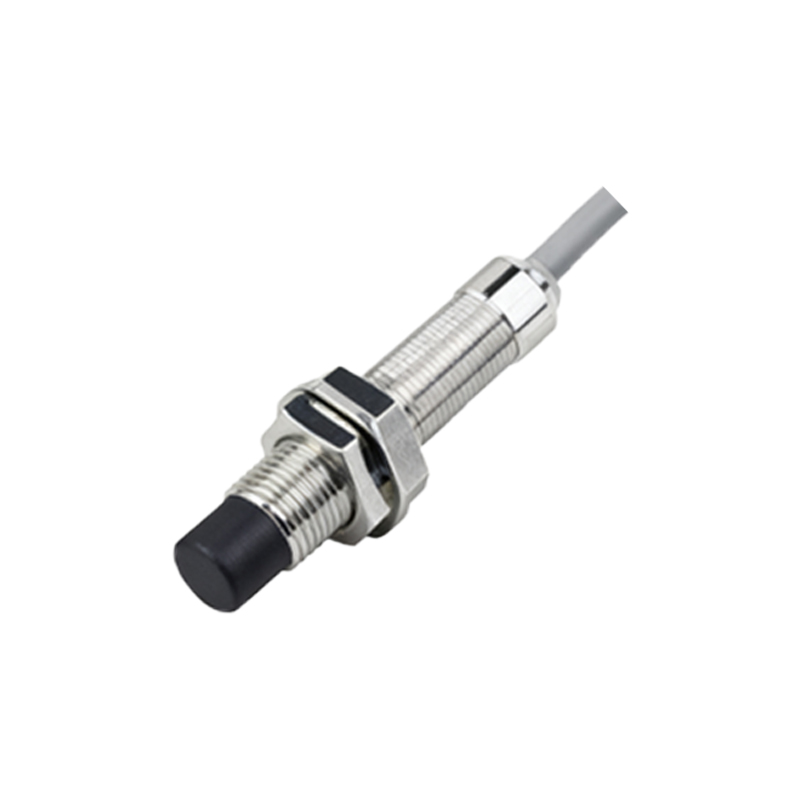
Inductive proximity sensors are non-contact electronic devices that detect the presence of metallic objects without physical contact. Their operation relies on the principle of electromagnetic induction. A typical sensor consists of four main components: an oscillator circuit, a coil (which generates the electromagnetic field), a detection circuit, and an output circuit. When a metallic target enters the sensor's active field, eddy currents are induced on the target's surface. These currents absorb energy from the oscillator, causing a reduction in its amplitude. The detection circuit monitors this amplitude change and triggers the output circuit to switch states, providing a usable signal.
The core of the design is the sensing coil and its associated oscillator, often a Colpitts or Hartley configuration. The coil's geometry—its diameter, number of windings, and core material—directly determines the sensor's sensing range, field shape, and sensitivity. Larger coil diameters generally provide longer sensing distances but with a less focused field. Ferrite cores are commonly used to concentrate and shape the magnetic field, improving sensitivity and directionality. The operating frequency, typically ranging from 100 kHz to 1 MHz, is a critical design parameter. Higher frequencies allow for the detection of thinner metals and faster response times but may reduce the maximum sensing distance and increase power consumption.
Designers must carefully consider the target material. Ferrous metals (like iron and steel) increase the coil's inductance due to their high magnetic permeability, leading to a longer effective sensing range. Non-ferrous metals (like aluminum, copper, or brass) are detected primarily through the eddy current effect and typically have a shorter nominal sensing range, often requiring calibration or a reduction factor. The standard target for specifying sensing distance is usually a square of mild steel (Fe360) with a thickness equal to the sensor's rated sensing distance or 1mm, whichever is greater.
Environmental robustness is a key advantage. Since the sensing principle is based on electromagnetic fields, these sensors are inherently resistant to contaminants like dust, oil, and moisture that would obstruct optical sensors. The housing is typically made of corrosion-resistant materials like nickel-plated brass, stainless steel, or PBT plastic. The face of the sensor is often a non-metallic, wear-resistant material (like PTFE or ceramic) that allows the field to pass through while protecting the coil.
Output configuration is another vital design aspect. Sensors provide either a digital (switching) or analog output. Digital outputs include NPN (sinking), PNP (sourcing), or complementary configurations. Analog outputs, either voltage (0-10V) or current (4-20mA), provide a signal proportional to the distance to the target, enabling precise position monitoring. The choice depends on the control system interface. Response time, the speed at which the sensor reacts to a target's appearance or disappearance, is crucial for high-speed applications like counting or sorting on production lines.
Practical application considerations are paramount. Designers must account for installation effects. Flush-mounted sensors can be embedded in metal mounting brackets without affecting performance, as their field is focused forward. Non-flush sensors have a larger lateral sensing field and must be installed with adequate clearance from surrounding metal to prevent false triggering. Temperature stability is achieved through circuit compensation, ensuring the switching point remains consistent across an industrial temperature range, commonly -25°C to 70°C.
Modern advancements include miniaturization, leading to sensors in M5, M8, and M12 housing sizes, and the integration of IO-Link communication. IO-Link transforms a simple binary sensor into a smart device capable of reporting parameters like temperature, operating hours, signal strength, and even allowing remote configuration of switching points and hysteresis. This facilitates predictive maintenance and Industry 4.0 integration.
In summary, successful inductive proximity sensor design is a careful balance of electromagnetic theory, materials science, electronic circuit design, and mechanical packaging. It aims to create a reliable, robust, and cost-effective solution for countless industrial automation tasks, from position verification and part counting on assembly lines to safety interlocking on machinery.