Proximity sensors are a cornerstone of modern automation and interaction design. At the heart of their functionality lies a critical parameter: sensing distance. This distance, often specified as the nominal sensing range, defines the operational boundary within which a sensor can reliably detect the presence of an object without physical contact. Understanding the factors that influence and define this distance is essential for engineers, designers, and technicians across industries.
The fundamental principle behind proximity sensing involves the emission of a field or beam and the analysis of changes in that field caused by a target object. For inductive sensors, this field is an electromagnetic one, generated by a coil and oscillator. When a metallic object enters this field, it induces eddy currents, which dampen the oscillator's amplitude, triggering a detection signal. The effective sensing distance for inductive sensors is heavily dependent on the target material's properties, specifically its electrical conductivity and magnetic permeability. For instance, mild steel can be detected at the sensor's rated nominal distance, while stainless steel might reduce that range by 10-30%, and non-ferrous metals like copper or aluminum may reduce it even further, sometimes by up to 60%.
Capacitive sensors operate on a different principle, detecting changes in capacitance. They generate an electrostatic field. Any object, metallic or non-metallic, that enters this field alters its dielectric constant, changing the capacitance and triggering detection. Their sensing distance is influenced by the target's material density, size, and dielectric constant. Materials with high dielectric constants, like water or ceramics, are detected more easily and at potentially longer effective distances than low-density materials such as dry wood or foam. Furthermore, the sensing distance can be affected by environmental factors like humidity or the presence of contaminants on the sensor face.
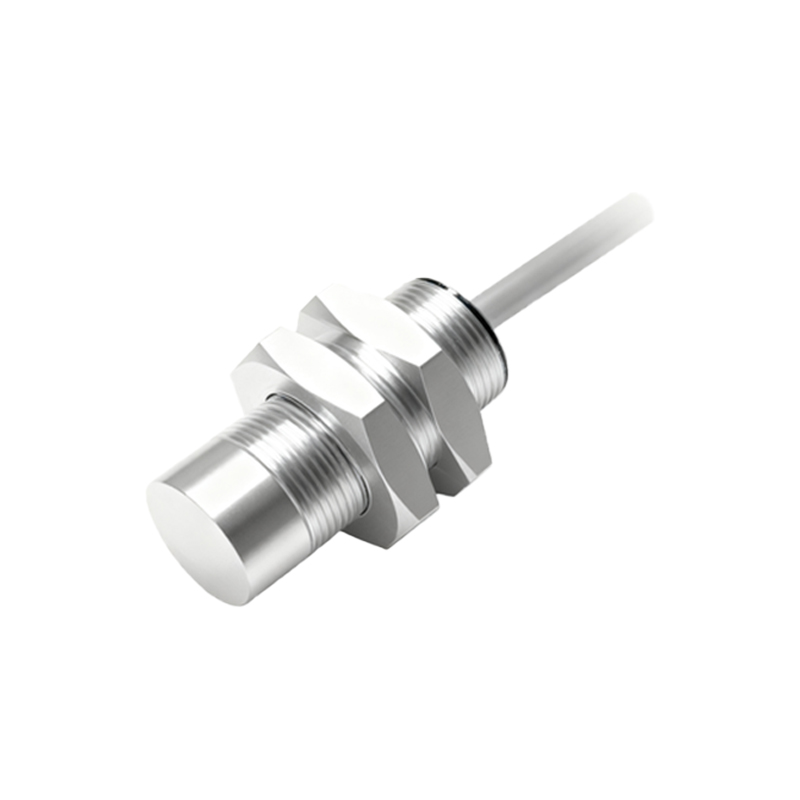
Ultrasonic sensors calculate distance by measuring the time-of-flight of a sound wave. They emit high-frequency sound pulses and listen for the echo. The maximum reliable sensing distance is a function of the sound wave's attenuation in air, which is affected by temperature, humidity, air pressure, and even air turbulence. Dust, foam, or angled surfaces can also scatter the sound wave, reducing the effective range or causing false readings.
Photoelectric sensors, using modulated light beams (visible, infrared, or laser), have their effective range determined by the light source's intensity, the receiver's sensitivity, and the target's reflectivity. A highly reflective, light-colored target can be detected at a much greater distance than a dark, absorptive one. Environmental light interference, fog, dust, or dirt on the lens can significantly degrade the maximum operational distance.
Beyond the sensor type and target material, several universal factors dictate real-world performance. The sensor's size generally correlates with its power and range; a larger inductive or capacitive sensor typically has a longer nominal sensing distance. The installation environment is crucial. Metal mounting surfaces can create a "shielding" effect for inductive sensors, reducing their range, which is why many specify a "non-flush" or "flush-mountable" design with corrected sensing distances. Voltage supply fluctuations can also impact the stability of the generated field, potentially altering the detection threshold.
Optimizing for the required distance involves careful selection and application. A common best practice is to derate the nominal sensing distance. For reliable operation, the target should operate within 70-80% of the sensor's published nominal range. This derating accounts for manufacturing tolerances, temperature drift, voltage variations, and target material inconsistencies. For applications requiring precise distance measurement rather than simple presence detection, analog-output or IO-Link enabled sensors are preferred. These provide a continuous signal proportional to the distance, enabling sophisticated control for tasks like tensioning, winding, or fill-level monitoring.
In application, these principles come to life. On an automotive assembly line, inductive sensors with a precise 5mm range count metallic gear teeth at high speed. In a food packaging plant, capacitive sensors ignore plastic bottles but detect the liquid level inside them. Ultrasonic sensors on a warehouse Automated Guided Vehicle (AGV) maintain a safe following distance, adjusting for ambient temperature changes. A smartphone uses a miniature infrared proximity sensor to disable the touchscreen when held to the ear, conserving power.
Ultimately, the specified "proximity sensor distance" is a starting point. The achievable, reliable working distance is a system property, resulting from the intricate interplay between sensor physics, target characteristics, and environmental conditions. Successful implementation demands a holistic view, moving beyond the datasheet number to consider the entire operational context, ensuring robust, fail-safe performance in the field.