In the realm of precision measurement and detection, green laser sensors have emerged as a pivotal technology, offering distinct advantages over their traditional red laser counterparts. The core of this technology lies in its use of a 532nm wavelength laser, which falls within the green spectrum of visible light. This specific wavelength is not chosen arbitrarily; it is a result of frequency-doubling an infrared laser source, a process that yields a beam with unique properties critical for high-performance sensing.
The human eye exhibits peak sensitivity to green light, approximately 550nm. This biological fact translates into a significant practical benefit: a green laser dot or line appears significantly brighter to the human observer than a red laser of the same power output. This enhanced visibility is paramount in alignment, positioning, and setup procedures in industrial environments, reducing operator error and fatigue. Beyond perception, the shorter wavelength of green light interacts differently with materials. It experiences less diffraction, meaning the beam can be focused to a much smaller, tighter spot. This enables superior resolution for tasks like precision contour scanning, micron-level displacement measurement, and inspection of minute surface features. Furthermore, green light demonstrates higher reflectivity off a wide range of surfaces, including non-ferrous metals like copper, brass, and silicon, which often pose challenges for red lasers. This makes green laser sensors indispensable in electronics manufacturing, semiconductor inspection, and automotive welding applications.
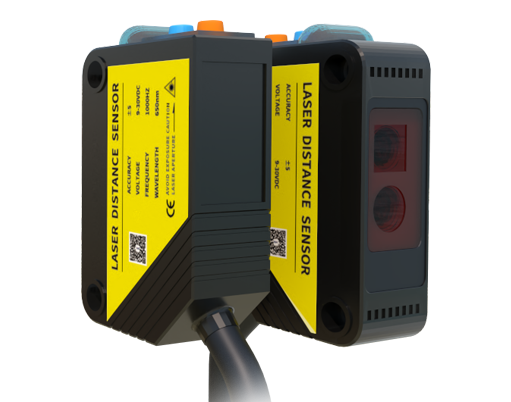
The architecture of a typical green laser sensor involves several sophisticated components. It begins with a laser diode emitting infrared light. This light passes through a non-linear optical crystal, which effectively doubles its frequency, halving its wavelength to produce the characteristic green beam. This beam is then collimated and directed towards the target. The reflected light is captured by a high-sensitivity receiver, often a Position Sensitive Detector (PSD) or a CMOS/CCD array. Advanced onboard processors analyze the received signal pattern, triangulating the exact distance or profiling the target's surface with remarkable speed and accuracy. Modern sensors integrate robust housings rated for IP67 or higher, protecting the delicate optics from dust, coolant, and mechanical shock common in factory settings.
Applications for green laser sensors are vast and growing. In automated manufacturing, they are deployed for precise height detection, edge guidance, and presence sensing on highly reflective or low-contrast assembly lines. In 3D scanning and metrology, they capture detailed surface topographies of complex parts, from turbine blades to medical implants, with sub-micron accuracy. The logistics sector utilizes them for high-speed parcel dimensioning and pallet profiling. Emerging fields like autonomous mobile robots (AMRs) rely on these sensors for navigation and obstacle detection in variably lit environments, as the green beam maintains consistency where red lasers might fail.

When selecting a green laser sensor, key specifications must be evaluated. Measurement range, spot size, repeatability, and linearity define its precision capabilities. Response speed, measured in kHz, determines its suitability for high-throughput production. Environmental ratings for temperature, humidity, and vibration ensure reliability. Communication protocols like IO-Link, Ethernet/IP, or Profinet facilitate seamless integration into Industry 4.0 and smart factory networks, allowing for remote configuration, monitoring, and predictive maintenance.
While offering superior performance in demanding scenarios, green laser sensors are generally more complex and costly than red laser sensors due to the frequency-doubling technology. Therefore, the choice between red and green depends heavily on the application's specific requirements. For tasks involving dark, absorbent, or organic materials, red lasers may suffice. However, when the challenge involves shiny metals, long working distances, extreme precision, or the need for a highly visible beam, green laser technology provides an unrivaled solution.
Ongoing research focuses on enhancing power efficiency, reducing module size, and integrating smarter algorithms for adaptive sensing. As industries continue to push the boundaries of miniaturization and quality control, the role of the green laser sensor as a critical enabler of precision and automation is set to expand further, solidifying its position at the forefront of optoelectronic sensing technology.