In the world of industrial automation and precision measurement, non-contact sensing technology is paramount for reliability, speed, and longevity. Among the various technologies available, the eddy current proximity sensor stands out for its robustness and accuracy in challenging environments. Unlike optical or capacitive sensors, eddy current sensors operate on a fundamental electromagnetic principle, making them exceptionally suitable for applications involving metals.
The core operating principle is based on electromagnetic induction. The sensor contains a coil through which a high-frequency alternating current is passed. This current generates an oscillating magnetic field that extends from the active face of the sensor. When a conductive target, typically a metal, enters this field, circular electrical currents called "eddy currents" are induced on the surface of the target. These eddy currents, in turn, generate their own magnetic field, which opposes the original field from the sensor coil. This interaction changes the impedance of the sensor's coil. The integrated electronics within the sensor detect this change in impedance, process the signal, and produce a corresponding output, which can be a switching signal or an analog value proportional to the distance.
This mechanism confers several distinct advantages. First, the sensing is purely physical and electromagnetic, making these sensors highly resistant to contaminants such as dust, oil, coolant, and dirt. They are not affected by opaque or transparent media, provided the media is non-conductive and non-ferromagnetic. Second, they offer very high resolution and repeatability, capable of detecting minute positional changes, often in the micrometer range. This makes them ideal for precise displacement and vibration monitoring. Third, they can operate at high speeds, responding to rapid changes in target position. Finally, because the sensing effect occurs only in conductive materials, they are inherently immune to non-metallic objects, reducing false triggers.
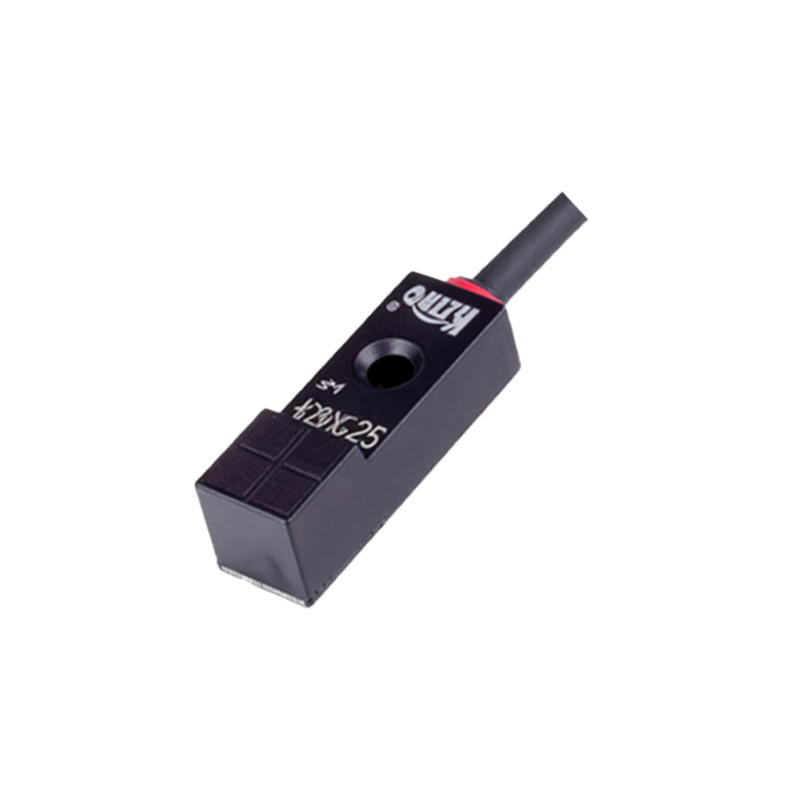
The performance of an eddy current sensor is influenced by the target material. Different metals have different electrical conductivities and magnetic permeabilities. Ferrous metals like steel and iron, due to their magnetic properties, produce a stronger effect and typically allow for a longer sensing range. Non-ferrous metals like aluminum, copper, or brass have a shorter nominal sensing range. Reputable manufacturers provide correction factors or specific calibration data for various target materials. For the most precise applications, it is recommended to calibrate the sensor with the exact target material it will be used with.
Applications for eddy current proximity sensors are vast and critical across numerous industries. In manufacturing and machining, they are used for precise position feedback of robotic arms, end-effectors, and tool turrets. They monitor rotational speed by detecting gear teeth or keyways on shafts. In the realm of condition monitoring, they are the preferred choice for measuring shaft runout, axial thrust, and vibration in turbines, compressors, and large motors, providing vital data for predictive maintenance. They are also employed in metal detection, part presence verification on conveyor lines, and thickness measurement of non-conductive coatings on metal substrates.
Selecting the right eddy current sensor requires careful consideration of several parameters. The sensing range is the first criterion; it must be suitable for the application with some safety margin. The target material and its size (which should generally be at least equal to the sensor's sensing face diameter) are crucial for accurate operation. The output type must be chosen: a digital PNP/NPN switch for simple presence detection, or an analog output (0-10V, 4-20mA) for continuous distance measurement. Environmental factors like temperature extremes, pressure, and potential exposure to chemicals will dictate the required housing material and protection rating (e.g., IP67). Mounting constraints and the frequency response (for high-speed applications) are also key decision factors.
In summary, eddy current proximity sensors are a mature, highly reliable technology that solves complex sensing problems in harsh industrial settings. Their non-contact nature, material selectivity, and insensitivity to contaminants make them an indispensable tool for engineers seeking to enhance precision, safety, and operational efficiency in systems involving metallic components. By understanding their operating principle and key selection criteria, users can effectively integrate these powerful sensors to achieve superior control and monitoring outcomes.