Capacitive proximity sensors are versatile devices widely used in industrial automation, consumer electronics, and safety systems. Unlike inductive sensors that detect only metallic objects, capacitive sensors can sense a variety of materials, including liquids, plastics, wood, and even human skin. This capability makes them essential in applications ranging from level detection in tanks to touch interfaces on smartphones. Understanding the working principle of capacitive proximity sensors requires a grasp of basic capacitance concepts and how they are applied in practical sensing scenarios.
At its core, a capacitive proximity sensor operates by generating an electrostatic field. The sensor typically consists of an electrode (often the sensor face itself) that acts as one plate of a capacitor. The target object or material serves as the other plate, with the air gap between them acting as the dielectric. When a voltage is applied to the electrode, an electric field forms around it. As a target object enters this field, it alters the capacitance of the system. Capacitance, measured in farads, is the ability of a system to store an electrical charge. It depends on three factors: the surface area of the electrodes, the distance between them, and the dielectric constant of the material between the electrodes. In sensing applications, the primary variable is the distance or the presence of a material changing the effective dielectric constant.
The sensor’s internal circuitry continuously monitors changes in capacitance. Most capacitive sensors use an oscillator circuit that generates a high-frequency signal. When no target is present, the oscillator operates at a baseline frequency. As a target approaches, the capacitance increases, causing the oscillator’s frequency or amplitude to shift. This change is detected by a threshold circuit, which triggers an output signal—typically a digital switch (ON/OFF) or an analog value proportional to distance. Some advanced sensors incorporate compensation mechanisms to ignore background interference, such as humidity or temperature variations, ensuring stable operation in diverse environments.
Key components of a capacitive sensor include the sensing electrode, oscillator, demodulator, and output stage. The electrode design, often circular or rectangular, influences the shape and range of the electric field. Shielding is another critical aspect; shielded sensors have a grounded ring around the electrode to confine the field radially, making them ideal for flush mounting in metal surfaces. Unshielded sensors offer a larger sensing range but are more susceptible to interference from adjacent objects. The sensing distance, usually a few millimeters to several centimeters, depends on factors like the target material’s dielectric constant. Materials with higher dielectric constants (e.g., water or metals) are detected more easily than low-constant materials (e.g., dry wood or foam).
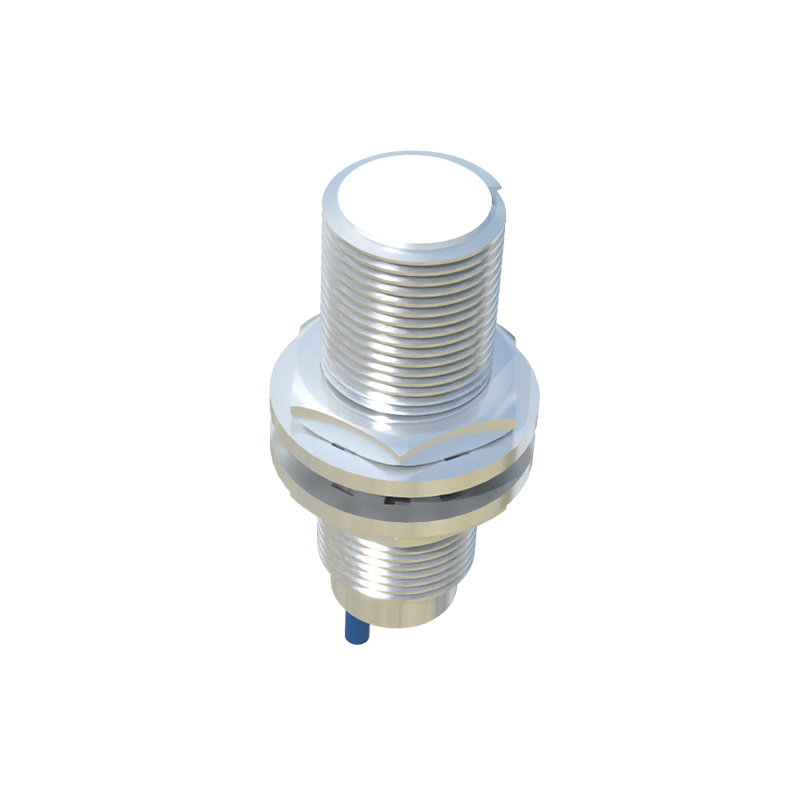
Applications of capacitive proximity sensors are extensive. In industrial settings, they monitor fill levels in containers, detect presence of non-metallic parts on conveyor belts, or ensure safety by sensing human proximity to machinery. In consumer devices, they enable touch-sensitive buttons, liquid level indicators in appliances, and screen proximity detection in phones. Their ability to function through non-metallic barriers (like glass or plastic walls) allows for hygienic or sealed installations, common in food processing or medical equipment.
When selecting a capacitive sensor, considerations include the target material, required sensing range, environmental conditions (e.g., dust, moisture), and output type. Calibration is often necessary to adjust sensitivity for specific materials. Despite their advantages, limitations exist: they can be affected by conductive contaminants or extreme environmental changes, and sensing range is generally shorter than ultrasonic or optical sensors. However, ongoing advancements in microelectronics and signal processing continue to enhance their accuracy and reliability.
In summary, capacitive proximity sensors leverage changes in electrostatic capacitance to detect objects without physical contact. Their principle hinges on the interaction between an electric field and a target’s dielectric properties, enabling detection of diverse materials. With robust designs and adaptive circuitry, these sensors play a pivotal role in modern automation and interactive technologies, offering a non-invasive, durable solution for proximity and presence sensing across numerous industries.