Laser distance sensors have become indispensable tools across numerous industries, from manufacturing and logistics to robotics and construction. Among the various configurations available, dual window laser sensors represent a significant advancement, offering enhanced functionality and reliability for demanding applications. This article delves into the core principles, key advantages, and practical considerations of these sophisticated devices.
At its heart, a laser distance sensor operates on the principle of time-of-flight or phase-shift measurement. A laser diode emits a focused beam of light towards a target. The sensor then detects the reflected light. By precisely calculating the time delay or phase difference between the emitted and reflected signals, the sensor determines the distance to the target with high accuracy. A "window" in this context refers to the defined operational range within which the sensor is configured to take measurements.
The innovation of a dual window system lies in its programmability. Unlike a single-window sensor that has one fixed measurement range (e.g., 50mm to 300mm), a dual window sensor allows users to define two independent, non-overlapping measurement zones. For instance, Window 1 could be set from 100mm to 200mm, and Window 2 from 400mm to 600mm. The sensor can be configured to output distinct signals based on which window the measured distance falls into.
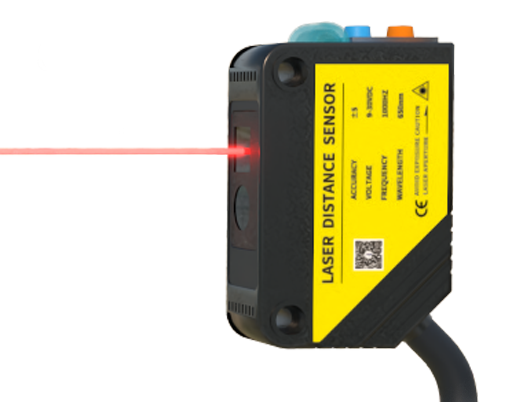
This capability unlocks several powerful application modes. The most common is the "Window Switch" mode. Here, the sensor acts as a highly precise two-level proximity switch. If the measured distance is within Window 1, it might output a digital HIGH signal. If the distance is within Window 2, it outputs a digital LOW signal. If the target is outside both windows, a third state (perhaps OFF) can be indicated. This is ideal for sorting, bin picking, or checking for the presence or absence of objects at specific locations on a production line.

Another critical application is in-state monitoring and error prevention. Consider a robotic gripper. Window 1 can be set to the correct picking distance, confirming a successful grasp. Window 2 can be set to a "collision alert" distance, much closer to the sensor. If an object unexpectedly enters Window 2, it signals a potential collision or misalignment, allowing the system to halt immediately, preventing damage.
The benefits of employing a dual window laser sensor are substantial. Firstly, they increase system flexibility and reduce hardware needs. One dual window sensor can often replace two conventional single-window sensors or a sensor paired with external controllers, simplifying wiring and cabinet space. Secondly, they enhance process reliability. By providing clear, programmable thresholds for "good" and "bad" states, they minimize false readings and improve quality control. Thirdly, they offer excellent value, consolidating functionality into a single, robust device.
When selecting and implementing a dual window sensor, several factors must be considered. The choice between time-of-flight and phase-shift technology affects maximum range and resolution. Environmental conditions are paramount; factors like ambient light, dust, steam, or the target's surface color and texture (e.g., shiny black objects) can impact performance. Many modern sensors feature background suppression algorithms and teach-in functions via a button or IO-Link to easily set the window thresholds, even on difficult surfaces. The output type (digital NPN/PNP, analog 4-20mA/0-10V, or serial communication) must be compatible with the host controller, such as a PLC.
In conclusion, dual window laser distance sensors are powerful instruments that bring intelligence and efficiency to distance measurement tasks. By enabling programmable measurement zones, they provide versatile solutions for complex automation challenges involving positioning, sorting, monitoring, and safety. Their ability to deliver precise, reliable data with simplified system architecture makes them a preferred choice for engineers seeking to optimize industrial processes and build more resilient, intelligent systems.