Laser sensors have become integral components across numerous industries, from manufacturing and robotics to automotive and consumer electronics. Their ability to provide precise, non-contact measurements makes them invaluable. But what exactly happens inside these sophisticated devices? The internal operation is a fascinating interplay of optics, electronics, and signal processing, all centered on the fundamental properties of laser light.
At the very core of every laser sensor is the laser diode. This semiconductor component generates the coherent light beam. Unlike ordinary light, laser light is monochromatic (a single wavelength), directional, and in phase. This coherence is crucial as it allows the beam to travel long distances with minimal dispersion, enabling accurate targeting. Inside the laser diode, an electrical current is applied, stimulating electrons to release energy in the form of photons. These photons are then amplified within an optical cavity, resulting in the emission of a concentrated, powerful beam. This beam is the starting point for all subsequent measurements.
The generated laser beam is then conditioned and directed. It typically passes through a collimating lens, which shapes the divergent light into a tight, parallel beam. This ensures a small, well-defined spot on the target object, which is essential for high resolution. In many sensor designs, the beam may also be split by a beam splitter. One part becomes the measurement beam directed towards the target, while another may serve as an internal reference, aiding in stability and compensation for environmental factors like temperature drift.

The heart of the sensing action lies in the interaction between this beam and the target. The sensor employs one of several primary measurement principles, each with distinct internal circuitry. The most common is the triangulation method. Here, the emitted laser beam strikes the target's surface. The reflected light, now at an angle dependent on the distance to the target, is focused by a receiving lens onto a position-sensitive detector, typically a CMOS or CCD array. The internal electronics precisely calculate the spot's position on this detector. A simple trigonometric calculation, hardwired into the sensor's microprocessor, converts this pixel position into a precise distance measurement. The closer the target, the greater the angle of reflection and the further the spot moves on the detector.
Another widespread principle is time-of-flight (ToF). This method is often used for longer ranges. The internal circuitry is designed to measure the time delay between emitting a short laser pulse and receiving its reflection. This requires extremely fast and sensitive components: a pulsed laser diode, a high-speed photodetector like an avalanche photodiode (APD), and a precision timer circuit. The microprocessor calculates distance based on the known speed of light. Modern ToF sensors often use a phase-shift technique, where a modulated continuous-wave laser is emitted, and the phase difference between the outgoing and incoming modulated light is measured, providing even higher accuracy.
For measuring vibration or minute displacements, laser interferometry is used internally. This sophisticated technique relies on the wave nature of light. The beam is split into a reference beam and a measurement beam. The measurement beam reflects off the target and recombines with the reference beam inside the sensor. The resulting interference pattern—alternating bands of light and dark—is detected. Any movement of the target changes the optical path length, shifting the interference fringes. Internal photodetectors and signal processors monitor these fringe shifts with nanometer precision, translating them into displacement data.
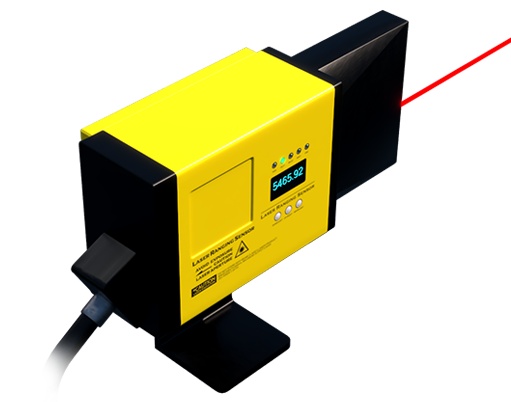
Regardless of the principle, the raw signal from the photodetector is weak and noisy. This is where the internal signal processing electronics come into play. The signal is first amplified by a low-noise amplifier. It then passes through filters to remove ambient light interference (like from factory lighting) and electronic noise. An analog-to-digital converter (ADC) digitizes this cleaned signal. The sensor's embedded microprocessor or a dedicated application-specific integrated circuit (ASIC) then executes the core algorithm—be it triangulation math, time-of-flight calculation, or interferometric analysis—to derive the final measurement value (distance, position, thickness, etc.).
Finally, this digital result is prepared for output. The sensor's internal communication interface, such as an IO-Link, analog voltage/current output, or a digital bus (Ethernet/IP, PROFINET), transmits the data to the host system, like a PLC or robot controller. Advanced sensors also house internal memory for storing calibration data and configuration parameters, ensuring consistent performance.
In summary, the internal world of a laser sensor is a marvel of miniaturized engineering. It transforms the pure, coherent light from a laser diode into highly reliable data through a carefully orchestrated sequence of optical conditioning, target interaction, sensitive detection, and intelligent digital processing. Understanding these internal mechanisms not only demystifies their operation but also highlights the precision required in their design and manufacturing, explaining their critical role in modern automation and measurement technology.