In the world of precision measurement and industrial automation, selecting the right sensor technology is critical for ensuring accuracy, reliability, and efficiency. Two prominent technologies often considered for non-contact measurement tasks are laser displacement sensors and fiber optic sensors. While they may seem to serve similar purposes at a glance, their underlying principles, construction, and ideal applications differ significantly. Understanding these distinctions is essential for engineers and system integrators to make an informed choice.
Fundamental Operating Principles
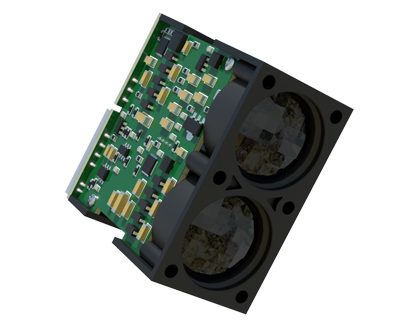
The core difference lies in how each sensor generates and handles light. A laser displacement sensor is a self-contained unit that projects a focused, coherent laser beam onto a target surface. The reflected light is captured by a receiving element within the same sensor head. It then calculates the distance to the target using one of several methods, most commonly triangulation or time-of-flight. The sensor processes this data internally to provide a direct displacement or distance output.
In contrast, a fiber optic sensor is a system comprising two main parts: a controller (or amplifier) and a fiber optic cable with a sensing probe. The controller contains a light source (often an LED) and a photodetector. Light is transmitted from the controller through the fiber optic cable to the probe tip. When the probe tip approaches a target, the properties of the reflected light change—its intensity, phase, or wavelength shifts depending on the distance or presence of the object. This modified light travels back through the cable to the controller, which interprets the change to determine the measurement. The sensing element is essentially the probe tip, while the "brain" is housed separately.
Key Comparative Characteristics
1. Physical Design and Size: Laser sensors are typically compact, integrated devices. The sensor head contains all optical and electronic components necessary for measurement. Fiber optic systems offer exceptional flexibility in sensing head design. The probe can be extremely small—down to fractions of a millimeter in diameter—and the fiber cable can be long, thin, and routed into tight, hazardous, or hard-to-reach spaces where a standard laser sensor head cannot fit.

2. Environmental Robustness: The electronic components of a laser sensor are located in the measurement head, which can be susceptible to extreme temperatures, strong vibrations, or electromagnetic interference (EMI) in harsh environments. Fiber optic sensors excel here. The sensing probe is passive, containing no electronics, making it highly resistant to high temperatures, intense EMI, corrosive atmospheres, and explosive environments. The controller can be safely installed in a remote, protected cabinet.
3. Measurement Performance: Laser displacement sensors generally offer superior measurement ranges (from millimeters to several meters), higher resolution, and faster response speeds. They are ideal for precise profile scanning, thickness measurement, and vibration analysis where micron-level accuracy is required. Fiber optic sensors are champions of ultra-precise proximity detection and micro-displacement measurement at very short ranges. They are unparalleled for detecting tiny parts, edge guidance, or presence/absence verification with extreme sensitivity.
4. Installation and Flexibility: Installing a laser sensor is straightforward: mount the head, connect the cable, and configure. Changing the measurement point requires physically moving the sensor. A fiber optic system is more modular. One controller can often support multiple fiber probes through switches, allowing monitoring of several points. The thin, flexible cables simplify wiring in complex machinery.
5. Cost Considerations: A single-point laser displacement sensor often has a lower initial unit cost for a standard application. However, for multi-point sensing, a fiber optic system with one controller and several probes can be more economical. The total cost of ownership must factor in durability; the ruggedness of fiber probes can lead to lower maintenance costs in demanding settings.
Typical Application Scenarios
Choose a Laser Displacement Sensor when:
* Performing high-speed, high-accuracy 2D/3D profile scanning.
* Measuring the thickness, warpage, or vibration of an object.
* The measurement range is beyond a few millimeters.
* The environment is relatively clean and stable (e.g., laboratory, cleanroom, assembly line).
Choose a Fiber Optic Sensor when:
* The space for the sensor head is extremely confined.
* The environment features high temperatures, strong EMI (e.g., near welding robots or motors), or risk of explosion.
* The task is detecting the presence/absence of very small objects (e.g., microchips, tiny springs).
* Multiple measurement points need to be monitored from a central unit.
* The target is highly reflective, transparent, or has a difficult surface for a standard laser.
In summary, the choice is not about which technology is universally better, but which is optimal for the specific constraints and requirements of the application. Laser displacement sensors are the workhorses for direct, high-performance geometric measurement. Fiber optic sensors are the specialists for challenging environments, micro-detection, and multi-point monitoring where their unique passive-probe architecture provides an unbeatable advantage. A clear understanding of their differences ensures the selected sensor delivers not just data, but reliable and actionable intelligence for the automation system.