Fundamental Principle of Diffuse Reflection
Diffuse reflection photoelectric sensors operate on a simple yet effective principle: the emitter sends a modulated infrared or visible light beam toward a target object. When the object is present, the light reflects off its surface in multiple directions, and a portion of this scattered light returns to the sensor's receiver. The sensor detects this return signal and triggers an output. Unlike through-beam or retro-reflective sensors, diffuse sensors require no separate reflector or receiver unit, simplifying installation in confined spaces. However, sensing range is significantly affected by target reflectivity, color, and surface texture, with typical distances ranging from a few centimeters to several meters.
Key Components and Optical Design
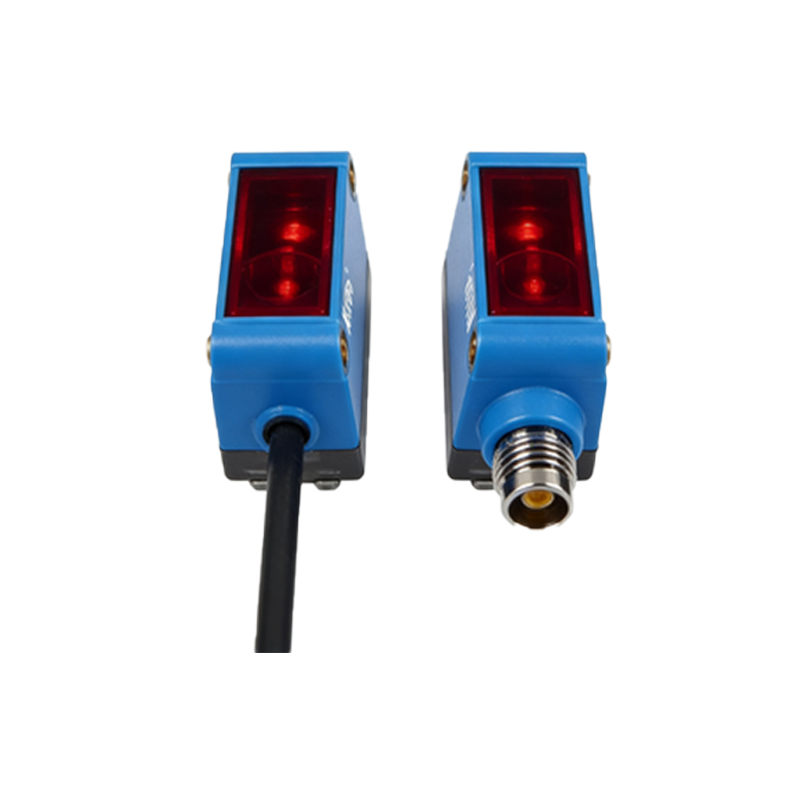
A standard diffuse sensor consists of an LED emitter, a photodiode or phototransistor receiver, a lens system, and signal processing electronics. The emitter often uses modulated light to minimize interference from ambient light sources. The receiver is tuned to the same modulation frequency, allowing it to distinguish the target's reflection from background illumination. The lens design focuses the emitted beam and collects reflected light efficiently. For improved performance in harsh industrial environments, many sensors incorporate a collimating lens to narrow the beam and a wide-angle lens on the receiver to capture more scattered light.
Detection Characteristics and Limitations
One critical aspect is the sensor's response to different target colors and materials. Dark or matte surfaces absorb more light, reducing effective sensing range. Conversely, white or glossy surfaces reflect more light, extending range. Engineers must account for this variability during system design. For example, a sensor rated for 1 meter on a white target may only detect a black object at 0.3 meters. Additionally, the sensor's blind zone near the emitter can cause false triggering due to lens flare. Advanced models use background suppression technology to filter out reflections from stationary objects behind the target.
Applications in Industrial Automation
Diffuse sensors excel in applications where space is limited or where retro-reflectors cannot be installed. Common uses include presence detection on conveyor belts, counting transparent or irregularly shaped objects, and detecting liquid levels in opaque tanks. Their ability to detect objects without physical contact makes them ideal for food processing, packaging, and automotive assembly lines. For reliable operation, engineers should select sensors with appropriate sensing range, response time, and output configuration (e.g., NPN, PNP, or analog).
Advanced Techniques for Enhanced Performance
Modern diffuse sensors incorporate digital signal processing to improve accuracy and immunity to interference. Some models use time-of-flight measurement to estimate distance, while others employ multi-pixel arrays for pattern recognition. These innovations enable detection of small or low-contrast objects, such as transparent plastic bottles. Additionally, adjustable sensitivity potentiometers or teach-in buttons allow field calibration to match specific application conditions. When integrating these sensors into PLC systems, engineers must consider wiring noise, cable length, and synchronization with other automation components.
Installation and Troubleshooting Best Practices
Proper installation is crucial for optimal performance. The sensor should be mounted perpendicular to the target surface to maximize reflected light. Avoid shiny backgrounds that could cause false reflections. Cable routing should follow standard EMC practices to prevent electromagnetic interference. Common issues include intermittent detection due to vibration, lens contamination from dust or oil, and cross-talk between multiple sensors in close proximity. Regular cleaning with lint-free cloths and periodic alignment checks can maintain reliability.