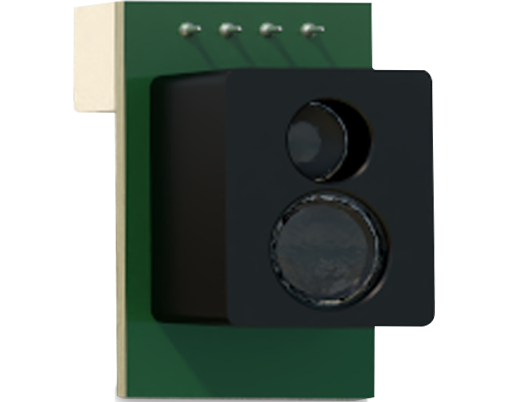
In the realm of industrial automation and precision measurement, laser contact sensors have emerged as indispensable tools. Unlike traditional mechanical probes that physically touch a surface, these advanced sensors utilize a focused beam of light to detect the presence, position, or displacement of an object without making direct contact. This non-contact principle is the cornerstone of their functionality, offering significant advantages in applications where delicate surfaces, high speeds, or sterile environments are involved.
The core technology behind a laser contact sensor typically involves a laser diode that emits a coherent light beam. This beam is directed towards the target object. The sensor then analyzes the reflected light using a receiving element, such as a position-sensitive detector (PSD) or a charge-coupled device (CCD). By interpreting changes in the reflected beam's position, intensity, or phase, the sensor can calculate precise measurements of distance, height, thickness, or simply confirm an object's presence. Common measurement principles include triangulation, time-of-flight, and confocal microscopy, each suited for different ranges and accuracy requirements.
The benefits of employing laser contact sensors are manifold. First and foremost is their non-contact nature, which eliminates the risk of damaging sensitive materials like semiconductor wafers, polished metals, or soft plastics. It also prevents wear and tear on the sensor itself, leading to longer service life and reduced maintenance. Secondly, they offer exceptionally high precision and resolution, capable of detecting minute changes down to the sub-micron level. This makes them ideal for quality control in manufacturing, where tolerances are extremely tight. Furthermore, their high-speed response allows for real-time monitoring and feedback in dynamic production lines, far surpassing the capabilities of mechanical touch probes.
The applications of laser contact sensors span a diverse array of industries. In automotive manufacturing, they are used to inspect engine components, measure body panel gaps, and ensure the precise alignment of parts. In the electronics sector, they verify the coplanarity of integrated circuit leads, measure solder paste thickness on printed circuit boards (PCBs), and inspect micro-components. The pharmaceutical and packaging industries rely on them for fill-level detection, capsule inspection, and monitoring seal integrity. Additionally, they play a crucial role in robotics for precise object positioning and guidance, and in metrology labs for calibrating standards and conducting high-accuracy dimensional analysis.

Selecting the right laser contact sensor for a specific task requires careful consideration of several key parameters. The measuring range defines the minimum and maximum distances over which the sensor can operate accurately. Resolution indicates the smallest detectable change in distance, while linearity refers to the accuracy of the measurement across the entire range. The spot size of the laser beam is critical; a smaller spot allows for measurement on very small features or edges. Environmental factors such as ambient light, temperature fluctuations, and the presence of dust or vapors must also be considered, as they can affect performance. Many sensors come with built-in features to compensate for these conditions, such as background suppression or temperature stabilization.

Integration of these sensors into automated systems is typically straightforward, thanks to standardized digital or analog outputs like IO-Link, Ethernet, or 4-20mA signals. This allows for seamless communication with programmable logic controllers (PLCs) and other control systems, enabling automated decision-making based on the sensor's readings.
In conclusion, laser contact sensors represent a pinnacle of non-contact measurement technology. Their ability to deliver high-speed, high-precision data without physical interaction makes them a vital component in modern industrial processes, driving efficiency, ensuring quality, and enabling automation in ways previously unattainable. As technology advances, we can expect these sensors to become even more compact, robust, and intelligent, further expanding their role in the factories and laboratories of the future.