Introduction to Photoelectric Sensing in Industrial Automation
Photoelectric sensors are fundamental components in modern industrial automation, converting light signals into electrical outputs for object detection, positioning, and quality control. Unlike mechanical switches, they operate without physical contact, ensuring longevity and reliability in harsh environments. The core principle involves a light emitter, typically an LED (infrared, visible red, or laser), and a receiver such as a photodiode or phototransistor. The sensor measures the intensity, presence, or absence of reflected or transmitted light to determine target status.
Emitting and Receiving Light: The Basic Mechanism
The light source emits a modulated beam to minimize interference from ambient light. Modulation means the LED pulses at a specific frequency (e.g., 1 kHz to 100 kHz), and the receiver synchronizes its detection circuit to that exact frequency. This filtering technique, often called synchronous demodulation, rejects stray light from sunlight or artificial sources. The photodetector generates a current proportional to incident light, which is then amplified and compared to a threshold. When the received light level crosses the threshold, the output state changes (e.g., from OFF to ON).
Thrubeam Mode: Direct Measurement with Separated Units
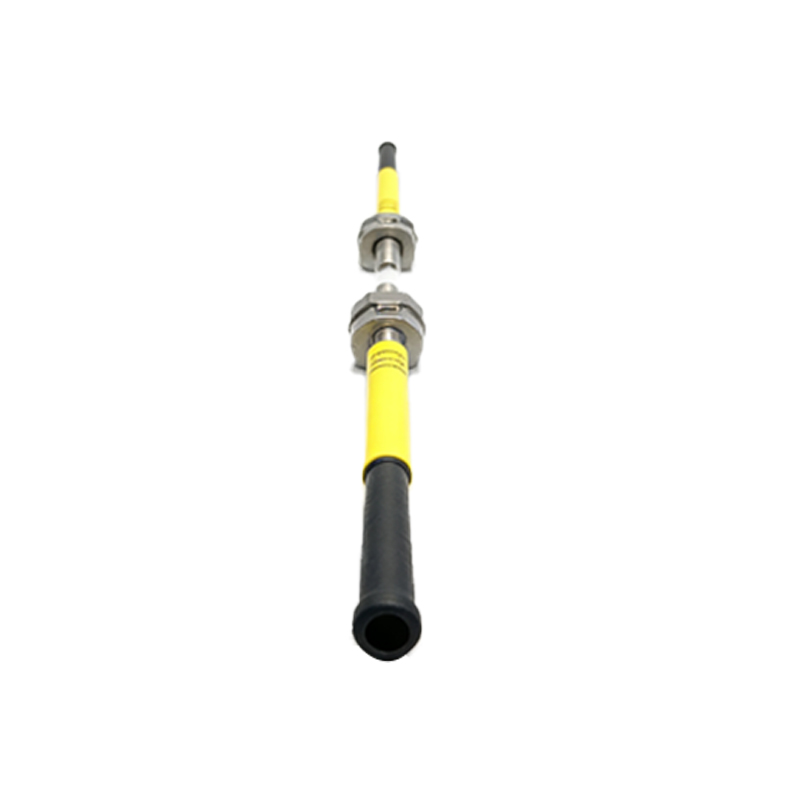
In thrubeam mode, the emitter and receiver are housed in separate enclosures, aligned directly opposite each other. The light beam travels through air or across a gap. When a target interrupts the beam, the receiver detects a drop in light intensity, triggering the output. This method offers the longest sensing range (up to 50 meters for industrial lasers) and highest immunity to contamination. However, it requires precise alignment and wiring for both units. The measuring principle is binary: light present vs. light blocked.
Retroreflective Mode: Using a Reflector for Simplified Alignment
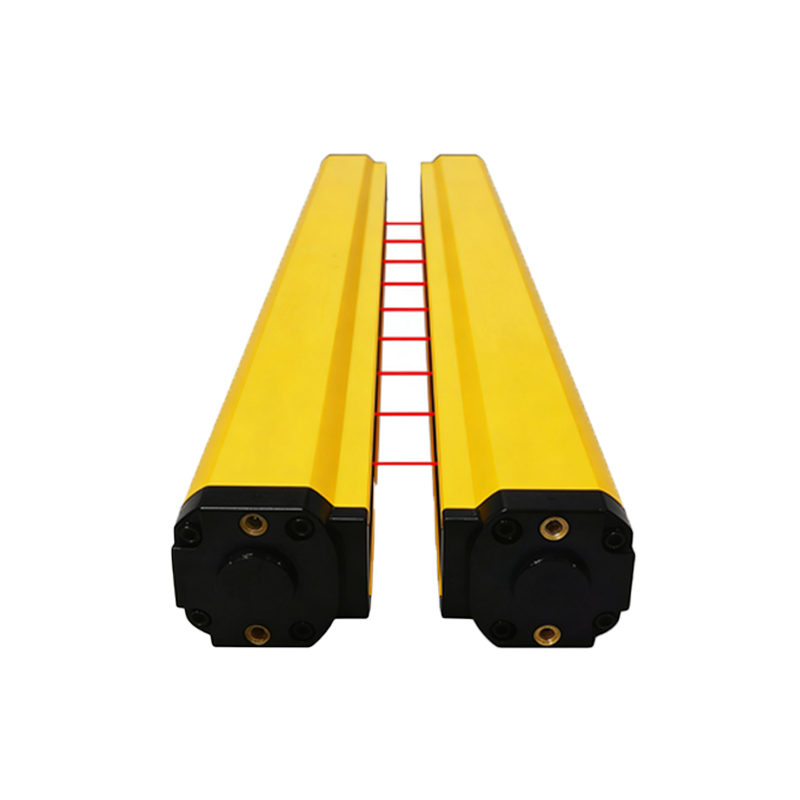
Retroreflective sensors combine the emitter and receiver in a single housing. A special reflector, often with corner-cube prisms or reflective tape, is placed opposite the sensor. The emitted light bounces off the reflector back to the receiver. When an object passes between the sensor and reflector, the beam is broken, causing a detection event. To handle shiny targets (like mirrors), sensors use polarized filters: the emitter sends polarized light, and only the reflector returns it with proper polarization; specular reflections from shiny objects are rejected. This mode balances range (up to 10 meters) and ease of installation.
Diffuse Mode: Measuring Reflected Light from the Target Itself
Diffuse photoelectric sensors use a single housing and rely on light reflected directly from the target surface. The emitter sends a beam; the receiver detects light scattered back. The sensor triggers when the returned light exceeds a set threshold. This is ideal for detecting objects at close range (usually up to 1 meter) without needing a reflector or separate receiver. The key challenge is differentiating targets based on color, reflectivity, and texture. For example, a black object absorbs more light than a white one, requiring automatic gain control or background suppression technologies (e.g., using two photodiodes for triangulation).
Background Suppression and Fixed-Focus Techniques
Advanced diffuse sensors employ background suppression to ignore objects behind the target. One common method uses a position-sensitive detector (PSD) or a dual-receiver array. The light spot on the receiver shifts based on target distance; the sensor triggers only when the spot falls within a predefined zone. Another technique is fixed-focus, where a lens system focuses the beam at a specific distance. Objects at that distance reflect light sharply onto the receiver, while background objects produce a defocused, weaker signal. These methods enable precise measurement of object presence regardless of surface color.
Laser-Based Measurement for High Precision
Laser photoelectric sensors use a collimated, coherent light source (Class 1 or Class 2 laser diodes) for pinpoint accuracy. The narrow beam allows detection of small targets (e.g., 0.1 mm diameter) at long ranges (up to 100 meters). Measurement can be analog: the receiver outputs a voltage or current proportional to received light intensity, enabling distance estimation via time-of-flight (TOF) or triangulation. In TOF sensors, the time between emission and return is measured, even for fast-moving objects. These are essential in robotics, logistics, and semiconductor manufacturing.
Environmental Factors Affecting Light Measurement
Industrial environments introduce dust, oil, vapor, and temperature variations that affect light measurement. Sensors must compensate for lens contamination via automatic cleaning algorithms or air purge systems. Temperature drift in the LED and receiver can be mitigated by using temperature-compensated circuits. Ambient light rejection relies on modulation and optical filters that pass only the emitter's wavelength. For extreme conditions, fiber-optic extensions separate the electronics from the sensing head, allowing operation in high-temperature or explosive areas.
Output Signals and Integration with Control Systems
Measured light levels are converted into standard output signals: NPN/PNP discrete outputs (for ON/OFF detection) or analog outputs (0-10 V, 4-20 mA) for continuous measurement. Many modern sensors include IO-Link communication for real-time diagnostics, parameter adjustment, and predictive maintenance. Integration with PLCs or DCS systems is straightforward via digital input modules. Key specifications to consider include response time (e.g., 0.1 ms for fast applications), hysteresis (to prevent oscillation near the threshold), and repeatability (e.g., ±0.01 mm for laser sensors).
Conclusion: The Role of Light Measurement in Industry 4.0
Photoelectric sensors remain the backbone of non-contact detection in factories, warehouses, and process plants. Understanding how they measure light—through modulation, reflection, and advanced signal processing—enables engineers to select the right mode for each application. Whether using thrubeam for long-range pallet detection or diffuse background suppression for transparent bottle inspection, the ability to precisely quantify light intensity and timing drives reliability in automated systems. As Industry 4.0 evolves, these sensors will incorporate smarter algorithms and wireless connectivity, further enhancing their measurement capabilities.