1. Through-Beam Sensors: The Gold Standard for Long-Range Detection
Through-beam sensors consist of a separate transmitter and receiver, offering the longest sensing range, often exceeding 30 meters. They excel in clean environments where uninterrupted line-of-sight is possible. Ideal for counting objects on conveyor belts or detecting small parts in assembly lines, these sensors provide high reliability but require precise alignment and wiring on both ends.
2. Retro-Reflective Sensors: Balanced Performance for Medium Ranges
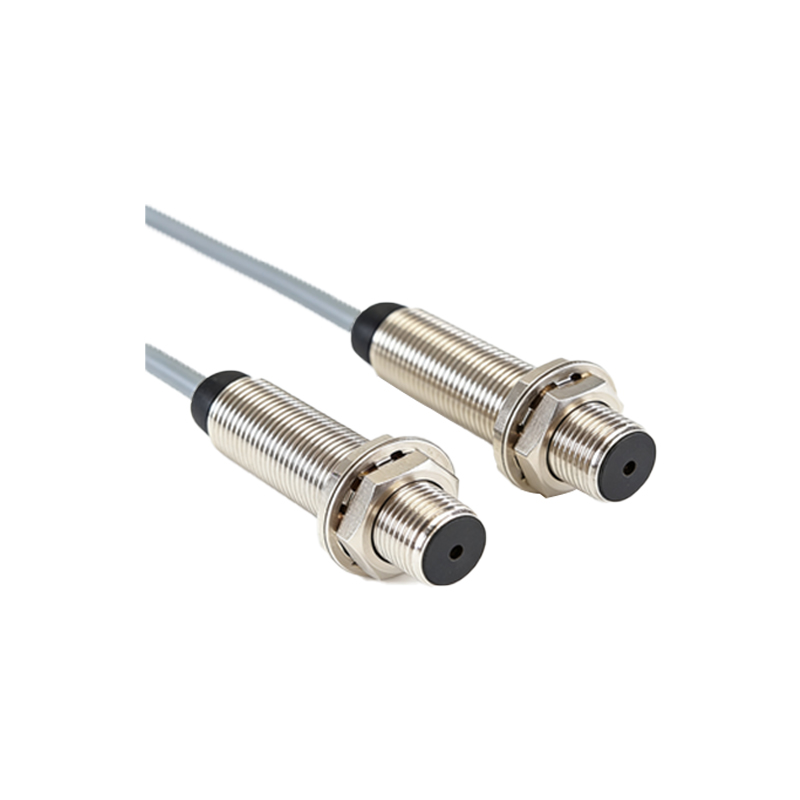
Retro-reflective sensors combine the transmitter and receiver in one housing, using a reflector to bounce the beam back. With ranges up to 10 meters, they simplify installation compared to through-beam types. They suit applications like packaging machinery and automated storage systems, though they can be affected by shiny surfaces that cause false reflections.
3. Diffuse Reflective Sensors: Versatility for Short-Range Detection
Diffuse sensors detect objects by measuring the light reflected directly from the target, without needing a separate reflector. Ranges typically reach 1 meter, making them perfect for short-distance tasks such as presence detection in robotic arms or material handling. They are cost-effective but less reliable on dark or transparent materials.
4. Background Suppression Sensors: Precision in Cluttered Environments
These sensors use advanced optics to ignore background objects, focusing only on a predefined sensing window. They excel in automated guided vehicles (AGVs) and packaging lines where multiple layers of items exist. Background suppression minimizes false triggers, ensuring accurate detection even on glossy or irregular surfaces.
5. Fiber Optic Sensors: Flexibility for Confined Spaces
Fiber optic sensors use flexible cables to transmit light to remote or hazardous areas. They withstand high temperatures, vibration, and electromagnetic interference, making them ideal for food processing or heavy machinery. Despite shorter ranges (under 1 meter), their adaptability suits custom applications like detecting tiny components in electronics assembly.
6. Laser Sensors: High-Accuracy for Fine Measurement
Laser photoelectric sensors emit a focused beam for precise detection, with ranges up to 50 meters. They are used in quality control, such as checking part dimensions or alignment in automotive manufacturing. Their high cost is offset by exceptional accuracy, but they require clean optics to maintain performance.
7. Color Mark Sensors: Specialized for Contrast Detection
These sensors differentiate between colors or contrasts using RGB LEDs, ideal for detecting registration marks on packaging films or labels. They operate at short ranges (under 100 mm) and are critical in printing and labeling equipment. Their reliability depends on consistent lighting conditions and clean surfaces.
8. Ultrasonic Sensors: Non-Optical Alternative for Tough Conditions
Though not strictly optical, ultrasonic sensors are often grouped with photoelectric types for object detection. They use sound waves, unaffected by dust, fog, or light. Ranges up to 8 meters suit level monitoring in silos or detecting transparent objects like glass bottles. They are slower than optical sensors but excel in harsh environments.
9. Polarized Retro-Reflective Sensors: Overcoming Reflective Surfaces
These sensors incorporate polarizing filters to reduce false signals from shiny objects, such as chrome or aluminum. Ranges are similar to standard retro-reflective types (up to 8 meters). They are preferred in automotive paint shops and metal processing lines where glare is common.
10. Area Sensors: Multi-Beam Detection for Large Coverage
Area sensors use an array of beams to detect objects over a wide zone, such as pallet dimensions or vehicle presence. Ranges vary from 1 to 10 meters. They are used in warehouse logistics and safety applications, but require careful calibration to avoid interference between beams.