Introduction to Photoelectric Sensors
Photoelectric sensors are essential components in industrial automation, used to detect objects, distances, and presence through light emission and reception. When operating with infrared light, these sensors leverage the invisible spectrum to achieve reliable detection in various environments, including dusty or low-light conditions. This article outlines the core principle behind how photoelectric sensors receive and process infrared light, focusing on the technical aspects that ensure precision and efficiency in industrial applications.
Emission and Propagation of Infrared Light
The process begins with the sensor’s emitter, typically an infrared LED, which generates light in the infrared spectrum (wavelengths ranging from 850 nm to 950 nm). This light is modulated at a specific frequency to distinguish it from ambient infrared sources, such as sunlight or heat radiation. The modulated beam propagates through the air toward the target or a reflector, depending on the sensor type (through-beam, retro-reflective, or diffuse). The choice of wavelength minimizes interference from visible light and enhances penetration through airborne particles.
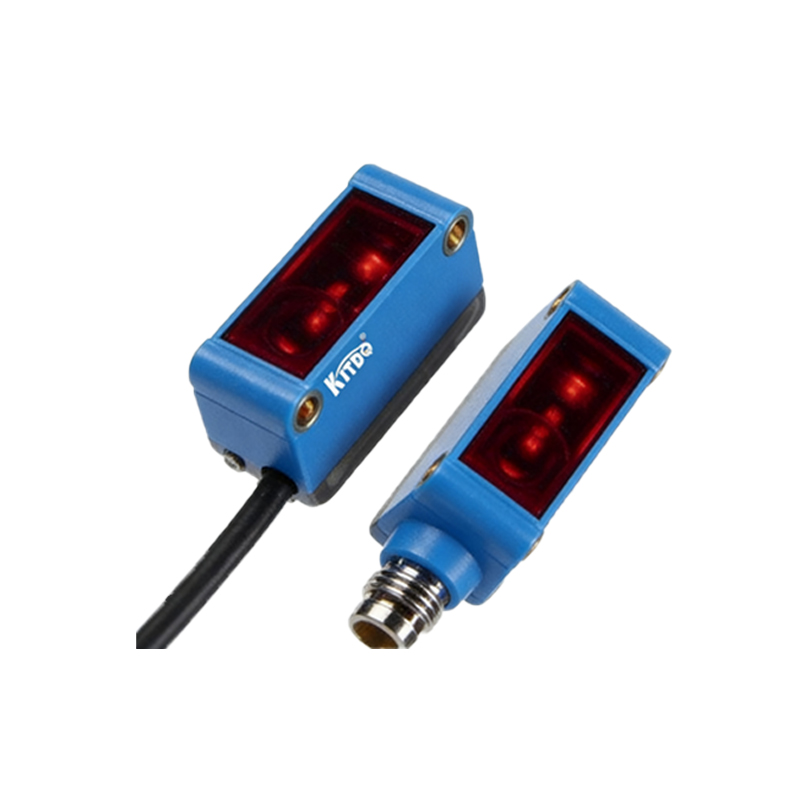
Reception Mechanism: Photodetector and Optics
The receiving section of the photoelectric sensor comprises a photodiode or phototransistor, along with focusing optics like lenses or filters. The optics collect and concentrate the incoming infrared light onto the sensitive area of the photodetector. A narrow bandpass filter is often placed in front of the photodetector to block out unwanted wavelengths, ensuring only the modulated infrared light reaches the sensing element. The photodetector converts the received light intensity into an electrical current through the photoelectric effect, where photons excite electrons in the semiconductor material, generating a measurable signal.
Signal Processing and Demodulation
Once the photodetector produces an electrical current, the sensor’s internal circuitry amplifies and processes this signal. The key step is demodulation, where the system separates the modulated signal from background noise. The amplifier matches the modulation frequency of the emitter, filtering out low-frequency interference from ambient light or heat sources. A comparator then compares the amplified signal to a preset threshold, determining whether the light beam is present or blocked. This logic generates a binary output (e.g., high or low) to indicate object detection.
Factors Affecting Reception Performance
Several factors influence how effectively the photoelectric sensor receives infrared light. The distance between the emitter and receiver, known as the sensing range, directly impacts signal strength due to inverse-square law attenuation. Surface reflectivity of targets, especially for diffuse sensors, affects the amount of light returned to the receiver. Environmental conditions, such as fog, dust, or steam, can scatter infrared light, reducing intensity. Additionally, alignment precision between emitter and receiver optics is critical for optimal reception. Engineers must account for these variables during system design and installation.
Advanced Reception Techniques
Modern photoelectric sensors employ advanced techniques to enhance infrared light reception. For example, automatic gain control dynamically adjusts the amplifier sensitivity based on background light levels, maintaining stable performance. Some sensors use time-of-flight methods to measure the delay in light return, enabling precise distance measurement. Digital signal processing also helps filter out transient noise, improving reliability in harsh industrial settings. These innovations allow infrared photoelectric sensors to operate effectively in diverse applications, from conveyor belt monitoring to robotic positioning.
Conclusion
The principle of photoelectric sensors receiving infrared light relies on a well-coordinated sequence of emission, optical focusing, photodetection, and signal demodulation. By understanding these technical elements, engineers can select and configure sensors for optimal detection in real-world scenarios. The use of infrared light provides distinct advantages, such as immunity to visible light interference and enhanced performance in challenging environments, making it a cornerstone of industrial sensing technology.