Accurate speed measurement is critical for motor control and performance monitoring across industrial applications. Traditional methods like tachometers and encoders often involve physical contact, leading to wear, maintenance issues, and potential interference with system operation. Laser sensor technology offers a non-contact, high-precision alternative that is revolutionizing how engineers measure rotational speed.
A laser sensor designed for speed measurement typically operates on the principle of laser Doppler velocimetry or, more commonly for rotational systems, laser reflection pulse counting. In a standard setup, the sensor emits a focused, coherent beam of light toward a rotating component, such as a motor shaft or a dedicated reflective marker attached to it. When the laser strikes the surface, a portion of the light is reflected back to the sensor's detector. If the surface has irregularities, markings, or intentionally applied reflective tape, the intensity of the returned light fluctuates as these features pass through the beam. The sensor's internal circuitry converts these fluctuations into electrical pulses. By counting the number of pulses per unit of time, the rotational speed in revolutions per minute (RPM) is calculated with high accuracy.
The advantages of using laser sensors are substantial. The non-contact nature eliminates mechanical loading on the motor shaft, preventing friction-induced errors and component wear. This is particularly valuable for high-speed motors or delicate systems where even minimal contact could affect performance. Laser sensors provide exceptional resolution and fast response times, capable of detecting rapid speed changes that contact-based sensors might miss. Installation is straightforward, requiring only a clear line of sight to the target, which simplifies integration into existing machinery without major modifications. They are also largely immune to electromagnetic interference, a common challenge in environments with powerful motors and drives.
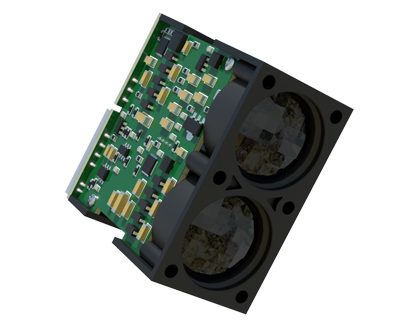
Key considerations for implementation include target surface preparation and environmental factors. For optimal signal strength, the measurement point should have a contrasting surface—such as a matte finish with a single reflective strip or a patterned encoder disc. Highly polished, uniform surfaces can scatter light and produce a weak signal. Ambient light conditions generally have minimal impact on modern, modulated laser systems, but excessive dust, steam, or vibration in the industrial environment can potentially affect beam integrity and reading stability. Selecting a sensor with an appropriate sensing range, laser class (typically Class 2 for safety), and output compatibility (e.g., analog voltage, digital pulse, or serial communication) is essential for system integration.
Applications extend far beyond simple RPM checks. In automotive testing, laser sensors measure wheel or drivetrain speed dynamically. In manufacturing, they synchronize conveyor belt speeds or monitor spindle rates in CNC machinery. For research and development, they provide precise data for efficiency mapping and validation of motor prototypes. Furthermore, this technology facilitates predictive maintenance programs by continuously tracking speed consistency; deviations from expected values can indicate issues like bearing wear or load imbalances before they cause failure.
Compared to optical encoders, which require shaft coupling, or proximity sensors, which have shorter ranges, laser sensors offer a versatile balance of precision, ease of use, and robustness. As motor systems become more advanced and integrated with IoT platforms, the role of accurate, reliable non-contact speed measurement will only grow. Laser sensors, with their direct digital output and compatibility with data acquisition systems, are perfectly positioned to meet this demand, providing the critical data needed for smarter control, higher efficiency, and improved operational safety in the age of automation.
