In the realm of precision measurement and automation, laser sensors have become indispensable tools. Their ability to deliver accurate, non-contact readings makes them ideal for a wide range of applications, from industrial quality control to robotics. However, the full potential of a laser sensor is often unlocked not just by its inherent specifications, but by its physical installation. One critical, yet frequently overlooked, aspect is the strategic use of tilt during mounting. Installing a laser sensor at a deliberate angle, rather than perfectly perpendicular to the target surface, is not an error but a sophisticated technique to overcome common operational challenges.
The primary rationale for tilting a laser sensor is to mitigate the issue of specular reflection. When a laser beam strikes a smooth, shiny surface—such as polished metal, glass, or glossy plastic—at a 90-degree angle, the beam can reflect directly back into the sensor's receiver. This phenomenon, known as retro-reflection, often causes signal saturation, inaccurate readings, or complete measurement failure. By introducing a tilt angle, the intense specular reflection is directed away from the receiver lens. The sensor then detects the weaker, diffuse scattered light from the surface, which provides a stable and reliable signal. A tilt of 5 to 15 degrees is typically sufficient to solve this problem, though the exact angle depends on the surface finish and the sensor's optical design.
Beyond handling reflective surfaces, tilt installation is crucial for measuring on uneven or textured materials. A perfectly perpendicular beam might reflect off a single high point on a rough surface, giving a false reading for the overall profile. A slight tilt can help the laser spot average over a slightly larger area or interact with the surface geometry in a more representative way, improving consistency. Furthermore, in applications involving continuous web materials, transparent films, or liquids, a tilted sensor helps avoid measuring through the material to a backing surface or receiving reflections from both the front and back surfaces, which can confuse the sensor's electronics.

The benefits extend into challenging environmental conditions. In settings with airborne dust, smoke, or light mist, a perpendicular laser path allows contaminants to settle directly on the sensor's front lens, gradually attenuating the signal. A tilted front face encourages particulates to slide off or accumulate less centrally, aiding in maintenance and prolonging operational periods between cleanings. It also helps prevent false triggers from airborne particles briefly intersecting the beam path, as the receiver's field of view is slightly offset from the emitter's line.
Implementing a tilt requires careful consideration. The most common method is to use an adjustable mounting bracket, allowing fine-tuning on-site. The key principle is to tilt the entire sensor body, maintaining the alignment between its internal emitter and receiver. The chosen angle must be balanced; too little tilt may not solve the reflection issue, while excessive tilt can introduce new errors. A significant tilt changes the effective measurement standoff distance and can lead to cosine error if not compensated. For displacement sensors measuring height, the reported value will be the distance along the laser's axis, not the vertical height. This geometric error must be corrected mathematically in the control system using the cosine of the tilt angle.
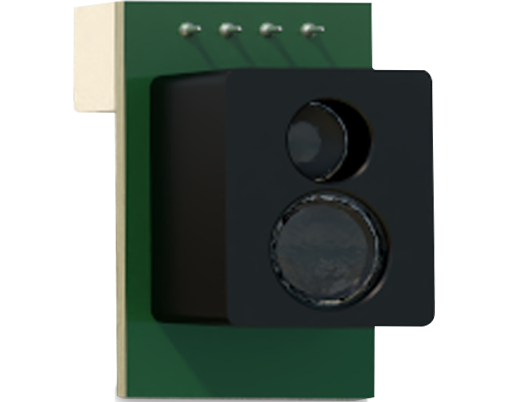
Modern laser sensors often come with integrated software features to compensate for tilt installation. Users can input the installation angle into the sensor's configuration software, enabling it to automatically output the corrected vertical distance or position. This eliminates manual calculation and reduces setup complexity. When planning an installation, it is also vital to ensure that the tilted sensor's beam path remains unobstructed and that the spot lands consistently within the defined measurement range on the target.
In conclusion, the deliberate tilting of a laser sensor is a powerful optimization strategy. It transforms a standard component into a more robust and adaptable solution, capable of handling problematic surfaces and harsh environments that would otherwise cause measurement failure. By understanding the principles of reflection, geometry, and environmental interaction, engineers and technicians can deploy laser sensors with greater confidence and precision. The simple act of angling a sensor mount moves beyond basic installation into the domain of applied optical engineering, ensuring that the investment in high-quality sensing technology yields consistently accurate and reliable data.