Introduction to Photoelectric Sensors
Photoelectric sensors are essential components in modern industrial automation, converting light signals into electrical outputs to detect objects, distances, or positions. As an electrical engineer, understanding their principles and applications is crucial for system design. These sensors operate by emitting a beam of light, typically infrared, visible red, or laser, and measuring changes in the received light intensity. Their non-contact nature makes them ideal for harsh environments, high-speed lines, and delicate materials. Key parameters include sensing range, response time, and ambient light immunity, which vary by type.
Working Principles and Light Sources
Photoelectric sensors rely on three main detection modes: through-beam, retro-reflective, and diffuse. Through-beam sensors have separate emitter and receiver, offering the longest range but requiring alignment. Retro-reflective sensors use a reflector, combining emitter and receiver in one housing. Diffuse sensors detect light reflected directly from the target, suitable for short-range applications. Light sources include LED (light-emitting diode) for general use, laser for precision, and IR for hidden detection. Engineers must choose based on target material (e.g., transparent, reflective) and environmental factors like dust or fog.
Key Technical Specifications
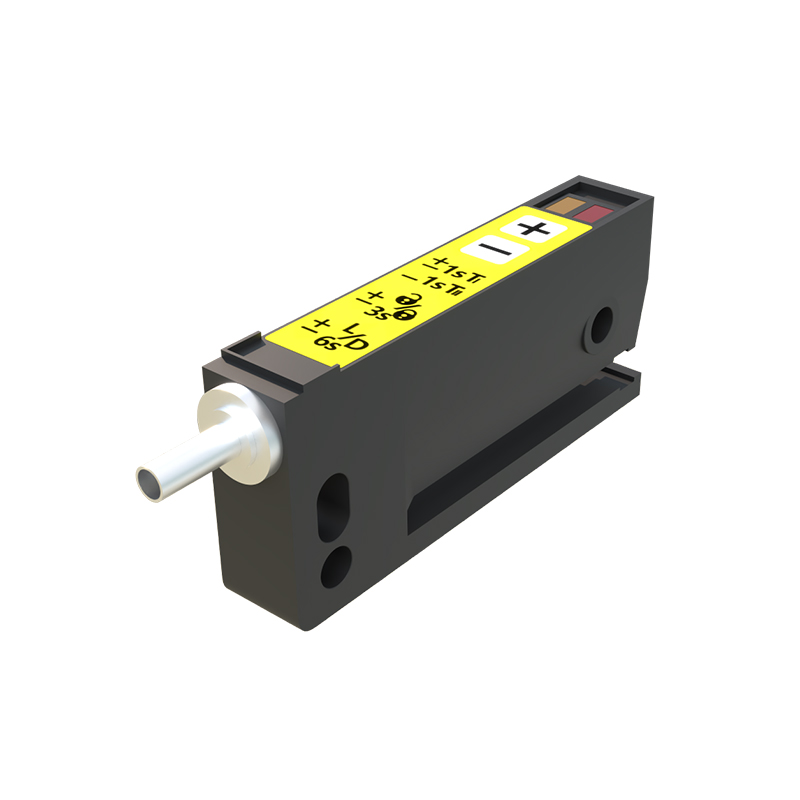
When selecting a sensor, consider critical specs: sensing distance (e.g., 0.1m to 50m), operating voltage (typically 10-30V DC or 24-240V AC), output type (NPN, PNP, or relay), and switching frequency (e.g., 1kHz for fast detection). Protection class (IP67 recommended for wet areas) and temperature range (-25°C to 55°C) ensure reliability. Additionally, hysteresis prevents oscillation near detection boundaries. For example, a diffuse sensor with background suppression ensures stable detection of dark objects on bright backgrounds, a common challenge in packaging lines.
Installation and Wiring Considerations
Proper installation is vital for sensor performance. Use shielded cables to avoid electromagnetic interference (EMI) from motors or drives. Mount sensors with secure brackets, maintaining recommended distance from reflective surfaces. For through-beam systems, ensure emitter and receiver alignment within 1 degree. Wiring must follow color codes: brown for V+, blue for V-, black for output, and gray for test input. Incorporate a 10ms delay for power-up stabilization. In conveyor systems, place sensors perpendicular to the target path to minimize false triggers from vibrations.
Common Applications in Industry
Photoelectric sensors are ubiquitous in manufacturing: detecting product presence on conveyor belts, counting bottles in beverage lines, and verifying cap closure. In logistics, they control robotic arms for picking. In automotive, they monitor tire positioning. Specialized versions like fiber optic sensors access tight spaces in PCB inspection. Engineers should consider multi-array sensors for width measurement or color-mark sensors for print registration. These applications demand fast response (under 1ms) and immunity to ambient light, often achieved through modulated light.
Troubleshooting and Maintenance Tips
Common issues include false triggers from dust, misalignment, or reflective targets. Clean lenses with isopropyl alcohol weekly. Verify supply voltage and check for cable damage. Use test mode to simulate detection. For intermittent faults, inspect for loose connectors or vibration. In harsh environments, consider sensors with automatic gain control (AGC) to compensate for lens contamination. Always replace with same brand/model to ensure compatibility. Document calibration settings for repeatable setups.
Future Trends and Innovations
Emerging trends include IO-Link communication for real-time diagnostics, miniaturization for embedded systems, and smart sensors with built-in processing for edge AI. Laser photoelectric sensors now achieve micron-level precision for semiconductor fabrication. Energy harvesting versions reduce wiring costs. As Industry 4.0 advances, photoelectric sensors will integrate with IoT platforms for predictive maintenance. Engineers must stay updated on standards like IEC 60947-5-2 for safety applications.