Introduction to Fluorescent Photoelectric Sensors
Fluorescent photoelectric sensors are advanced optical devices widely used in industrial automation for detecting objects and materials based on their fluorescent properties. Unlike standard photoelectric sensors that rely on reflected or transmitted light, these sensors exploit the phenomenon of fluorescence, where certain materials absorb light at one wavelength and emit it at a longer wavelength. This unique capability allows for high-precision detection in challenging environments, such as those with varying surface colors, transparency, or low contrast.
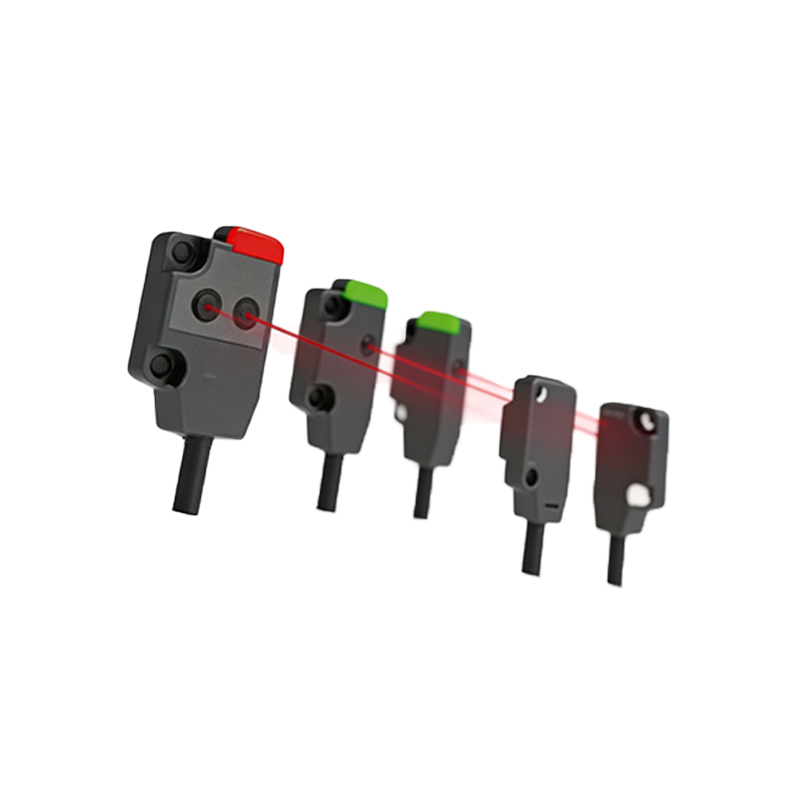
Core Principle: Fluorescence Emission
The fundamental principle behind a fluorescent photoelectric sensor involves the excitation of fluorescent materials. When a sensor emits a short-wavelength light, typically in the ultraviolet (UV) or blue spectrum, toward a target, materials with fluorescent properties absorb this energy. The absorbed energy raises electrons to a higher energy state. As these electrons return to their ground state, they release energy in the form of visible light at a longer wavelength. This emitted light is distinct from the excitation source, enabling the sensor to filter out ambient light and background reflections, thus achieving reliable detection.
Key Components and Their Functions
A typical fluorescent photoelectric sensor consists of three main components: an excitation light source, typically a UV LED; an optical filter system; and a photodetector. The UV LED emits a focused beam of light onto the target area. The optical filter placed in front of the photodetector is designed to block the excitation wavelength while allowing only the fluorescent emission to pass through. This selective filtering eliminates interference from the source light and ambient lighting, ensuring the photodetector captures only the signal from the fluorescent target. Modern sensors may also include a microprocessor for signal processing and output control.
Detection Process and Signal Analysis
During operation, the sensor continuously emits UV light pulses. When a fluorescent object enters the detection zone, the material emits a fluorescence signal. The photodetector receives this signal, converts it into an electrical current, and amplifies it. The signal is then compared against a preset threshold. If the fluorescence intensity exceeds the threshold, the sensor triggers an output, such as a digital high signal or a relay switch. This process is highly sensitive and can detect even minute amounts of fluorescent material, such as marks on a conveyor belt or fluorescent labels on products.
Advantages in Industrial Settings
Fluorescent photoelectric sensors offer several advantages over traditional sensors. They are immune to color variations, as detection relies on fluorescence rather than surface reflectivity. This makes them ideal for distinguishing objects with similar colors or transparent materials. Additionally, they can operate effectively in high-ambient-light conditions due to the use of bandpass filters. Their ability to detect invisible fluorescent markers also enables covert or non-intrusive sensing, which is valuable in quality control, sorting, and packaging applications.
Common Applications and Examples
In manufacturing, these sensors are used for detecting fluorescent markings on products for identification and tracking. For instance, in the food industry, they can verify the presence of invisible UV-fluorescent inks on packaging. In the automotive sector, they are employed to check for the correct application of adhesives or lubricants that contain fluorescent additives. Other applications include counting transparent objects, detecting edge positions in web processing, and ensuring proper product orientation in assembly lines.
Limitations and Considerations
Despite their robustness, fluorescent photoelectric sensors have some limitations. They require the target material to have fluorescent properties, which may not be present in all objects. In some cases, fluorescent additives must be introduced to the process, adding cost. Temperature and humidity can also affect fluorescence efficiency, requiring environmental compensation. Furthermore, the sensor's range is typically shorter than that of standard photoelectric sensors, often limited to a few centimeters due to the low intensity of fluorescence signals.
Conclusion
Fluorescent photoelectric sensors represent a specialized yet powerful tool in industrial automation, leveraging the principle of fluorescence to overcome challenges faced by conventional sensors. By understanding their working principle, components, and application scenarios, engineers can effectively integrate these sensors into systems requiring high reliability and precision detection. As technology advances, improvements in UV LED efficiency and photodetector sensitivity will further expand their utility across diverse industries.