Understanding the Principle of Photoelectric Displacement Measurement
Photoelectric sensors are essential tools in industrial automation for measuring displacement without physical contact. The core principle relies on the modulation of light beams between an emitter and a receiver. When an object moves within the sensor's field, it disrupts or reflects the light, and the sensor converts this optical change into an electrical signal. Common methods include through-beam, retro-reflective, and diffuse reflection modes. For precise displacement measurement, time-of-flight (ToF) or triangulation techniques are often employed, where the delay or angle of reflected light determines distance.
Key Components in Photoelectric Displacement Sensors
A typical photoelectric displacement sensor consists of a light source (often an LED or laser diode), a photodetector, an optical lens system, and a signal processing unit. Laser-based sensors offer higher precision due to their narrow beam and coherence. The emitter projects a focused beam onto a target, and the receiver captures the reflected or interrupted light. Advanced models include compensation circuits to mitigate ambient light interference, ensuring stable readings even in harsh factory environments.

Triangulation Method for Accurate Distance Measurement
In triangulation-based sensors, the emitter and receiver are positioned at known angles. When light strikes a target surface, it reflects at an angle that varies with distance. The photodetector array senses the reflection position, and the sensor calculates displacement using trigonometric equations. This method achieves micron-level resolution, ideal for applications like PCB inspection or automotive part alignment. Frequent calibration and surface reflectivity considerations are critical for maintaining accuracy.
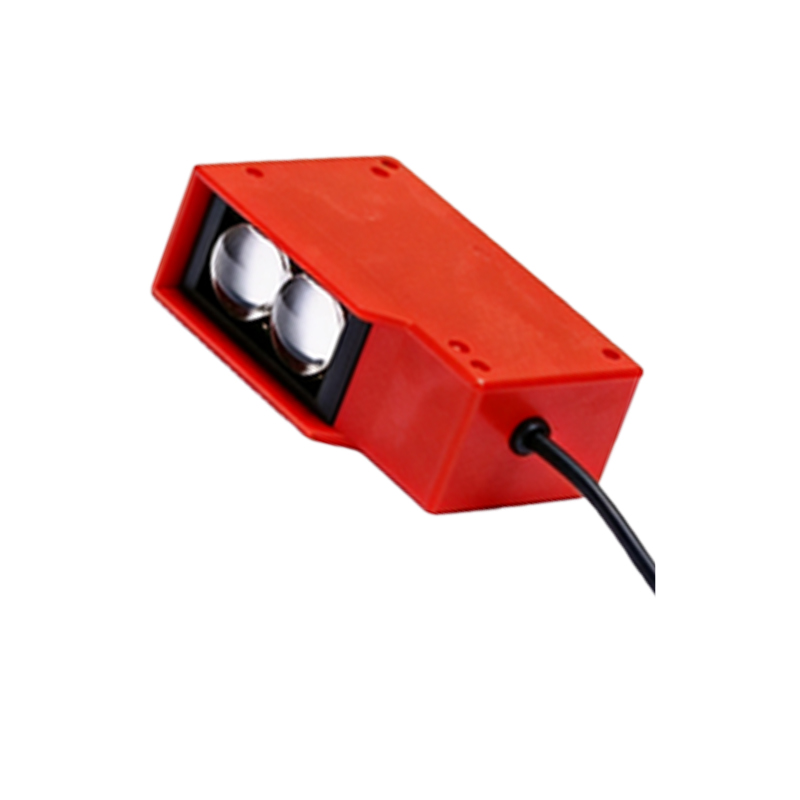
Time-of-Flight (ToF) Technology for Long-Range Displacement
ToF sensors measure displacement by emitting a light pulse and timing its return after reflection. The distance is calculated as half the product of light speed and time delay. This technique excels in long-range scenarios (up to tens of meters) and works with various target surfaces. Industrial robots often use ToF sensors for collision avoidance or positioning. The main challenge is maintaining precision in environments with dust or vibration, which can scatter light.
Applications and Practical Considerations in Industry
Photoelectric displacement sensors are widely used in assembly lines for thickness gauging, level monitoring, and position feedback in closed-loop systems. When selecting a sensor, engineers must consider resolution, response time, and environmental factors like temperature or humidity. For example, retro-reflective sensors are preferred for transparent objects, while diffuse sensors suit opaque materials. Proper mounting and alignment prevent false triggers, ensuring reliable displacement detection.