Understanding the Core Technology
A photoelectric sensor head is a critical component in industrial automation, functioning as the "eyes" of a sensing system. It operates on the principle of emitting a beam of light, typically from an LED or laser diode, and detecting changes in the received light's properties. These changes, such as the presence, absence, or intensity of the returned light, are converted into an electrical signal. The term "magnetic head" in this context is often a misnomer borrowed from older terminology; modern photoelectric heads do not use magnetism. Instead, they rely purely on optical and electronic components housed in a rugged enclosure designed to withstand harsh industrial environments like dust, moisture, and vibration.
Primary Operating Modes
Photoelectric sensor heads are categorized by their sensing modes, each suited for different applications. The through-beam mode uses separate emitter and receiver units. An object is detected when it interrupts the light beam traveling between them, offering the longest sensing range and highest reliability. The retro-reflective mode employs a single unit that emits light and receives its reflection from a dedicated reflector. Detection occurs when an object breaks this beam. Finally, the diffuse reflective mode (or proximity mode) detects an object by receiving light reflected directly from the object's surface. This self-contained mode is easiest to install but has a shorter range and can be influenced by the object's color and surface texture.
Key Performance Specifications
Selecting the right sensor head requires careful analysis of its specifications. Sensing range is the maximum distance at which reliable detection can occur, varying significantly between modes. Response time indicates how quickly the sensor can detect a change and output a signal, crucial for high-speed production lines. Light source type is another key factor; red visible LEDs are common for easy alignment, infrared LEDs offer better immunity to ambient light, and laser diodes provide precise, long-range detection for small objects. Environmental ratings, such as IP67 or IP69K for water and dust resistance, and NEMA ratings, are essential for ensuring longevity in challenging conditions.
Industrial Applications and Use Cases
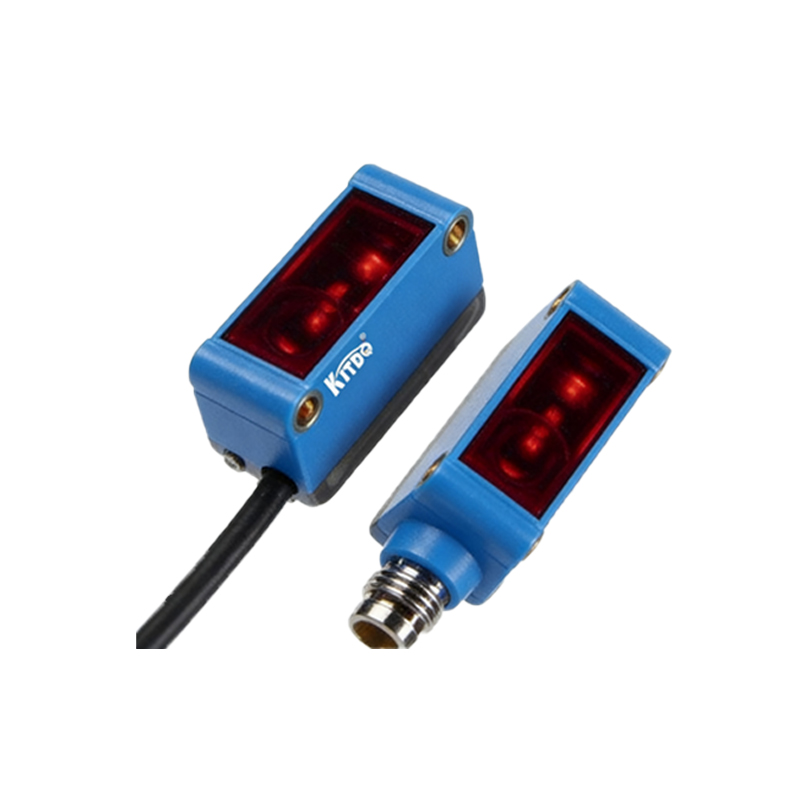
The versatility of photoelectric sensors makes them ubiquitous across manufacturing and logistics. On packaging lines, they count products, verify label presence, and control filling levels. In material handling, they detect the position of boxes on conveyors, manage palletizing robots, and ensure elevator door safety. Automotive assembly relies on them for precise part positioning and robotic guidance. Furthermore, specialized versions with background suppression or color recognition capabilities can detect transparent bottles, differentiate between labels, or ensure the correct orientation of components, solving complex inspection tasks.
Guidelines for Selection and Installation
Successful implementation hinges on proper selection and setup. First, define the application's core requirement: detecting presence, counting, positioning, or inspecting. Next, choose the appropriate sensing mode based on required range, object characteristics, and installation constraints. Always consider the operating environment—factors like dust, steam, or ambient light may necessitate sensors with specific spectral filters or ruggedized housings. During installation, precise alignment is critical for through-beam and retro-reflective types. For diffuse sensors, ensure the sensing distance accounts for the target's reflectivity. Regular maintenance, including lens cleaning and periodic function checks, is vital for sustained reliability.
Advancements and Future Trends
The evolution of photoelectric sensor heads is driven by Industry 4.0 and smart manufacturing demands. Modern sensors increasingly feature IO-Link communication, enabling the digital transmission of detailed status data (like signal strength or internal temperature) for predictive maintenance and process optimization. Miniaturization continues, allowing installation in tight spaces. Enhanced algorithms improve stability for detecting challenging objects, such as shiny metallic surfaces or clear glass. Integration with vision sensor capabilities and AI for basic pattern recognition is an emerging frontier, blurring the lines between simple presence detection and advanced machine vision.