Introduction to Photoelectric Sensors
Photoelectric sensors are fundamental components in industrial automation, leveraging light to detect the presence, absence, or distance of objects. These sensors operate by emitting a light beam, typically from an LED or laser diode, and measuring the change in received light intensity via a photodetector. The core principle hinges on the photoelectric effect, where incident photons generate an electrical current in the semiconductor material of the detector. In analog circuit design, the output from the photodetector is not merely a digital on/off signal but a continuous voltage or current proportional to the light intensity. This analog characteristic allows for precise measurement applications, such as determining object position, transparency, or surface reflectivity, providing nuanced data that digital sensors cannot capture.
Core Components and Circuit Topology
A typical analog photoelectric sensor circuit comprises several key stages. First, the emitter stage involves driving a light source, often an infrared LED, with a constant current source to ensure stable light output, minimizing errors from temperature drift or supply voltage fluctuations. The receiver stage centers on a photodetector, such as a phototransistor or photodiode. Photodiodes, used in photovoltaic or photoconductive modes, offer linear response and fast switching, ideal for precision analog sensing. The subsequent signal conditioning stage is critical; it includes a transimpedance amplifier (TIA) to convert the photodetector's small output current into a usable voltage. This amplifier must be designed with low noise and appropriate bandwidth to handle the sensor's frequency response, often incorporating filtering to reject ambient light interference, such as 50/60 Hz noise from artificial lighting.
Analog Signal Processing Techniques
Processing the analog signal from a photoelectric sensor requires careful design to maintain accuracy and reliability. After initial amplification, the signal may undergo further conditioning through operational amplifier circuits configured as filters, gain stages, or comparators for threshold detection. For instance, a low-pass filter removes high-frequency noise, while a programmable gain amplifier adjusts sensitivity based on application needs. In distance-sensing applications, like triangulation sensors, the analog output correlates directly with the position of a light spot on a position-sensitive detector (PSD), requiring precise linearization circuits. Additionally, temperature compensation circuits are often integrated to counteract the thermal effects on both the emitter and detector, ensuring consistent performance across operating environments. Advanced designs might include modulation/demodulation techniques, where the emitted light is modulated at a specific frequency, and the receiver circuit uses synchronous detection to isolate the signal from background noise dramatically enhancing signal-to-noise ratio.
Application-Specific Circuit Designs
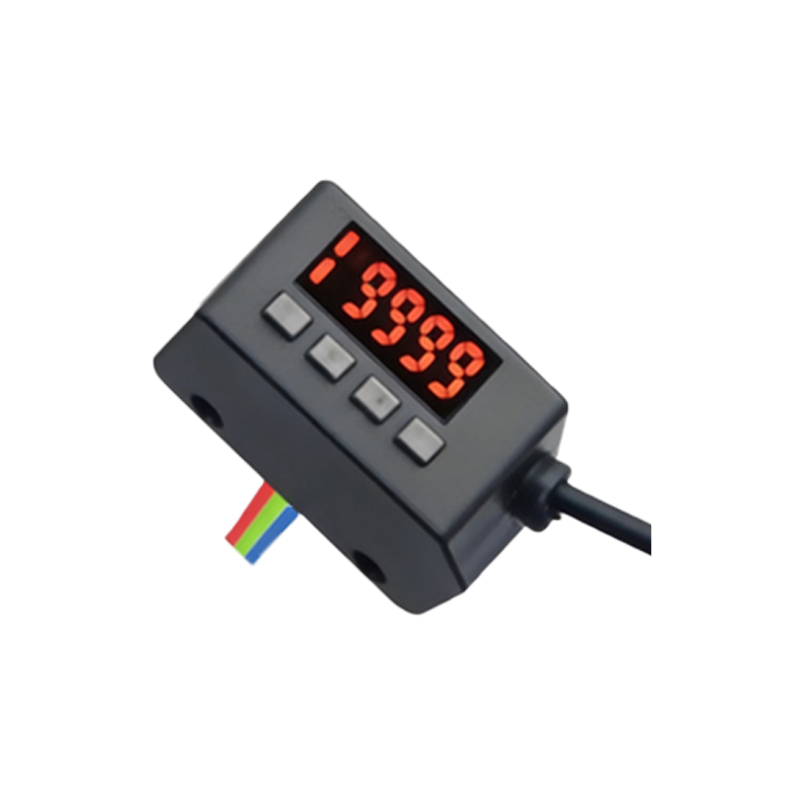
Different industrial applications demand tailored circuit configurations. In contrast sensing, which detects differences in surface reflectivity, circuits are optimized for high gain and fast response to distinguish between subtle reflectivity changes. For diffuse reflective sensors, where the emitter and detector are housed together sensing light reflected off an object, the circuit must handle a wide dynamic range due to varying object distances and colors. Through-beam sensors, with separate emitter and receiver units, often employ simpler circuits as they receive direct light, but still require robust amplification to maintain signal integrity over long distances. Analog output photoelectric sensors are also pivotal in continuous monitoring, such as measuring film thickness or liquid turbidity, where the output voltage linearly corresponds to the measured parameter, interfacing directly with PLC analog inputs or data acquisition systems.
Design Challenges and Optimization Strategies
Designing reliable analog photoelectric sensor circuits presents several challenges. Ambient light interference is a primary concern; designers mitigate this by using optical filters matched to the emitter's wavelength, modulating the light source, and implementing electrical filtering. Cross-talk in dense sensor arrays can be reduced by careful PCB layout, shielding, and time-division multiplexing. Power consumption is another consideration, especially in battery-operated devices, prompting the use of low-power components and pulsed operation modes. Calibration and drift over time necessitate circuits with trimmer potentiometers or digital potentiometers controlled by microcontrollers for automatic calibration. Ensuring long-term stability involves selecting components with low temperature coefficients and implementing feedback loops that adjust the emitter intensity based on received signal levels, maintaining consistent output despite LED aging or lens contamination.
Future Trends and Integration
The evolution of analog photoelectric sensors is closely tied to advancements in semiconductor technology. Integration of analog front-ends (AFEs) into single chips reduces component count and improves noise immunity. Smart sensors incorporating analog-to-digital converters (ADCs) and digital signal processors (DSPs) enable on-board processing, providing calibrated analog outputs alongside digital communication via protocols like IO-Link. Emerging applications in robotics and autonomous systems demand sensors with higher precision and faster response, driving the development of circuits with wider bandwidths and lower latency. Furthermore, the integration of machine learning algorithms for predictive maintenance and anomaly detection is beginning to influence circuit design, requiring analog outputs that feed into more sophisticated data analysis systems, bridging traditional analog sensing with the digital Industrial Internet of Things (IIoT).