Introduction to LED Photoelectric Sensors
LED photoelectric sensors are essential components in modern industrial automation, offering reliable detection of objects, distances, and positions. Unlike traditional incandescent or laser-based sensors, LED-based variants provide a cost-effective, energy-efficient, and long-lasting solution. These sensors operate by emitting a beam of light from an LED source and detecting changes in the received light signal, enabling precise control in manufacturing, packaging, and material handling systems. For electrical engineers, understanding their operating principles, types, and applications is crucial for designing robust automation systems.
Operating Principle and Key Components
An LED photoelectric sensor consists of a light-emitting diode (LED) as the transmitter and a photodetector (such as a photodiode or phototransistor) as the receiver. The LED emits modulated light, typically in the visible or infrared spectrum, to minimize interference from ambient light. The photodetector captures the reflected, transmitted, or interrupted light signal. When an object enters the sensing path, it alters the light intensity reaching the detector, triggering a switch output. Key parameters include sensing range, response time, and ambient light rejection. Engineers must consider the LED wavelength and modulation frequency to match application requirements.
Types of LED Photoelectric Sensors
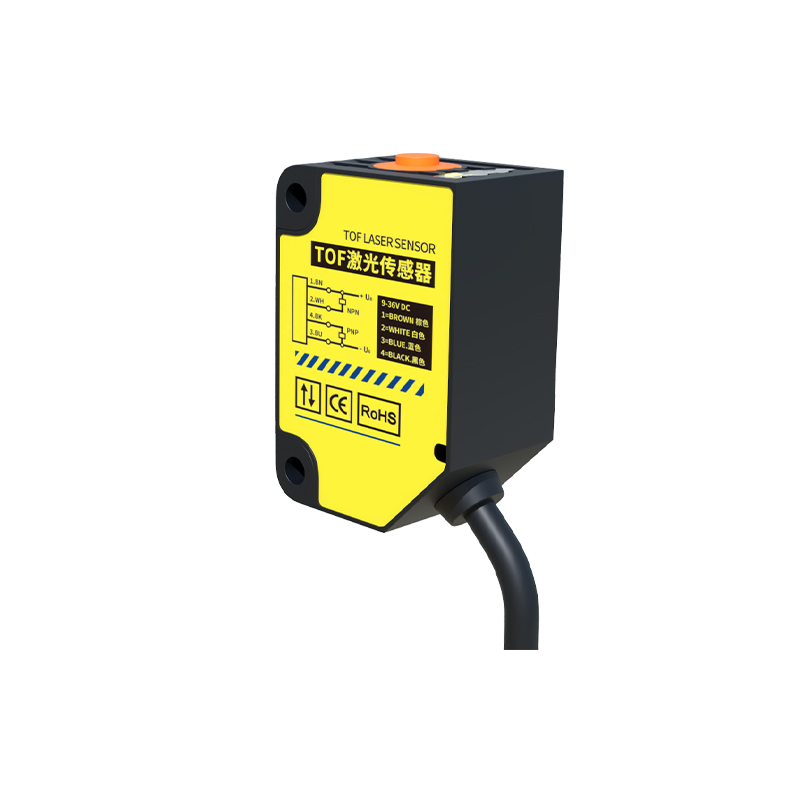
Three main types dominate the industry: through-beam, retro-reflective, and diffuse reflective sensors. Through-beam sensors have separate transmitter and receiver units, offering the longest sensing range (up to 30 meters) and highest reliability. Retro-reflective sensors combine transmitter and receiver in one housing, using a reflector to bounce the beam back, with ranges up to 10 meters. Diffuse reflective sensors detect objects by measuring reflected light from the target itself, making them suitable for short-range detection (up to 2 meters). Each type has trade-offs in installation complexity, cost, and sensitivity to surface properties.
Advantages Over Other Sensing Technologies
LED photoelectric sensors outperform inductive, capacitive, and ultrasonic sensors in several scenarios. They can detect a wide variety of materials, including transparent, reflective, and colored objects, which are challenging for other sensors. Their solid-state design ensures no moving parts, resulting in high durability and low maintenance. Additionally, modern LED sensors incorporate background suppression and polarization filters to enhance accuracy in challenging environments. For electrical engineers, these features reduce false triggers and improve system stability.
Application Examples in Industrial Automation
In automated assembly lines, LED sensors monitor part presence, count components, and verify packaging integrity. For example, a retro-reflective sensor can detect clear glass bottles on a conveyor, while a diffuse sensor ensures proper alignment of metal parts. In material handling, through-beam sensors guard robotic work cells and prevent collisions. Environmental factors like dust, moisture, and vibration can affect performance, so engineers often select sensors with IP67 ratings and adjust gain settings. Integration with PLCs and fieldbus systems (e.g., IO-Link) enables real-time data exchange.
Selection Criteria and Design Considerations
When choosing an LED photoelectric sensor, engineers evaluate sensing range, output type (NPN/PNP, analog, or IO-Link), and response speed. The target material and surface finish influence whether a diffuse or retro-reflective sensor is optimal. For outdoor or high-ambient-light applications, modulated LED signals with high-frequency pulsing improve noise immunity. Wiring and mounting constraints also matter; compact sensors with M8 or M12 connectors simplify installation. Engineers should verify compatibility with existing control systems and consider future scalability.
Maintenance and Troubleshooting Tips
Regular cleaning of LED lenses and reflectors prevents signal degradation. Misalignment is a common issue; using alignment aids like laser pointers or built-in indicator LEDs simplifies setup. If a sensor fails to detect consistently, check for electrical noise from nearby motors or inverters, and ensure the supply voltage is within specification. Advanced sensors provide diagnostic outputs for predictive maintenance. Replacing old sensors with newer models featuring adaptive sensitivity can improve long-term reliability.
Future Trends in LED Sensor Technology
The industry is moving toward smart sensors with integrated processing capabilities, such as object profile recognition and wireless communication. Multi-color LEDs allow sensors to distinguish objects by color, while time-of-flight (ToF) technology enables precise distance measurement. Energy harvesting designs are emerging for battery-less operation. For electrical engineers, staying updated on these trends will enable more efficient and flexible automation solutions.