Introduction to Diffuse Reflective Sensing
Diffuse reflective photoelectric sensors, often simply called diffuse sensors, represent a fundamental and widely used category in industrial automation and object detection. Unlike through-beam or retro-reflective sensors that require a separate receiver or a reflector, a diffuse sensor houses both the light emitter (typically an LED or laser diode) and the receiver (a phototransistor or photodiode) within a single housing. The operating principle is elegantly simple: the emitted light beam strikes the surface of a target object. A portion of this light is scattered or "diffusely reflected" in all directions. Some of this scattered light returns to the integrated receiver. The sensor's internal electronics then detect this returning light, triggering an output signal to indicate the presence of the object. This self-contained design makes diffuse sensors exceptionally easy to install and use, as they only require a single point of mounting and wiring.
The Core: The Photoelectric Sensor Chip
At the heart of every modern diffuse sensor lies a sophisticated photoelectric sensor chip or integrated module. This chip is a marvel of optoelectronics, combining several key functions into a compact silicon package. The emitter side is driven by a dedicated circuit that regulates current to the light source, ensuring consistent output intensity and longevity, often modulated at a specific frequency to mitigate interference from ambient light. The receiver side is far more than just a light-sensitive element. Advanced chips incorporate a high-gain amplifier, filters tuned to the emitter's modulation frequency, and automatic gain control (AGC) circuits. The AGC is particularly crucial for diffuse sensing, as it dynamically adjusts the sensor's sensitivity based on the average received light level, allowing it to function reliably despite varying target reflectivity or accumulation of dust on the lens.
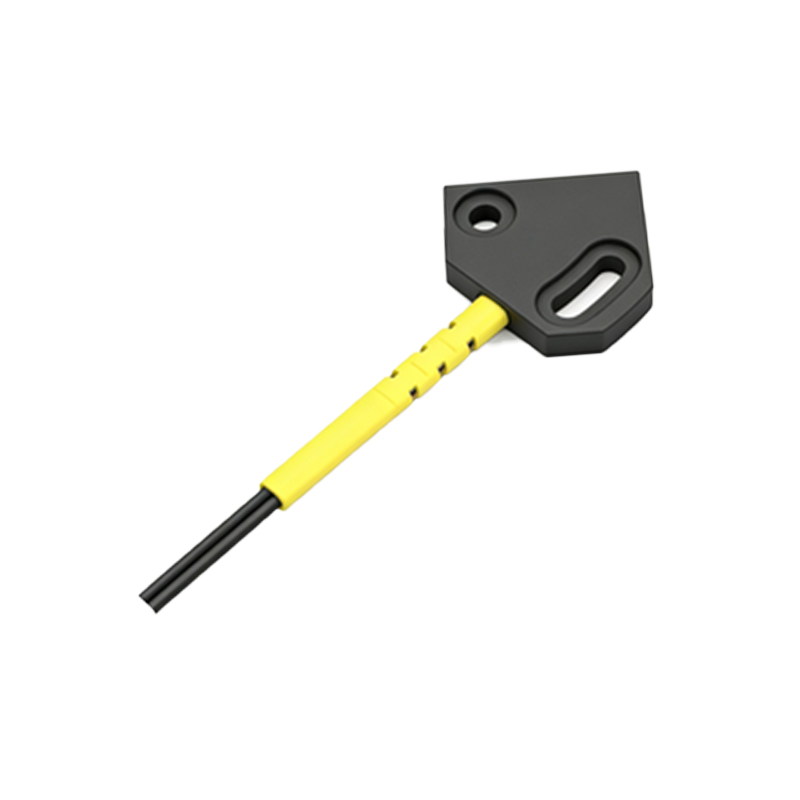
Key Performance Characteristics and Chip Technology
The performance of a diffuse sensor is directly dictated by the capabilities of its core chip. Key parameters include sensing range, response time, and background suppression. Standard diffuse sensors have a limited range, as the intensity of the diffusely reflected light decreases with the square of the distance. However, advanced chips enable Background Suppression (BGS) or Fixed Field Sensing technology. These chips use precise optical design on the silicon level, often with multiple receiver elements or a position-sensitive detector (PSD). The chip's logic compares the angle or spot position of the returning light, allowing it to detect an object only within a very specific, defined distance window while ignoring objects beyond that "background." This is invaluable for applications like detecting objects on a conveyor belt while ignoring the belt itself or the machine floor.
Application Spectrum in Industrial Automation
The versatility of diffuse reflective sensors, powered by their intelligent chips, leads to ubiquitous application across factories. Common uses include object detection on high-speed assembly lines, counting products as they pass a point, checking for the presence of labels or caps on bottles, and verifying the stacking of materials. Miniaturized versions, enabled by chip-scale packaging, are used inside electronic devices for paper detection in printers or tray positioning. In packaging machinery, they ensure cartons are properly formed before filling. Their robustness and lack of need for a reflector make them ideal for environments where mounting a separate receiver is impractical or where the target object itself can serve as the reflective surface.
Selecting the Right Sensor and Chip Considerations
Choosing the appropriate diffuse sensor requires careful analysis of the application needs, which in turn specifies the required chip features. For standard presence detection of highly reflective objects at short ranges, a basic chip with a modulated LED is sufficient. For demanding applications involving low-reflectivity targets (like black rubber or matte cardboard), a sensor with a focused laser diode emitter and a high-sensitivity receiver chip is necessary. If the application involves a varying background or requires precise detection at a specific distance, a Background Suppression (BGS) chip is mandatory. Engineers must also consider the chip's output type (digital NPN/PNP, analog, or IO-Link), response speed for high-throughput lines, and environmental hardening for resistance to dust, moisture, or electrical noise.
Installation, Alignment, and Calibration Tips
Proper installation is critical for reliable operation. The sensor should be mounted securely to minimize vibration. Alignment towards the target is less critical than with through-beam sensors, but optimal performance is achieved when the sensor is perpendicular to the target surface. For challenging surfaces, a preliminary test with the actual target material is recommended. Many modern sensors with advanced chips feature teach-in buttons or programmable functions via IO-Link. This allows users to easily set the sensing threshold or the background suppression distance by simply presenting the sensor with the "object present" and "object absent" conditions, leveraging the chip's internal logic to auto-configure for the specific environment.
Future Trends and Advancements in Chip Design
The future of diffuse reflective sensor chips is oriented towards greater intelligence, miniaturization, and connectivity. We are seeing the integration of microprocessors onto the sensor chip, enabling advanced diagnostics, condition monitoring (like lens contamination warnings), and more sophisticated filtering algorithms. The rise of IO-Link communication is turning simple sensors into smart devices, providing detailed parameterization and real-time data from the chip itself. Furthermore, advancements in VCSEL (Vertical-Cavity Surface-Emitting Laser) and SPAD (Single-Photon Avalanche Diode) technologies promise chips with longer ranges, higher precision, and even lower power consumption for the next generation of diffuse photoelectric sensors.