In the realm of industrial automation, building management, and security systems, the reliable detection of door position is paramount. Among the various sensing technologies available, the proximity sensor designed for door frame integration stands out as a critical component. This device, often a non-contact sensor, detects the presence or absence of a door within its sensing range, triggering a corresponding electrical signal. Its applications span from simple safety interlocks to complex automated entry systems.
Unlike traditional mechanical limit switches that require physical contact, a door frame proximity sensor operates on the principle of electromagnetic induction, capacitive sensing, or, less commonly, ultrasonic technology. Inductive sensors are the most prevalent for metal doors. They generate an oscillating electromagnetic field. When a conductive metal door enters this field, eddy currents are induced in the door, causing a change in the sensor's oscillation amplitude. This change is detected and converted into a switch signal, indicating the door is "closed" or "present." For non-metallic doors, such as wood or glass, capacitive proximity sensors are employed. These sensors detect changes in capacitance caused by the presence of any material, making them versatile for various door types.
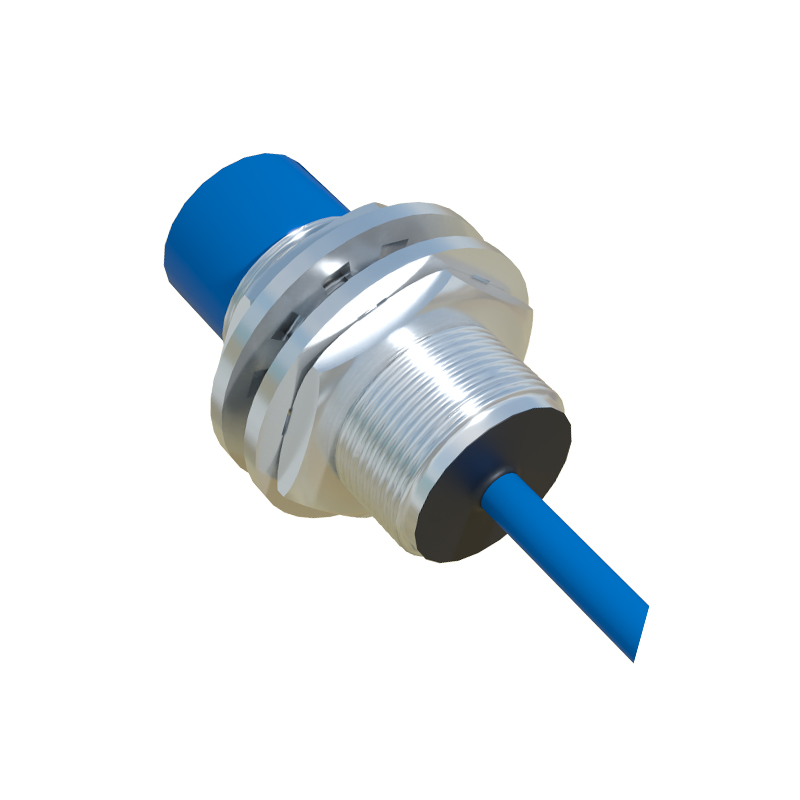
The integration of these sensors into the door frame or its surrounding structure is a key design consideration. They are typically housed in compact, rugged enclosures rated for industrial environments, often with IP67 or higher ingress protection against dust and water. This allows for installation in harsh conditions like warehouses, manufacturing plants, or exterior doors. The sensor is usually mounted flush within the frame, with its sensing face directed towards the path of the door. When the door swings or slides into the closed position, it passes within the sensor's specified sensing range—commonly from a few millimeters up to 40mm for standard models—activating the output.
The benefits of using a dedicated proximity sensor for door monitoring are substantial. First and foremost is safety. In industrial settings, sensors can be used to ensure machine guards or safety doors are fully closed before potentially hazardous equipment is energized, preventing accidents. They are integral to safety interlock systems. Secondly, they enable automation. Automatic doors in commercial buildings, clean rooms, or hospitals rely on such sensors to confirm door status as part of their control logic. In automated material handling and logistics, knowing a bay door or cabinet is sealed is essential for system sequencing.
Furthermore, these sensors contribute to energy efficiency and security. In climate-controlled environments, a sensor confirming a door is sealed helps maintain temperature and reduces energy waste. For security systems, a door position sensor provides a critical input for alarm panels, signaling unauthorized entry if a door is opened outside of scheduled times. The reliability of solid-state proximity sensors, with their lack of moving parts, translates to minimal maintenance, long service life, and high switching frequency compared to mechanical alternatives.
When selecting a proximity sensor for a door frame application, several parameters must be evaluated. The sensing range must be appropriate for the door's movement and alignment tolerances. The output type (e.g., NPN, PNP, NO, NC) must be compatible with the control system's PLC or input card. Environmental factors like temperature extremes, potential chemical exposure, and mechanical vibration dictate the required housing material and protection rating. For specialized applications, such as elevator doors, sensors with very high repeat accuracy and fail-safe designs are mandatory.
Installation and wiring are generally straightforward. Most sensors feature LED status indicators for easy commissioning and diagnostics. Proper alignment between the sensor and the target area on the door is crucial for consistent operation. It is also important to consider the "target material"; inductive sensors require ferrous or non-ferrous metals, while capacitive sensors are material-agnostic but may be influenced by environmental humidity.
In conclusion, the proximity sensor for door frames is a deceptively simple yet profoundly important device. It acts as the digital "eye" that provides a fundamental piece of binary information: door open or door closed. This information forms the backbone of countless automated and safety-critical processes. From ensuring a worker's safety on a factory floor to facilitating the smooth operation of an automatic supermarket entrance, these sensors work silently and reliably. As automation and smart building technologies continue to advance, the demand for robust, accurate, and versatile door position sensing will only grow, solidifying the role of the proximity sensor as an indispensable component in modern infrastructure.