Introduction to Photoelectric Sensors
Photoelectric sensors are indispensable components in modern industrial automation, utilizing light to detect the presence, absence, or distance of objects. Their operation is based on the emission of a light beam, typically from an LED or laser diode, and the reception of this beam by a photodetector. The interaction of the target object with this light beam causes a change in the received signal, which is then processed by the sensor's electronics to generate a discrete or analog output. These sensors are prized for their non-contact detection capability, high speed, long sensing ranges, and reliability across diverse environments. From simple object counting on a conveyor belt to precise positioning in robotic assembly, photoelectric sensors form the backbone of countless control and monitoring systems, ensuring efficiency, safety, and quality in manufacturing and process industries.
Through-Beam Sensors
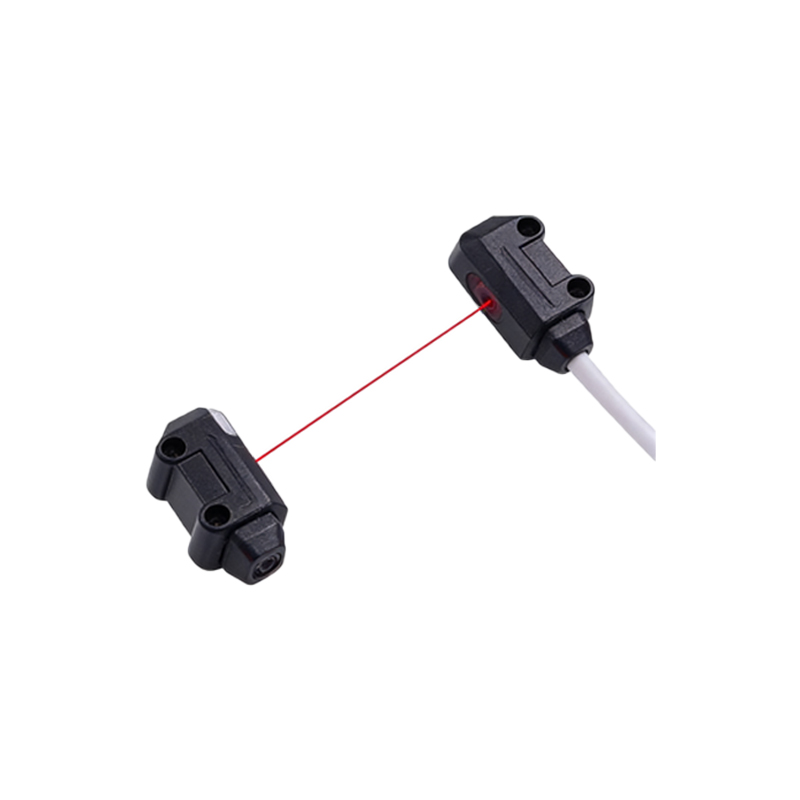
Through-beam sensors, also known as opposed-mode sensors, consist of two separate units: a transmitter and a receiver. The transmitter emits a continuous beam of light, which is aimed directly at the receiver unit. Detection occurs when an object physically interrupts this light beam, causing the receiver's signal to drop. This configuration offers the longest possible sensing range for photoelectric sensors, often exceeding 100 meters in ideal conditions. It is also highly reliable and less susceptible to environmental factors like target color, reflectivity, or surface finish, as it relies solely on beam interruption. Common applications include detecting large or opaque objects on high-speed conveyors, safety light curtains for personnel protection around hazardous machinery, and break-beam detection in material handling systems where consistent, long-range operation is critical.
Retroreflective Sensors
Retroreflective sensors house both the light emitter and receiver in a single housing. They operate by projecting a light beam towards a specialized reflector, often a corner-cube or tape reflector, which returns the beam directly back to the receiver. An object is detected when it blocks this reflected beam. This design simplifies installation compared to through-beam sensors, as only one device needs wiring and alignment, and the reflector is a passive component. Sensing ranges are shorter than through-beam but longer than diffuse sensors. A key feature is the use of polarized filters to prevent false triggers from shiny objects. The emitter's light is polarized in one direction, and the receiver has a filter polarized at a 90-degree angle. The reflector depolarizes the light, allowing it to pass through the receiver's filter, while light reflected directly from a glossy object remains polarized and is blocked, ensuring accurate detection.
Diffuse Reflective Sensors
Diffuse reflective sensors, or proximity-mode sensors, also integrate the emitter and receiver into one unit. However, they detect objects based on the diffuse reflection of light from the target's surface itself. The sensor emits light, and if an object is present within its sensing field, a portion of the scattered light is reflected back to the receiver. Detection is highly dependent on the object's size, color, and surface texture; light-colored, matte surfaces reflect better than dark, shiny ones. Sensing distances are typically the shortest among the three main types. These sensors are ideal for applications where mounting a reflector is impractical, such as detecting objects on varying backgrounds, close-range presence detection, or distinguishing between different colored labels or materials. Advanced versions include background suppression and fixed-field models that use triangulation to detect objects only within a precise, defined distance, ignoring more distant backgrounds.
Specialized Photoelectric Sensor Variants
Beyond the core types, several specialized photoelectric sensors address niche industrial challenges. Fiber optic sensors use flexible light guides to transmit light to and from a remote sensing head, allowing detection in extremely tight spaces, high-temperature zones, or areas with high electromagnetic interference. Color sensors differentiate between colors by analyzing the reflected light's wavelength composition, crucial for sorting and quality control. Luminescence sensors detect the presence of markings, such as invisible UV inks, by exciting and measuring fluorescent emissions. Contrast sensors detect the difference in contrast between a mark and its background, commonly used in label registration. Finally, distance-measuring sensors, using time-of-flight or triangulation principles, provide a continuous analog output proportional to the distance to the target, enabling precise positioning and dimension checking.
Key Selection Criteria and Applications
Selecting the appropriate photoelectric sensor requires careful analysis of the application parameters. Key factors include sensing range, required response time, target characteristics (size, material, color), environmental conditions (ambient light, dust, moisture, temperature), and required output type (PNP/NPN, analog, IO-Link). Through-beam sensors excel in long-range, harsh, or dirty environments. Retroreflective sensors offer a good balance of range and ease of installation. Diffuse sensors provide versatile, short-range detection without additional hardware. In practice, photoelectric sensors are ubiquitous. They count bottles in packaging lines, verify part presence in assembly robots, control stack height in palletizing, ensure correct web tension in printing, and provide edge guidance in CNC machines. Their versatility and reliability make them a fundamental technology for achieving precision, efficiency, and automation in the industrial landscape.