Introduction to Inductive Proximity Sensors
Inductive proximity sensors are fundamental, non-contact detection devices widely utilized in industrial automation. They operate on the principle of electromagnetic induction to detect the presence or absence of metallic objects within their sensing range. The core component is a coil wound around a ferrite core, which forms part of an oscillator circuit. When an alternating current flows through this coil, it generates an alternating electromagnetic field in front of the sensor face. When a metallic target enters this field, eddy currents are induced on the target's surface. These eddy currents draw energy from the oscillator, leading to a reduction in the oscillation amplitude. This change is detected by the sensor's circuitry, which subsequently triggers a solid-state output switch. This robust operating principle makes them exceptionally reliable for harsh industrial environments, immune to factors like dust, oil, and moisture that often plague optical or capacitive sensors. Their primary function is position sensing, but they are also crucial for counting, speed monitoring, and part verification on assembly lines.
Key Technical Characteristics and Advantages
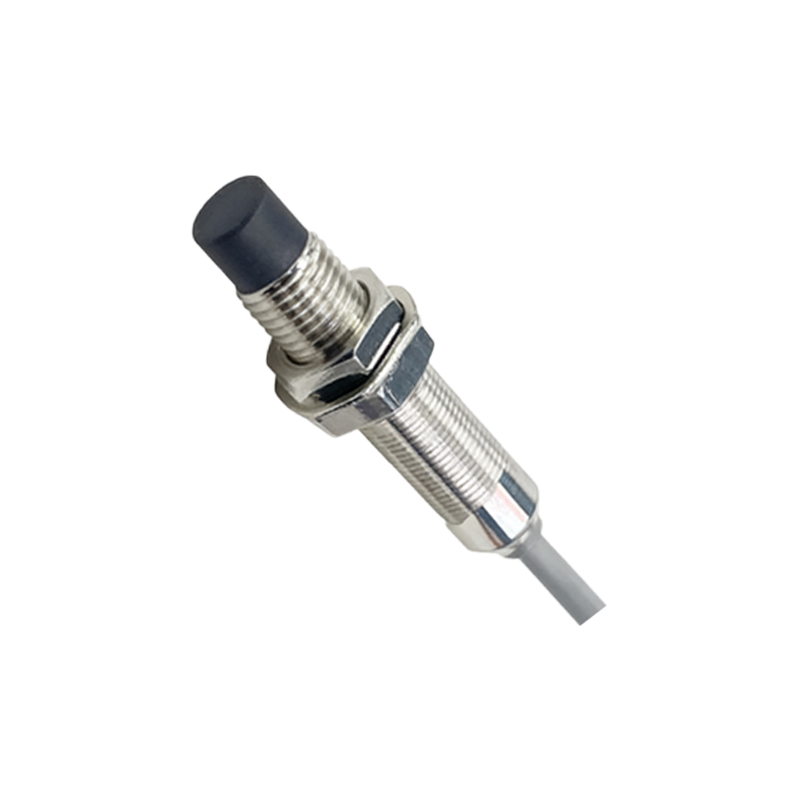
The performance of an inductive proximity sensor is defined by several critical parameters. The sensing distance, or nominal range (Sn), is specified for a standard target, typically a square of mild steel. It is crucial to note that this range varies with different metals; for instance, the effective sensing distance for stainless steel or aluminum is often reduced, requiring a correction factor. Another vital characteristic is the repeat accuracy, which refers to the sensor's ability to consistently detect a target at the same point. High-quality sensors offer excellent repeatability, often within microns, ensuring precise machine control. These sensors are celebrated for their exceptional durability. With no moving parts and a hermetically sealed sensing face, they withstand severe mechanical shock, vibration, and exposure to coolants or cutting fluids. Their switching frequency, or response speed, is extremely high, allowing them to detect objects moving at very high speeds, which is essential in modern high-cycle automation. Furthermore, they are inherently self-contained, requiring no separate amplifier in standard two-wire or three-wire DC configurations, simplifying installation and reducing system complexity.
Common Output Types and Wiring Configurations
Inductive proximity sensors are available with various output configurations to interface seamlessly with Programmable Logic Controllers (PLCs) and other control systems. The two primary families are DC and AC/DC sensors. DC sensors are predominant in factory automation and come in three main wiring types. Two-wire sensors are directly connected in series with the load, simplifying installation but often having a higher residual current when off. Three-wire sensors are the most common, offering separate connections for power supply, ground, and the switched output signal (either NPN sinking or PNP sourcing). The choice between NPN and PNP is critical and depends on the PLC input module's design. Four-wire sensors combine both a Normally Open (NO) and a Normally Closed (NC) contact in one device, providing wiring flexibility. AC/DC-widerange sensors can operate on a broad voltage spectrum, from 20V to 250V AC/DC, making them versatile for legacy systems or specific applications. The output switching element is typically a solid-state transistor (for DC) or a triac (for AC), ensuring a long operational life with hundreds of millions of switching cycles.
Material and Form Factor Considerations
The physical construction of an inductive sensor is tailored to its application. The housing is usually made of nickel-plated brass, stainless steel, or rugged PBT/PS plastic, offering varying degrees of resistance to chemicals and mechanical impact. The sensing face is a critical area, often made of a specialized plastic composite that allows the magnetic field to pass through while protecting the internal coil. For welding applications, sensors are equipped with weld-field immunity, featuring housings and face materials that resist spatter adhesion and are shielded from the strong magnetic interference generated by welding equipment. Form factors are highly diverse. Standard cylindrical models (e.g., M8, M12, M18, M30 threaded barrels) are ubiquitous for general-purpose mounting. Rectangular or block-style sensors offer a longer sensing range in a compact package. Slot-style or ring-style sensors are designed for specific tasks like detecting the teeth of a gear for speed measurement. The selection of the correct form factor, material, and mounting style is essential for reliable operation and integration into the machine design.
Application Examples Across Industries
The versatility of inductive proximity sensors makes them indispensable across virtually every manufacturing sector. In automotive assembly, they verify the presence of engine blocks on pallets, count pistons on a conveyor, and confirm the closed position of robotic grippers. In metalworking and CNC machining