Introduction to Retro-Reflective Sensing
Retro-reflective photoelectric sensors, often called reflex sensors, are a cornerstone of industrial automation. They operate on a simple yet effective principle: the sensor unit houses both an emitter (typically an LED) and a receiver. The emitter projects a beam of light towards a specialized reflector, which returns the light directly back to the receiver along the same path. An object breaking this beam path triggers the sensor's output. This design offers a significant advantage over through-beam sensors by requiring wiring and power on only one side of the detection area, simplifying installation and reducing cost. The core challenge in this setup is ensuring that the receiver reliably detects only the light reflected from the dedicated reflector and ignores stray ambient light or reflections from shiny background objects. This is where advanced optical designs, particularly those involving convergent beams, become critical.
The Role of the Convergent Beam (Focused Beam)
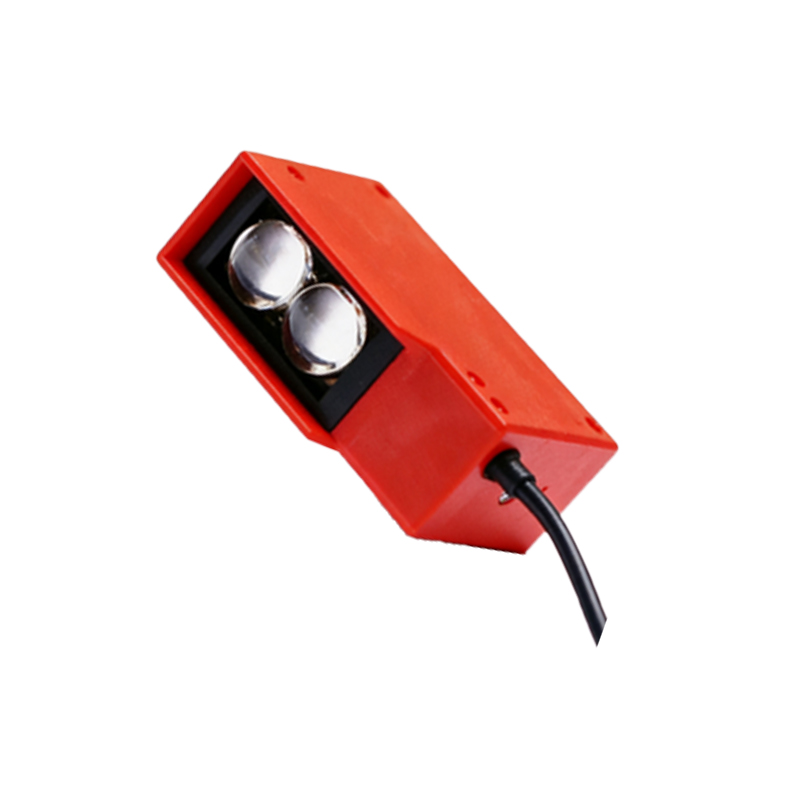
A standard diffuse or retro-reflective sensor emits a beam that diverges as it travels. This can lead to detection inaccuracies, especially with small objects or at longer ranges. The convergent beam, or focused beam, technology addresses this by using a lens system to focus the emitted light into a narrow, precise beam at a specific "focal point" or "beam waist." This focused spot is where the beam is at its smallest diameter and highest intensity. In a retro-reflective configuration, the sensor is carefully aligned so that this focal point coincides with the position of the retro-reflector. The returning light from the reflector follows the same focused path back to the receiver lens, which is also tuned to this specific focal distance. This precise optical alignment drastically improves signal stability and sensing reliability.
Overcoming the Shiny Object Problem
One of the most persistent issues with standard retro-reflective sensors is false triggering caused by shiny objects, such as polished metal or glossy packaging. A shiny object can act like a mirror, reflecting the emitter's light directly into the receiver even when the object is not at the intended detection point, potentially causing an erroneous "no object" signal. Convergent beam technology is specifically engineered to mitigate this. Because the emitted light is tightly focused, it only forms a valid optical path when the reflector is positioned exactly at the predetermined focal point. A shiny object located elsewhere in the sensing field will not reflect the focused beam correctly back into the narrowly tuned receiver optics. The receiver lens is designed to accept light only from the precise path corresponding to the focal distance, effectively rejecting spurious reflections from shiny surfaces outside this critical zone.
Technical Advantages and Performance Metrics
The implementation of a convergent beam in retro-reflective sensors delivers measurable performance benefits. First, it enables a longer sensing distance compared to a standard divergent beam of the same power, as energy is concentrated rather than dispersed. Second, it provides superior detection accuracy for small objects, as the defined beam spot is smaller. Third, it enhances stability against environmental factors like dust or light fog, as the stronger, focused signal is less prone to attenuation. Key specifications to evaluate include the *focal distance* (the optimal sensing range), the *beam spot size* at that distance (indicating precision), and the *excess gain* (a measure of surplus light energy available to overcome contamination). Sensors with convergent beams often exhibit high excess gain values at their focal point, ensuring reliable operation in demanding conditions.
Application Scenarios in Industrial Automation
The robust performance of convergent beam retro-reflective sensors makes them ideal for specific challenging applications. They are extensively used in packaging machinery for detecting the presence of metallic foil lids, shiny labels, or transparent films on containers, where standard sensors would fail. In automotive assembly, they reliably detect polished car body parts or chrome components on conveyor lines. They are also crucial in material handling for precise positioning of pallets or metallic totes, and in electronic manufacturing for detecting the presence of small, reflective components like chips or connectors. Any application involving a reflective background or target, varying surface finishes, or requiring precise edge detection at a fixed distance is a strong candidate for this sensor type.
Installation and Alignment Best Practices
To fully leverage the capabilities of a convergent beam retro-reflective sensor, correct installation is paramount. The most critical step is precise alignment between the sensor head and the retro-reflector at the specified focal distance. Manufacturers often provide alignment aids like visible red laser beams or precise mechanical brackets. The sensor and reflector must be mounted securely to prevent vibration from misaligning the tight optical path. It is also essential to ensure the reflector is clean and free of damage, as scratches can scatter the focused beam. The sensing environment should be evaluated for potential optical interferents, such as highly reflective surfaces parallel to the beam path, which should be masked or angled away. Following the manufacturer's guidelines for mounting distance, alignment tolerance, and environmental ratings guarantees optimal performance and longevity.
Comparison with Other Sensing Modes
While powerful, convergent beam retro-reflective sensing is not a universal solution. It is important to contrast it with other photoelectric modes. Through-beam sensors offer the longest range and highest reliability for object detection but require separate emitter and receiver units on opposite sides. Diffuse (proximity) sensors detect objects without a reflector but have shorter ranges and are highly influenced by the object's color and surface texture. Standard retro-reflective sensors are cost-effective for general-purpose use but struggle with shiny objects. The convergent beam variant sits in a specialized niche, providing the single-sided convenience of retro-reflective sensing while adding the precision and shiny-object immunity typically associated with fine-tuned through-beam systems, albeit within a defined focal range.
Future Trends and Technological Developments
The evolution of retro-reflective sensors with convergent beams continues alongside advancements in industrial IoT and smart sensing. Future trends include the integration of advanced diagnostics via IO-Link communication, allowing sensors to report parameters like received light intensity, lens contamination levels, and operating temperature. This enables predictive maintenance. Furthermore, improvements in LED technology and lens design are yielding sensors with even smaller beam spots and multiple programmable focal points for flexible application. The development of background suppression algorithms within the sensor's circuitry, combined with convergent optics, promises even greater immunity to complex reflective backgrounds. As factories demand higher precision and reliability, these intelligent, focused optical sensors will remain vital components in the automation toolkit.