The Heart of Automation: Defining the Modern Proximity Sensor
At the core of countless industrial automation systems lies a critical, yet often unseen, component: the proximity sensor. These non-contact devices detect the presence or absence of an object within their sensing field, triggering vital actions in machinery. The manufacturing of these sensors is a precise symphony of engineering, materials science, and rigorous quality control. A leading proximity sensor manufacturing plant is not merely an assembly line; it is a hub of technological innovation where reliability and precision are engineered into every unit. From inductive sensors detecting metals to capacitive sensors for non-metals, and ultrasonic variants for distance measurement, the production process is tailored to meet diverse and demanding industrial applications.
Precision from the Start: The Cleanroom and SMT Assembly
The journey begins in a controlled environment. High-grade electronic components, including specialized oscillator ICs, coils, and amplifiers, arrive at the factory. The most critical phase for the sensor's printed circuit board (PCB) assembly occurs in a dedicated cleanroom area. Here, state-of-the-art Surface Mount Technology (SMT) lines place microscopic components onto PCBs with micron-level accuracy. Automated optical inspection (AOI) systems immediately scan each board, identifying any soldering defects or misaligned parts. This stage is paramount, as the performance, sensitivity, and long-term stability of the sensor are directly determined by the quality of this electronic heart. The assembled PCBs then proceed through conformal coating processes to protect against moisture, dust, and chemical contaminants prevalent in industrial settings.
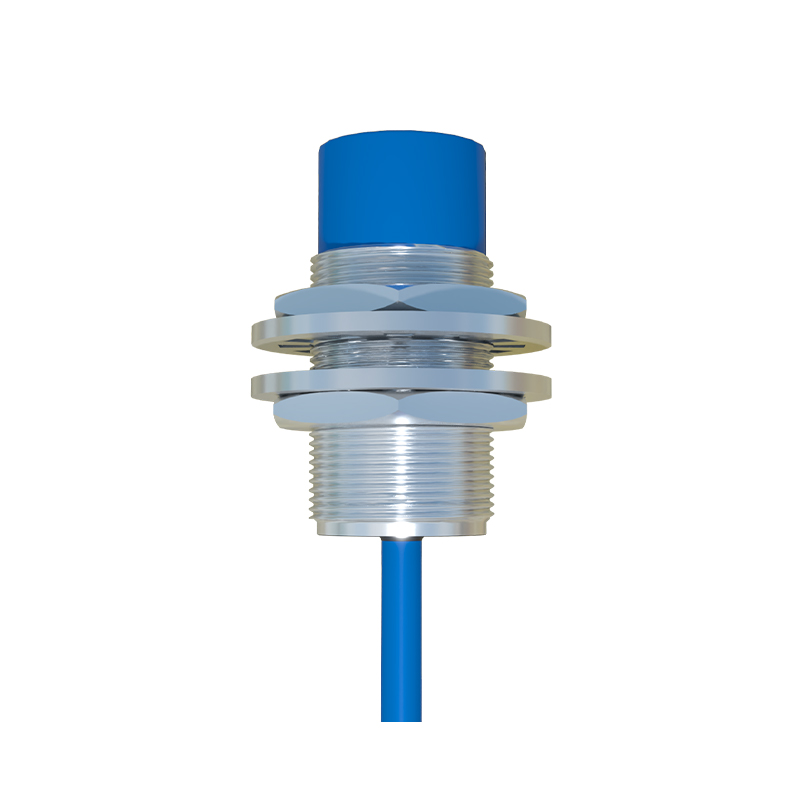
Forging the Sensing Face: Housing and Core Assembly
Concurrently, the sensor's rugged exterior is taking shape. High-performance engineering plastics, such as PBT or PVDF, are injection-molded into durable housings rated for IP67 or higher. These housings are designed to withstand extreme temperatures, physical impacts, and exposure to coolants or oils. For inductive sensors, a ferrite core is precisely wound with copper wire to create the sensing coil, a process often automated for consistency. The coated PCB is then meticulously integrated into the housing. Critical steps involve potting or encapsulating the internal electronics with epoxy resin. This process not only provides exceptional mechanical stability and shock resistance but also ensures optimal thermal management and complete environmental sealing, guaranteeing the sensor's integrity in harsh factory floors.
The Calibration Crucible: Tuning for Peak Performance
Once assembled, every single proximity sensor must undergo a rigorous calibration and testing regimen. This is where manufacturing transforms into precision tuning. Sensors are placed on automated test benches that simulate real-world conditions. Key parameters such as sensing distance, repeat accuracy, hysteresis, and switching frequency are measured and adjusted. For instance, an inductive sensor's oscillator circuit is fine-tuned to achieve its nominal sensing range (e.g., 8mm for an M18 sensor) with a tolerance often within 5%. Advanced test systems use certified reference targets and temperature chambers to verify performance across the entire operating temperature range, from -25°C to 70°C. Only units that pass all electrical and functional tests proceed to the next stage.
Endurance Proving Grounds: Environmental and Lifecycle Testing
Quality assurance extends far beyond functional calibration. Batch samples from every production run are subjected to destructive and endurance testing in a dedicated laboratory. These tests include thermal shock cycling, prolonged exposure to high humidity, salt spray tests for corrosion resistance, and vibration tests simulating years of operation on heavy machinery. Electrical endurance testers cycle the sensors millions of times to validate the predicted mechanical lifespan. This relentless validation process ensures that the sensors leaving the factory are not just working but are built to deliver fail-safe operation for years, minimizing downtime in customer applications. This commitment to over-testing is a hallmark of a top-tier manufacturer.
Smart Manufacturing and Traceability
A modern proximity sensor plant is deeply integrated with Industry 4.0 principles. Laser engraving systems mark each sensor with a unique data matrix code containing its serial number, type, and production data. This code enables full traceability throughout the supply chain and the sensor's lifecycle. Production data from every stage—SMT, assembly, calibration, and final test—is logged into a Manufacturing Execution System (MES). This allows for real-time monitoring of production quality, yield rates, and quick root-cause analysis should any anomaly be detected. The final packaging process is also automated, with sensors sorted, labeled, and packed according to global customer requirements, ready to ship and become the reliable "eyes" of automation systems worldwide.