Introduction to Inductive Proximity Sensors
Inductive proximity sensors are fundamental, non-contact electronic devices widely utilized in industrial automation for detecting the presence or absence of metallic objects. Operating on the principle of electromagnetic induction, these sensors generate an oscillating electromagnetic field from a coil located at their sensing face. When a metallic target enters this field, eddy currents are induced within the target, causing a change in the oscillation amplitude. This change is detected by the sensor's internal circuitry, which subsequently triggers a solid-state output switch. Renowned for their robustness, reliability, and high switching frequency, inductive sensors are indispensable in harsh environments where mechanical wear, dirt, oil, or vibration would compromise other sensing technologies. Their ability to function without physical contact ensures a long operational life and minimal maintenance, making them a preferred choice for countless applications from machine tools and material handling to automotive assembly lines.
Core Operating Principles and Technology
The efficacy of an inductive proximity sensor hinges on its sophisticated yet elegant operating principle. At its heart is an LC resonant oscillator circuit, where 'L' represents the inductance of the coil and 'C' the capacitance. This circuit creates a high-frequency electromagnetic field that radiates from the ferrite core at the sensor's active surface. The key parameter is the "switching distance" or nominal sensing range (Sn), which is defined for a standard target—typically a square of mild steel (Fe360) with a thickness equal to the sensor's diameter. When a conductive metal object enters this field, energy is absorbed to generate eddy currents, leading to a dampening of the oscillations. A subsequent evaluation circuit monitors this damping. Once the damping exceeds a predefined threshold—corresponding to the object being within the sensing range—the output state changes. Modern sensors incorporate advanced microprocessors for precise evaluation, offering features like temperature compensation, immunity to electromagnetic interference (EMI), and programmable switching hysteresis to prevent signal chatter.
Key Selection Criteria for Optimal Performance
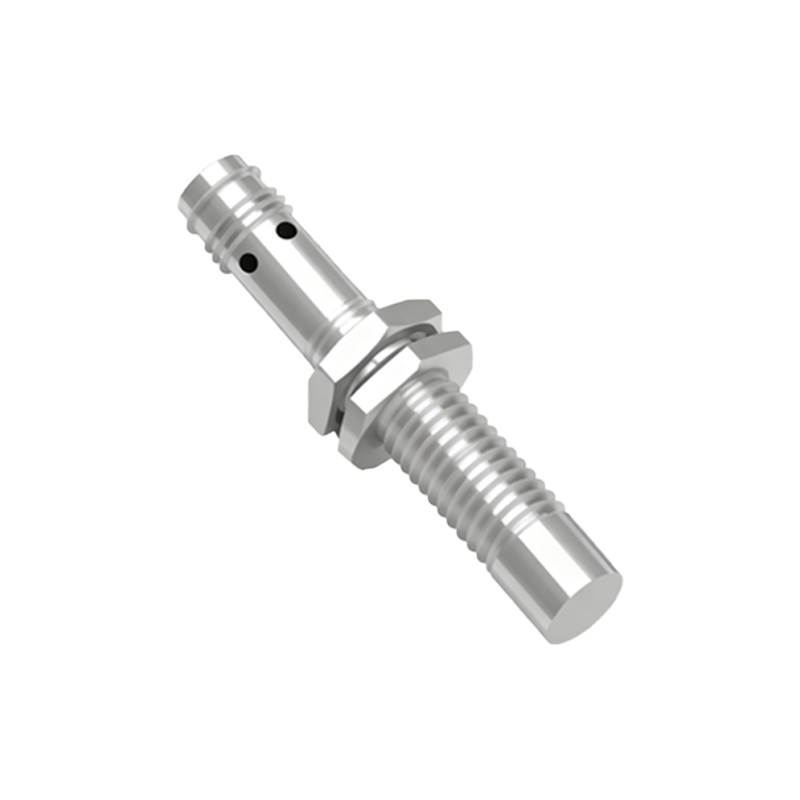
Selecting the right inductive sensor is critical for system reliability. Engineers must consider several technical parameters beyond just the sensing distance. First is the target material; while all metals can be detected, the effective sensing range varies. For instance, steel typically provides 100% of the nominal range, stainless steel about 85-90%, and non-ferrous metals like aluminum or copper only 30-50%. The sensor's housing material (e.g., nickel-plated brass, stainless steel, or PBT plastic) must be chosen based on the environmental conditions, including exposure to chemicals, washdowns, or extreme temperatures. The electrical output type (NPN/PNP, NO/NC) must match the control system's input card requirements. Other vital factors include the switching frequency (for high-speed applications), protection class (IP67/IP69K for dust and water ingress), and the presence of built-in diagnostics like LED status indicators or IO-Link communication for Industry 4.0 connectivity, which enables parameter setting, condition monitoring, and predictive maintenance.
Advanced Features and Specialized Variants
The evolution of inductive technology has led to specialized sensors catering to niche applications. Factor-1 sensors, for example, offer the same sensing range regardless of the target's material (ferrous or non-ferrous), simplifying installation and inventory. Cylindrical miniature sensors (e.g., M5, M8, M12) are essential in space-constrained robotic grippers. High-temperature variants, with sensing heads capable of withstanding over 200°C, are deployed in foundries or welding processes. Analog output sensors provide a continuous voltage or current signal proportional to the distance to the target, enabling precise positioning tasks. Furthermore, weld-field immune models are specifically designed to ignore the strong magnetic fields generated by resistance welding, preventing false triggering. The integration of IO-Link, a point-to-point serial communication protocol, transforms standard sensors into smart devices, allowing for remote configuration, real-time process data access, and seamless integration into digital twin environments.
Application Best Practices and Installation Guidelines
Proper installation is paramount to achieving the stated performance and longevity. A primary consideration is the "flush-mounting" capability. Shielded (flush-mountable) sensors can be installed embedded in metal without affecting their sensing range, as their magnetic field is concentrated axially. Unshielded sensors have a longer range but require a non-metallic surround, as their field extends laterally. Adequate clearance must be maintained between multiple sensors to prevent mutual interference. The sensing face should be kept clean from accumulations of metallic swarf or conductive dust, which can cause a permanent signal or reduced range. For dynamic applications, engineers must ensure the target approaches the sensor perpendicular