Introduction to Photoelectric Sensors
Photoelectric sensors are indispensable components in modern industrial automation, playing a critical role in object detection, positioning, and quality control. These devices operate on the principle of converting light signals into electrical signals. A typical photoelectric sensor consists of a light source (emitter), a photodetector (receiver), and associated signal processing circuitry. The emitter projects a beam of light, which is then either received directly, reflected, or modulated by the target object. The receiver detects this light and the processing electronics interpret the change to produce a usable output signal, such as a switch closure or a voltage change. Their non-contact nature, high speed, and reliability make them superior to mechanical switches for countless applications, from packaging lines and material handling to safety systems and consumer electronics.
Classification by Sensing Method
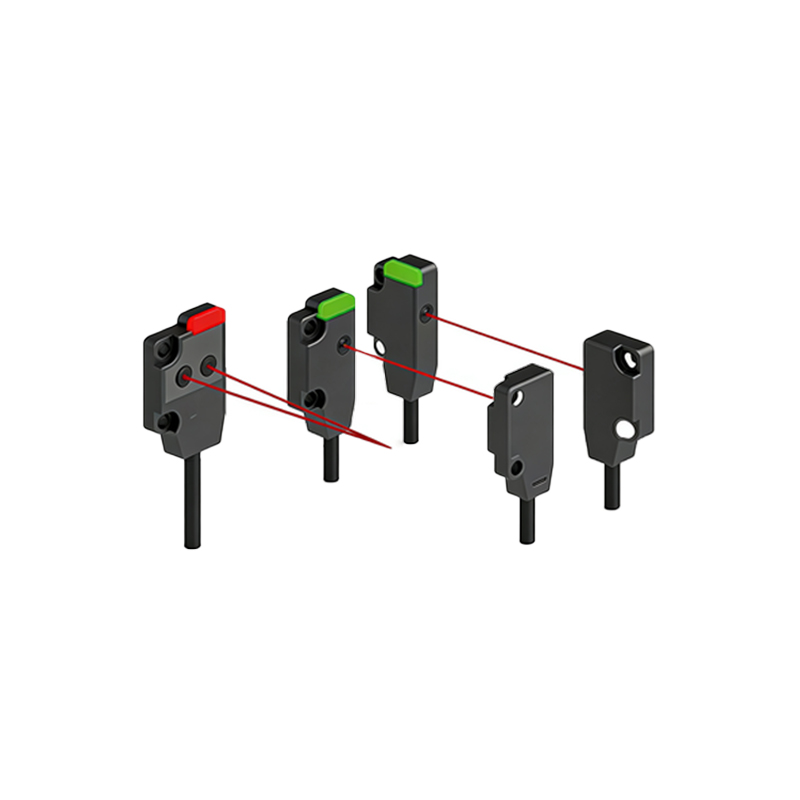
The primary classification of photoelectric sensors is based on their operational sensing method, which defines how the light beam travels between the emitter and receiver. The three fundamental types are through-beam, retro-reflective, and diffuse reflective sensors. Through-beam sensors, also known as opposed-mode sensors, feature separate, opposing units for the emitter and receiver. The object is detected when it interrupts the direct beam. This method offers the longest sensing range and highest reliability, as it is largely immune to the object's color, texture, or reflectivity. Retro-reflective sensors house both emitter and receiver in a single housing. They rely on a reflector, typically a corner-cube reflector, to bounce the beam back. Detection occurs when an object blocks this reflected beam. They offer a good balance of range and installation simplicity. Diffuse reflective sensors, or proximity-mode sensors, also have a combined emitter and receiver. They detect an object by the light diffusely reflected from the object's own surface. The sensing distance is shorter and depends heavily on the object's color and surface properties, but they require no separate reflector, simplifying setup.
Classification by Light Source Type
The type of light source used is another key differentiator, impacting sensing range, precision, and application suitability. Light Emitting Diodes (LEDs) are the most common, favored for their long life, low cost, and compact size. Red LEDs are standard for general-purpose sensing. Infrared LEDs are used for covert detection or in environments with ambient light interference. Recent advancements have brought high-performance blue LEDs, which are excellent for detecting transparent objects or specific colors due to their shorter wavelength. Laser diodes represent another category, producing a highly focused, coherent beam. They enable extremely precise detection over very long distances and are used in precision positioning and measurement applications. Finally, some specialized sensors may use modulated white light for true color recognition tasks, though these are less common in standard industrial sensing.
Classification by Output Configuration
The electrical output of a photoelectric sensor defines how it interfaces with control systems like PLCs (Programmable Logic Controllers). Digital output sensors are the most prevalent, providing a simple ON/OFF signal. They come in several sub-types: NPN (sinking) and PNP (sourcing) outputs for DC sensors, which define the current flow direction, and relay or triac outputs for AC sensors. Analog output sensors provide a continuous signal, such as 0-10V or 4-20mA, proportional to the received light intensity or the distance to the target. These are used in applications requiring measurement or grayscale analysis, like monitoring transparency or detecting fill levels. A more advanced category is the IO-Link sensor, which is a digital sensor with a point-to-point serial communication protocol. IO-Link sensors not only provide switch status but also allow bidirectional communication for parameter setting, diagnostics, and process data transmission, enabling Industry 4.0 connectivity.
Classification by Special Function and Housing
Beyond the basic types, photoelectric sensors are further classified by specialized functions designed for challenging environments or specific tasks. Background suppression sensors are a sophisticated type of diffuse sensor that uses triangulation to detect objects only within a precise, defined range, ignoring objects and surfaces beyond it, regardless of color. This is crucial for consistent detection on conveyor belts. Fiber optic sensors utilize flexible fiber optic cables to guide light to and from a remote amplifier unit. The sensing head can be extremely small and is ideal for high-temperature, high-vibration, or space-constrained locations. Contrast sensors are designed to detect differences in contrast or color marks on surfaces, essential in printing and labeling. Furthermore, sensors are categorized by housing material and design, such as cylindrical metal housings (M12, M18, M30 threads) for rugged environments, rectangular plastic housings for cost-effective solutions, and specialized hygienic housings with smooth surfaces for washdown in food & beverage or pharmaceutical industries.
Selection Criteria and Conclusion
Selecting the appropriate photoelectric sensor requires a systematic evaluation of several application parameters. The primary considerations are the required sensing distance, the size and characteristics of the target object (including color, material, and surface finish), the required response speed, and the environmental conditions (presence of dust, moisture, ambient light, or temperature extremes). The sensing method is chosen first based on range and object properties. The light source type is then selected for precision or environmental compatibility. The output configuration must match the control system's input card specifications. Finally, special functions like background suppression or specific housing ratings (IP67, IP69K) are considered for demanding applications. Understanding these classification methods empowers engineers to specify the optimal sensor, ensuring robust, reliable, and efficient operation within complex automated systems, thereby maximizing productivity and minimizing downtime.