Introduction to Slot-Type Photoelectric Sensors
A slot-type photoelectric sensor, often referred to as a through-beam sensor or a fork sensor, is a fundamental component in industrial automation and control systems. Its primary function is to detect the presence, absence, or position of an object by utilizing a beam of light. Unlike other photoelectric sensor configurations, the slot-type design integrates both the light emitter (typically an LED) and the light receiver (a phototransistor or photodiode) within a single U-shaped or fork-shaped housing. This housing features a precise gap or "slot" through which objects pass. This integrated, opposed arrangement is the defining characteristic that offers unique advantages in reliability and ease of installation, making it a preferred choice for countless applications where precise object detection is critical.
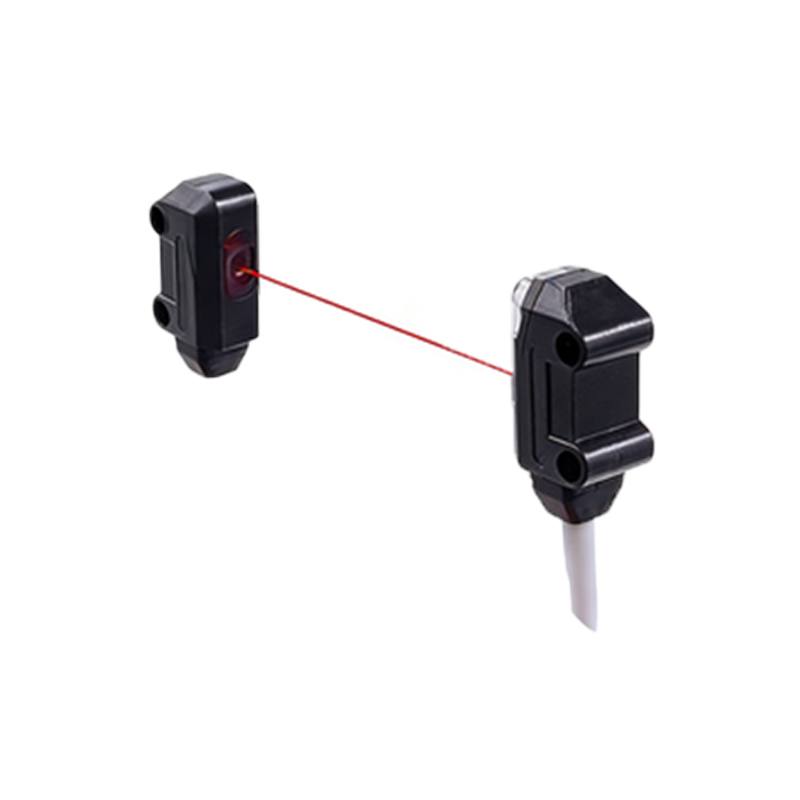
Core Operating Principle
The fundamental principle is straightforward. The emitter on one side of the slot continuously projects a beam of light—often infrared, red, or laser—directly across the gap to the receiver on the opposite side. The receiver circuit is designed to monitor the intensity of this received light. When the slot is clear, the light beam reaches the receiver uninterrupted, maintaining the sensor's output in its normal state (either "ON" or "OFF," depending on the logic design). When an object passes through the slot, it physically interrupts or attenuates the light beam. This change in light intensity is instantly detected by the receiver, which then triggers a change in the sensor's electrical output signal. This signal transition is used by a connected controller, such as a PLC, to register an event, like counting a part, verifying a label, or initiating the next step in a process.
Internal Components and Light Sources
The key internal components are the light source and the photodetector. Modern slot sensors predominantly use Light Emitting Diodes (LEDs) as light sources due to their long life, low heat generation, and fast response times. Infrared LEDs are very common as they are less susceptible to interference from ambient visible light. Red visible LEDs are also used, providing the benefit of a visible beam for easier alignment during setup. For high-precision applications requiring a very narrow, collimated beam, laser diodes are employed. The receiver is a semiconductor device like a silicon phototransistor, which converts the incoming light photons into a proportional electrical current. The sensor's electronics then condition this signal, often incorporating amplifiers, comparators, and output drivers to provide a clean, stable switch signal immune to electrical noise.
Output Types and Logic Modes
Slot sensors provide discrete digital outputs to interface with control systems. The two main types are NPN (sinking) and PNP (sourcing) transistor outputs, compatible with different PLC input card standards. Furthermore, they operate in specific logic modes: Light-ON or Dark-ON. In Light-ON mode (also called "normally closed"), the output is active (ON) when the receiver is receiving light (slot is clear). When the beam is blocked, the output turns OFF. Conversely, in Dark-ON mode ("normally open"), the output is active only when the beam is blocked. The choice of mode depends on the safety and logic requirements of the application. For instance, a safety interlock might use Dark-ON logic so that a broken beam (indicating an obstruction) activates an alarm or stops a machine.
Key Advantages Over Other Sensor Types
The slot-type configuration offers several distinct benefits. First, because the emitter and receiver are pre-aligned in a fixed housing, installation is simple and maintenance-free; there is no need for tedious optical alignment as with separate emitter-receiver pairs. This built-in alignment ensures consistent, reliable operation and high resistance to vibration. Second, the opposed-beam design provides a very sharp sensing boundary, resulting in high positional accuracy and repeatability. It can detect very small objects, down to sub-millimeter sizes, depending on the beam width. Finally, it is generally immune to the color, reflectivity, or surface finish of the target object, as it relies on beam interruption rather than reflection.
Common Industrial Applications
The applications for slot-type photoelectric sensors are vast across manufacturing and packaging. They are extensively used for object counting on conveyor lines, detecting the presence of components in assembly machines, and verifying the passage of items. In printing and labeling, they detect the leading edge of paper or the presence of a label. They serve as safety devices in automated doors to prevent closing on an object. In the electronics industry, they are crucial for verifying the presence of semiconductor chips on tape-and-reel carriers. Their ability to detect transparent objects, like glass or plastic films, by refracting the light beam makes them invaluable in related industries.
Selection Considerations and Installation Tips
Selecting the right sensor involves several parameters. The slot width and depth must accommodate the size and travel path of the target object. The required sensing resolution dictates the choice of light source (standard LED vs. laser). The response time must be fast enough for the application's speed. Environmental factors are critical; sensors may require ruggedized housings (IP67 rating) for washdown areas or resist chemicals. During installation, ensure the object passes cleanly through the center of the slot. Keep the lens surfaces clean from dust, oil, or debris that could attenuate the beam. For critical applications, models with an alignment indicator (often an LED) are recommended to confirm proper beam reception during setup.
Conclusion
In summary, the slot-type photoelectric sensor is a robust, precise, and easy-to-use solution for object detection. Its principle of operation—based on the interruption of a fixed, opposed light beam—provides reliability that is often superior to reflective or diffuse-mode sensors. By understanding its core principles, output logic, and application strengths, engineers and technicians can effectively integrate these sensors to enhance automation system performance, improve quality control, and ensure operational safety in a wide array of industrial environments.