Introduction to Micro Photoelectric Sensors
Micro photoelectric sensors are compact, highly efficient devices that detect the presence, absence, or distance of objects using a light transmitter and receiver. Their miniaturized design allows for integration into space-constrained applications without compromising performance. Operating on the principle of converting light signals into electrical outputs, these sensors are fundamental to automation, offering non-contact detection with high speed and precision. The core components typically include an LED or laser diode as the light source and a phototransistor or photodiode as the receiver. Their robustness against environmental factors like dust or vibration, depending on the model, makes them indispensable in modern industrial settings, from intricate assembly lines to harsh manufacturing environments.
Through-Beam Sensors
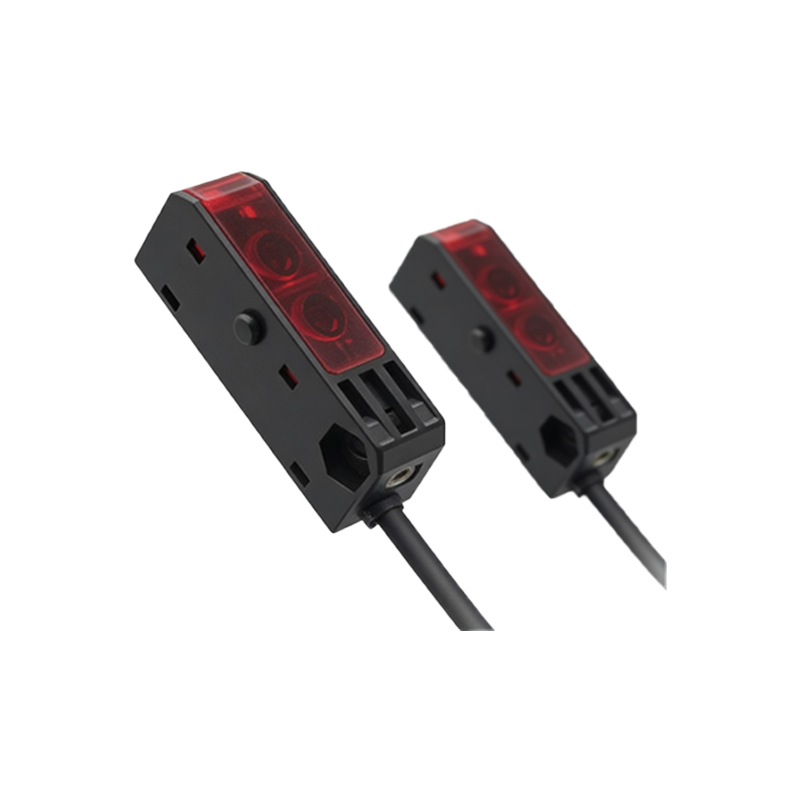
Through-beam sensors, also known as opposed-mode sensors, consist of separate, aligned transmitter and receiver units. The transmitter emits a continuous or modulated light beam directly to the receiver. An object is detected when it interrupts this beam. This configuration provides the longest sensing range and highest excess gain among photoelectric sensors, making it highly reliable for detecting opaque objects even in the presence of dirt or fog. Common applications include object counting on high-speed conveyors, break detection in material processing, and safety curtains on automated machinery. Their primary advantage is unwavering reliability, though installation requires precise alignment of two separate components.
Retro-Reflective Sensors
Retro-reflective sensors house both the transmitter and receiver in a single housing. They operate by directing a light beam towards a specialized reflector, such as a corner-cube reflector, which sends the beam directly back to the receiver. Detection occurs when an object blocks this reflected beam. These sensors offer a simpler installation process than through-beam types, as only one device and a reflector need to be mounted. They are ideal for detecting objects at moderate distances. A key feature is the ability to ignore shiny objects through polarization filters, which prevent false triggers from surfaces that might otherwise reflect light like the target reflector.
Diffuse Reflective Sensors

Diffuse reflective sensors, or proximity-mode sensors, also integrate the emitter and receiver into one unit. They detect an object when the emitted light reflects off the object's surface and scatters back to the receiver. This design allows for the simplest installation, requiring only a single device. However, sensing distance is shorter and can be influenced by the color, texture, and reflectivity of the target object. Advanced versions use background suppression technology or fixed-field teaching to define a precise sensing range, ignoring objects beyond a set distance. These sensors are widely used for presence detection, bottle filling level control, and robotic end-effector positioning.
Fiber Optic Photoelectric Sensors
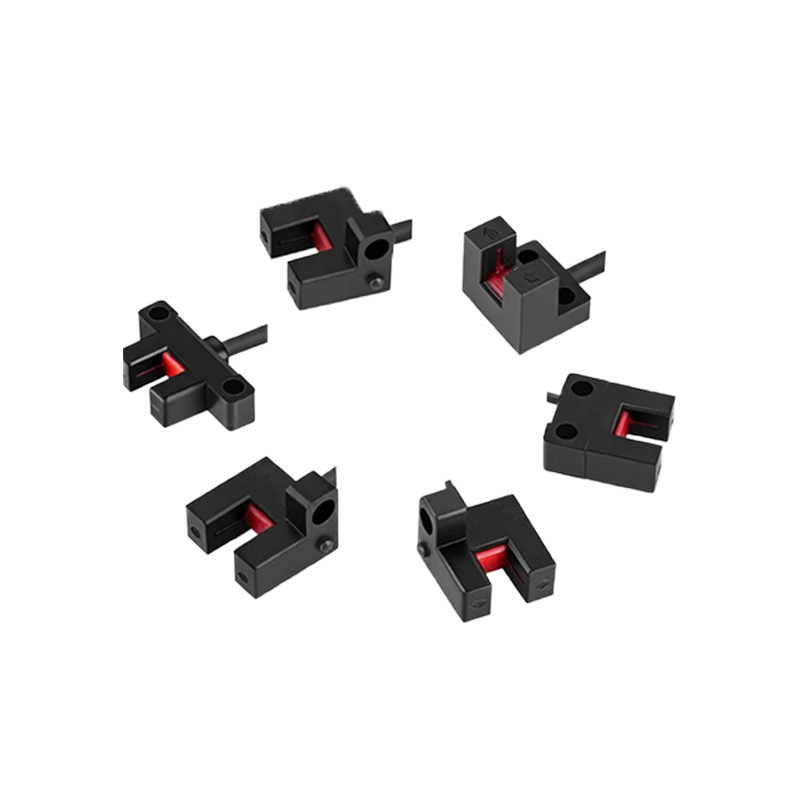
Fiber optic photoelectric sensors utilize flexible fiber optic cables to guide light to and from a remote amplifier unit. This design allows the sensing head to be extremely small, capable of fitting into tight spaces, high-temperature zones, or areas with strong electromagnetic interference. The amplifier, containing the actual light source and processing circuitry, can be mounted in a more protected location. These sensors are perfect for detecting minute objects, such as electronic components, or for use in hostile environments like welding cells or cleanrooms. They are available in through-beam, retro-reflective, and diffuse reflective versions, offering versatility for specialized micro-detection tasks.
Laser Sensor Variants
Micro photoelectric sensors employing laser diodes offer significant advantages in precision. They emit a highly focused, visible or invisible laser beam, enabling the detection of very small objects, precise edge detection, and accurate distance measurement. Laser sensors are often used in diffuse or through-beam modes. Their coherent light allows for stable detection over longer distances and on low-reflectivity surfaces. Applications include wafer alignment in semiconductor manufacturing, precise assembly verification in electronics, and high-accuracy dimensioning systems. Safety classifications (e.g., Class 1, Class 2) are crucial considerations for laser-based devices to ensure eye safety in the workplace.
Key Selection Criteria and Industry Applications
Selecting the appropriate micro photoelectric sensor requires analyzing several parameters: sensing distance, object size and material, required response speed, environmental conditions (dust, moisture, temperature), and output type (PNP/NPN, analog, IO-Link). In the electronics industry, they place components on PCBs. In packaging, they ensure label presence and carton sealing. Automotive assembly lines rely on them for robot guidance and part verification. The food and beverage sector uses them for fill-level control and packaging inspection. Their miniaturization and evolving smart features, like diagnostic data via IO-Link, continue to drive efficiency and enable new levels of automation in Industry 4.0 applications.