Introduction to Photoelectric Sensor Operation
Photoelectric sensors are fundamental components in industrial automation, utilizing a light beam to detect the presence, absence, or distance of an object. Their operation hinges on the interplay between an emitter, which projects light, and a receiver. When the emitted light beam is interrupted or reflected by a target object, the sensor's internal circuitry triggers a change in its output state. This output is what interfaces with control systems like PLCs (Programmable Logic Controllers), and it is precisely at this junction that the concepts of Normally Open (NO) and Normally Closed (NC) contacts become critical. Understanding the function and selection of these contact configurations is essential for designing safe, reliable, and efficient automated systems.
Defining Normally Open (NO) Contact Functionality
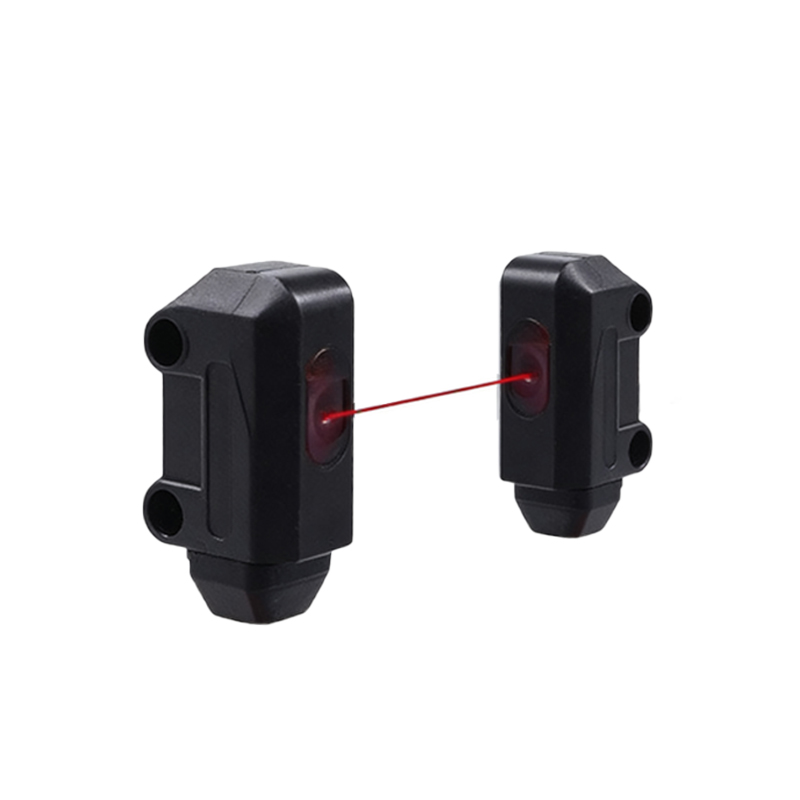
A photoelectric sensor with a Normally Open (NO) contact, also referred to as a "make" contact, is designed so that its output circuit is open (non-conducting) when the sensor is in its normal, non-activated state. In this context, "normal" typically means the condition where the sensor's light beam is uninterrupted and no target object is detected within its sensing range. The output switch is off. When a target object is detected—that is, when the beam is broken or reflected to the receiver—the sensor activates and closes its output circuit. The NO contact "makes" the connection, allowing current to flow to the connected load, such as turning on an indicator lamp, starting a motor, or sending a signal to a PLC input. This configuration is intuitive and widely used for standard detection tasks, such as counting objects on a conveyor or initiating an action upon part presence.
Defining Normally Closed (NC) Contact Functionality
Conversely, a photoelectric sensor with a Normally Closed (NC) contact, or a "break" contact, operates in the opposite manner. In its normal, non-activated state (beam uninterrupted), the NC output circuit is closed (conducting). Current flows freely to the connected load. When the sensor detects a target object and activates, it opens the output circuit, breaking the connection and stopping the current flow. This configuration is less intuitive initially but serves vital purposes, primarily related to safety and fail-safe design. An NC contact is often employed in safety monitoring applications, such as guarding a light curtain on a machine. If the beam is broken (indicating an intrusion), the circuit opens, triggering an immediate stop.
Comparative Analysis and Application Scenarios
The choice between NO and NC is not merely a preference but a strategic decision based on system requirements. NO contacts are typically selected for standard operational logic where an action is initiated upon detection. For instance, in packaging, an NO sensor detects a box and triggers the tape dispenser. NC contacts, however, are paramount for safety-critical functions and fail-safe conditions. Consider a sensor monitoring the position of a safety guard. Using an NC configuration, if the sensor itself fails, or if its wiring is cut, the circuit will open (mimicking an activation state) and signal a fault, causing the machine to halt safely. This is known as a "fail-safe" design. If an NO contact were used for the same guard, a wire break could go undetected, leaving the machine operational despite an open guard—a dangerous scenario.
Wiring Considerations and Circuit Design
Implementing NO and NC contacts requires careful attention to wiring and the logic of the control system. Most modern programmable photoelectric sensors offer a selectable output mode, allowing the user to configure the same physical output terminal as either NO or NC via a switch or software. The wiring to the load (e.g., a PLC input module) remains physically identical; the difference is in the logical behavior. In a PLC program, an input from an NC sensor will appear as "true" or "1" when the sensor is *not* activated (circuit closed). The programmer must account for this inverted logic. For simple relay-based controls, the choice of NO or NC will directly determine whether a relay coil is energized or de-energized in the normal state, impacting the design of the entire control sequence.
Selecting the Right Configuration for Your System
The selection process should begin with a risk assessment and a clear definition of the "normal" state for the application. Ask key questions: What should happen during a sensor failure, power loss, or wire break? If the safe state is to stop a process, an NC configuration is often mandatory. For non-critical event triggering, an NO configuration is usually simpler and more direct. Industry standards and safety regulations (like ISO 13849) often dictate the use of NC contacts for safety-related parts of control systems. Furthermore, in complex systems, a combination of both NO and NC outputs from different sensors or even from a single sensor with multiple outputs can create robust interlock and monitoring logic, enhancing both functionality and safety.
Conclusion and Best Practices
In summary, the distinction between Normally Open and Normally Closed contacts in photoelectric sensors is a cornerstone of effective industrial control design. NO contacts provide straightforward, action-initiated control, while NC contacts are indispensable for implementing fail-safe logic and meeting safety standards. The best practice is to default to NC for any function where an undetected fault could lead to an unsafe condition. Always consult machine safety guidelines and thoroughly document the chosen configuration in electrical schematics and PLC code comments. By mastering the application of NO and NC contacts, engineers ensure that automated systems are not only intelligent and efficient but also fundamentally safe and reliable.