Introduction to Photoelectric Sensors
Photoelectric sensors are versatile devices widely used in industrial automation for detecting the presence, absence, or distance of objects. They operate by emitting a light beam, typically from an LED or laser diode, and measuring changes in the received light due to reflection, absorption, or interruption. These sensors offer high precision, fast response times, and non-contact operation, making them essential in manufacturing, packaging, and safety systems. Their reliability in harsh environments, such as those with dust or vibration, has cemented their role in modern electrical engineering. Understanding their classification is key to selecting the right sensor for specific applications, from simple object detection to complex positioning tasks.
Through-Beam Photoelectric Sensors
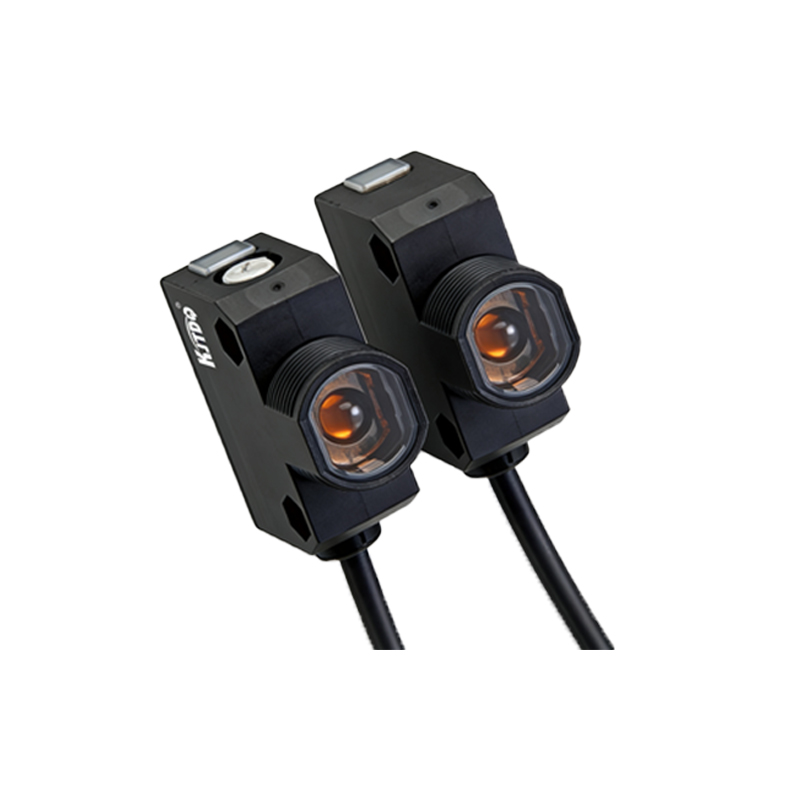
Through-beam sensors, also known as opposed-mode sensors, consist of separate emitter and receiver units placed opposite each other. The emitter projects a continuous light beam to the receiver. An object is detected when it interrupts this beam, causing a drop in the received light intensity. This configuration provides the longest sensing range and highest reliability among photoelectric sensors, as it is less affected by object color, texture, or reflectivity. Common applications include counting items on conveyor belts, detecting large objects in material handling, and ensuring safety in automated machinery by creating light curtains. Diagrams typically show the emitter and receiver aligned, with an object breaking the beam path.
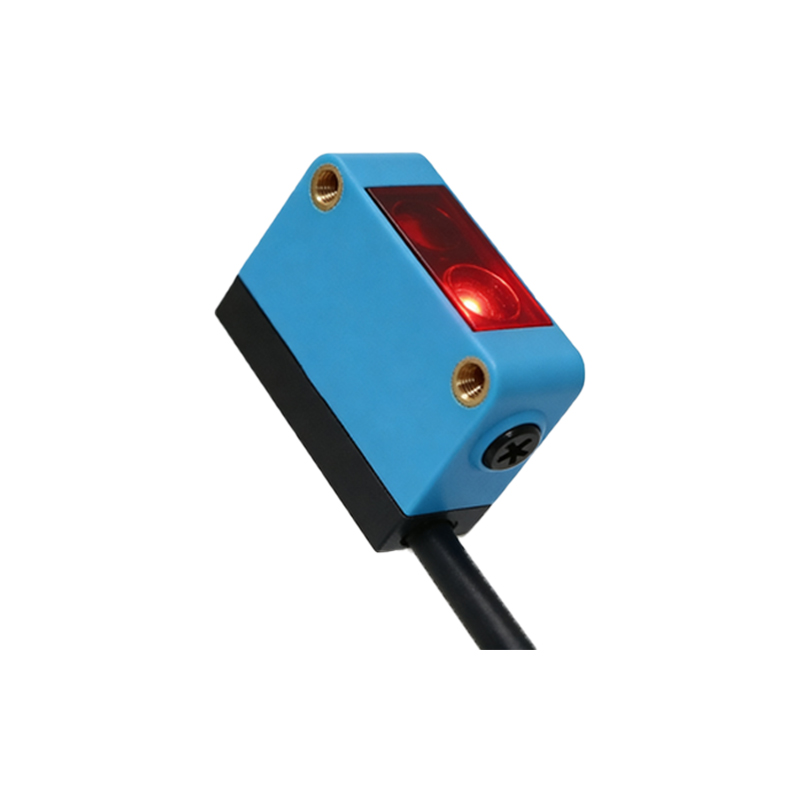
Retroreflective Photoelectric Sensors
Retroreflective sensors integrate the emitter and receiver into a single housing, using a reflector (such as a prism or tape) to bounce the light beam back. When an object passes between the sensor and reflector, it blocks the reflected beam, triggering detection. These sensors offer a moderate sensing range and are easier to install than through-beam types since only one unit needs wiring. They are ideal for detecting transparent or shiny objects, but may require polarization filters to avoid false triggers from direct reflections. Typical uses include packaging line control, door monitoring, and presence sensing in assembly stations. Diagrams illustrate the light path from the sensor to the reflector and back, with an object obstructing it.
Diffuse Reflective Photoelectric Sensors
Diffuse reflective sensors, or proximity-mode sensors, have the emitter and receiver in one unit but detect objects by measuring light reflected directly off the target's surface. The sensor emits a beam, and when an object is within range, some light scatters back to the receiver. This type is compact and suitable for short-range detection, but performance can vary with object color, material, and orientation—lighter objects reflect more light, enabling longer ranges. Applications include detecting items on shelves, robotic picking systems, and level sensing in containers. Diagrams show the emitted beam hitting an object and diffusing back to the receiver, with detection based on reflectance intensity.
Background Suppression Sensors
Background suppression sensors are a specialized subset of diffuse reflective sensors that use triangulation or focused optics to ignore reflections from distant backgrounds. They detect objects only within a precise range, ignoring anything beyond a set distance. This makes them excellent for distinguishing objects against cluttered backgrounds or varying surfaces, such as in logistics or automotive assembly. Diagrams often depict the sensor emitting a beam that reflects off an object at a specific angle, with background reflections being filtered out. These sensors enhance accuracy in tasks like part positioning and edge detection.
Fiber Optic Photoelectric Sensors
Fiber optic photoelectric sensors separate the sensing head from the amplifier unit using flexible fiber optic cables. The emitter and receiver functions are handled via fibers, allowing detection in tight spaces, high-temperature areas, or hazardous environments. They come in through-beam, retroreflective, and diffuse types, with diagrams showing light transmission through fibers to a sensing point. Applications include micro-part detection in electronics, monitoring in chemical plants, and medical device automation. Their small size and immunity to electromagnetic interference make them versatile for niche industrial needs.
Laser-Based Photoelectric Sensors
Laser-based sensors use a focused laser beam instead of standard LED light, providing high accuracy, long range, and precise spot sizing. They are classified under through-beam, retroreflective, or diffuse types but with enhanced capabilities. Diagrams highlight the narrow, coherent laser beam for tasks like alignment, thickness measurement, or small object detection. Common in semiconductor manufacturing and precision engineering, these sensors offer superior performance in low-light or high-ambient-light conditions.
Color Mark Sensors
Color mark sensors are diffuse reflective sensors tuned to detect specific colors or contrasts by analyzing reflected light wavelengths. They emit red, green, or blue light and compare the reflection to a reference, making them ideal for printing, labeling, and packaging industries. Diagrams show the sensor targeting a colored mark on a moving web, with detection based on color differentiation. They ensure quality control in processes where color registration is critical.
Ultrasonic and Photoelectric Hybrid Sensors
While not purely photoelectric, hybrid sensors combine photoelectric and ultrasonic technologies for enhanced detection in challenging scenarios, such as transparent objects or dusty environments. Diagrams may illustrate dual sensing paths, with photoelectric beams for surface detection and ultrasonic waves for distance measurement. These are used in complex automation systems where single-technology sensors fall short.
Selection Guidelines and Applications
Choosing the right photoelectric sensor depends on factors like sensing range, object properties, environmental conditions, and cost. Through-beam sensors suit long-range, reliable detection; retroreflective types offer ease of installation; diffuse sensors are compact for proximity sensing; and specialized variants address unique needs. Diagrams in this section often compare classifications side-by-side, aiding engineers in decision-making. Applications span from simple presence detection in warehouses to advanced robotics in smart factories, underscoring their importance in electrical engineering. Regular maintenance, such as lens cleaning and alignment checks, ensures optimal performance. As Industry 4.0 evolves, photoelectric sensors continue to integrate with IoT for real-time monitoring and data analytics.