Introduction to Reflective Photoelectric Sensors
Reflective photoelectric sensors are widely used in industrial automation for detecting the presence, absence, or distance of objects without physical contact. These sensors operate by emitting a light beam, typically infrared or visible light, from an integrated light source. When this beam strikes a target object, it reflects back to a receiver within the same sensor housing. The receiver then processes the reflected light to determine the object's status. A key aspect of their functionality lies in their output configuration, which is categorized as either normally open (NO) or normally closed (NC). Understanding the distinction between NO and NC is crucial for proper sensor selection, circuit design, and system safety in applications ranging from packaging machinery to conveyor systems and safety interlocks. The choice impacts how the sensor interacts with control systems like PLCs (Programmable Logic Controllers) and the overall logic of the automated process.
Defining Normally Open (NO) Output
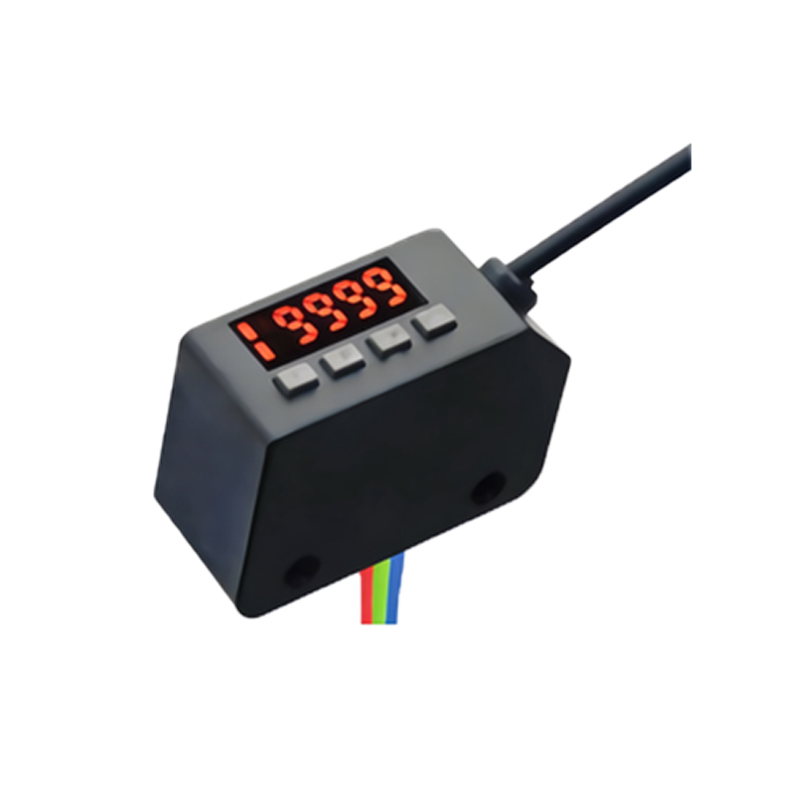
A reflective photoelectric sensor with a normally open (NO) output is designed such that its output switch is in an "open" or non-conducting state when no target object is present within its sensing range. In this idle condition, the electrical circuit is broken, and no signal (or a low-level signal) is sent to the connected control device. When a target object enters the sensing field and reflects sufficient light back to the receiver, the sensor activates. This activation causes the internal switch to close, completing the circuit and allowing current to flow. The output then switches to a "high" or "on" state, sending a signal (e.g., 24V DC) to indicate detection. NO configurations are often intuitive for "presence detection" logic, where an event is triggered by the arrival of an object. For instance, in a bottling line, an NO sensor detecting a bottle might signal a filler to start.
Defining Normally Closed (NC) Output
Conversely, a reflective photoelectric sensor with a normally closed (NC) output operates in the opposite manner. In its default state with no target detected, the internal switch is "closed" or conducting. This means the circuit is complete, and the sensor continuously sends a signal (e.g., a voltage) to the control system. When a target object is detected and reflects light to the receiver, the sensor activates and causes the internal switch to open. This breaks the circuit, stopping the output signal and changing it to a "low" or "off" state. NC configurations are fundamentally linked to safety and fail-safe design principles. They are preferred in applications where a break in the sensing beam or a sensor failure should trigger an alarm or halt a process to prevent hazards.
Key Operational Differences and Circuit Behavior
The core difference lies in the default electrical state and the response to detection. An NO sensor is "off" until it sees an object, then turns "on." An NC sensor is "on" until it sees an object, then turns "off." This directly influences the wiring and the logic programmed into the controller. In a typical two-wire DC sensor connected in series with a load, an NO type will not allow current to pass until activated. An NC type will allow current to pass until activated. For three-wire sensors (with separate power, ground, and output wires), the output wire will either supply voltage (sourcing) or sink current (sinking) depending on the model and NO/NC configuration. Understanding this behavior is essential to avoid short circuits or logic errors in the control panel.
Application Scenarios: Choosing NO or NC
The selection between NO and NC is driven by application requirements, particularly safety and logic simplicity. Normally Open outputs are commonly used in standard counting, positioning, and general object detection tasks where the process action is initiated by object presence. For example, detecting a box on a conveyor to start a labeling arm. Normally Closed outputs are critical in safety monitoring, error detection, and jam prevention. A classic application is in safety light curtains or area guards; if the beam is broken (object detected), the NC output opens, sending a stop signal to a machine. NC is also used in fault detection—if a sensor fails or loses power, the signal is lost, which can be programmed as a fault condition, enhancing system reliability.
Safety and Fail-Safe Considerations
In industrial environments, fail-safe design is paramount. A normally closed configuration is often mandated for safety-related functions because it provides a higher level of inherent safety. In an NC circuit, any failure that causes an open circuit—such as a wire break, sensor malfunction, or loss of power—mimics the "object detected" state. This will typically trigger a safe shutdown of equipment. With an NO circuit, the same failures (open circuit) result in no signal, which the control system might interpret as "no object present," allowing a dangerous machine to continue operating. Therefore, for emergency stops, guard door monitoring, or critical process interlocks, NC outputs are the standard choice to ensure a failure leads to a safe condition.
Interfacing with Control Systems (PLCs)
When connecting to a Programmable Logic Controller (PLC), the sensor's NO/NC state must align with the ladder logic or function block programming. A PLC digital input card reads the sensor's signal. For an NO sensor, the input becomes active (TRUE or 1) when an object is detected. For an NC sensor, the input is normally active (TRUE or 1) and becomes inactive (FALSE or 0) upon detection. Programmers can easily invert the logic in software, but the physical wiring and expected behavior must be consistent. Using an NC sensor for a safety interlock and wiring it to a dedicated safety input module is a common practice. This allows the system to distinguish between a normal stop (object detection) and a fault condition (wire break).
Conclusion and Selection Guidelines
In summary, the choice between normally open and normally closed for a reflective photoelectric sensor is not merely a preference but a strategic decision affecting functionality, safety, and system integrity. For standard detection tasks where action is based on presence, NO outputs offer straightforward logic. For applications where safety, fault detection, and fail-safe operation are priorities, NC outputs are indispensable. Always consult the sensor datasheet, as some modern programmable sensors allow the output mode (NO/NC) to be configured via a switch or software, offering greater flexibility. Ultimately, aligning the sensor's output behavior with the process requirements and safety standards ensures a robust and reliable automation solution.