Introduction to S524 Slot Type Photoelectric Sensors
The S524 slot type photoelectric sensor represents a critical component in modern industrial automation and control systems. As a through-beam sensor variant, it features a compact U-shaped housing that integrates both the light emitter and receiver in a single unit, separated by a precise air gap or "slot." This design allows for the detection of objects passing through this gap by interrupting the transmitted light beam. Engineered for reliability and precision, the S524 model is specifically tailored for applications requiring non-contact detection of small objects, precise edge guidance, or presence verification in constrained spaces. Its robust construction typically ensures resistance to environmental factors such as dust, ambient light interference, and minor mechanical vibrations, making it a versatile choice for diverse industrial settings from packaging and material handling to assembly and robotics.
Key Technical Specifications and Operating Principles
Operating on the principle of modulated infrared or visible red light, the S524 sensor emits a focused beam from one side of the slot to the opposing receiver. The internal circuitry is designed to detect a sudden drop in received light intensity, triggering a digital output signal—typically NPN or PNP transistor-based. Key specifications often include a sensing slot width of a few millimeters, a response time in the microsecond range, and a supply voltage compatible with standard DC industrial power sources (e.g., 12-24V DC). Many models feature a built-in sensitivity adjustment potentiometer, allowing engineers to fine-tune the detection threshold to ignore background noise or transparent objects. The optical system is precisely aligned during manufacturing to ensure a consistent and narrow beam, enabling the detection of very small objects like thin wires, PCB leads, or tiny mechanical parts with high repeatability.
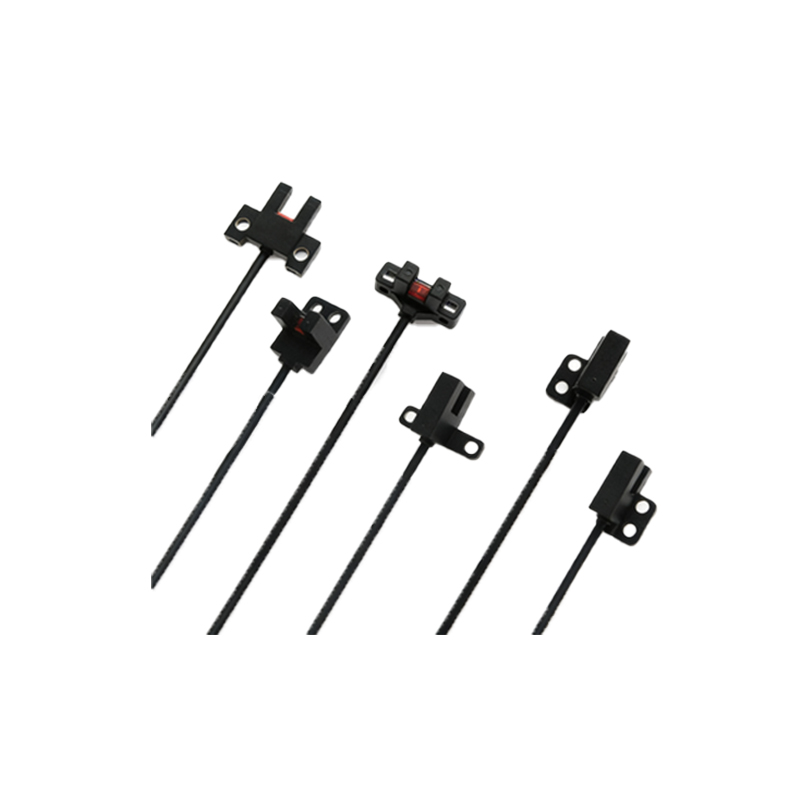
Advantages Over Other Sensor Types
Compared to diffuse-reflective or retro-reflective photoelectric sensors, the slot-type design of the S524 offers distinct benefits. The primary advantage is its immunity to variations in object color, reflectivity, or surface texture. Since detection relies solely on beam interruption, a black, shiny, or transparent object will be sensed as reliably as a white one, provided it is opaque enough to block the beam. This eliminates calibration hassles associated with reflective sensors. Furthermore, the fixed, short sensing distance across the slot minimizes the risk of false triggers from background objects, a common issue with diffuse sensors. The compact, integrated housing simplifies installation, requiring only a single mounting point and wiring connection, unlike separate emitter-receiver through-beam setups that need precise alignment and double the cabling.
Typical Industrial Application Scenarios
In practice, the S524 finds extensive use across automation lines. A common application is in printer and copier mechanisms for detecting paper jams or verifying the presence of paper at critical feed points. In textile machinery, it monitors thread breakage by sensing the thread running through the slot. Within electronic assembly, it counts or verifies the placement of small components on PCBs or detects the leading/trailing edges of tapes and labels. Packaging equipment utilizes these sensors to confirm the passage of product lids, caps, or small blister packs. Robotics integration is another key area, where the S524 provides precise feedback for gripper positioning or part presence in pick-and-place units. Its fast response time is crucial for high-speed counting and sorting tasks on conveyor systems.
Installation, Alignment, and Maintenance Best Practices
Proper installation is paramount for optimal performance. The sensor must be mounted securely to prevent misalignment due to vibration. The object path should be centered through the slot's opening, ensuring the target passes cleanly through the beam without grazing the inner walls. For detecting very fine objects like filaments, aligning the beam perpendicular to the object's direction of travel increases reliability. Electrical wiring should follow manufacturer guidelines, with attention to correct polarity, load matching, and the use of shielded cables in electrically noisy environments. Regular maintenance involves keeping the lens surfaces on both sides of the slot clean from dust, oil, or debris using a soft cloth and appropriate cleaner. Periodically checking the output signal stability with an oscilloscope or multimeter can preempt failures. Environmental considerations include avoiding direct exposure to strong ambient light sources facing the slot and ensuring operating temperatures remain within specified limits.
Troubleshooting Common Operational Issues
Several common issues can affect S524 sensor performance. Persistent false triggering is often caused by external light interference, which can be mitigated by adjusting the sensitivity, using a sensor with a modulated light source, or installing a protective shroud. Failure to detect objects may stem from lens contamination, incorrect sensitivity setting (too high), or an object that is too small or transparent for the beam wavelength. In such cases, cleaning the lenses, reducing the sensitivity, or selecting a sensor with a narrower beam slot may be necessary. Erratic output can indicate power supply instability, electrical noise, or a failing output transistor. Verifying stable supply voltage, ensuring proper grounding, and inspecting for loose connections are standard diagnostic steps. If the sensor's LED indicator behaves inconsistently with the output signal, internal component failure is likely, necessitating replacement.
Selection Criteria and Integration Considerations
Selecting the right S524 model requires analyzing application parameters. Critical factors include the minimum object size to be detected, which must be larger than the beam width at the slot's center; the required response speed, which must exceed the object's passage speed; and the output type (NPN sinking or PNP sourcing) to match the PLC or controller input card. The housing material (often ABS or metal) should be chosen based on the environmental exposure to chemicals, oils, or physical impact. For food-grade or washdown environments, stainless steel housing with IP67 ratings is advisable. Integration involves interfacing the output with control systems, often requiring pull-up resistors for NPN outputs or understanding the sink/source wiring diagrams. Designers should also account for the sensor's blind zones—the areas very close to the lenses where detection is unreliable—when positioning the sensor relative to the target path.
Future Trends and Technological Evolution
The evolution of slot type sensors like the S524 continues alongside Industry 4.0 trends. Future iterations are expected to incorporate IO-Link digital communication, enabling remote configuration, real-time diagnostics, and parameter setting changes directly from the control system. This facilitates predictive maintenance by monitoring parameters like internal temperature or lens contamination levels. Enhancements in LED technology may yield beams with sharper focus or alternative wavelengths for better detection of specific materials. Miniaturization will allow for even smaller slot widths to detect microscopic components in semiconductor manufacturing. Furthermore, integration with smart factory networks will allow these sensors to contribute data directly to manufacturing execution systems (MES), providing granular traceability and process optimization insights. The core reliability and simplicity of the slot-type principle ensure its enduring relevance, augmented by connectivity and intelligence.