Introduction to Photoelectric Sensors
Photoelectric sensors are fundamental components in industrial automation, utilizing light beams to detect the presence, absence, or distance of objects. These devices operate by emitting a light source—typically infrared, visible red, or laser—and measuring the reflected or interrupted light signal. Their versatility allows for applications across diverse sectors, including packaging, material handling, automotive assembly, and food processing. The core principle involves converting light energy into electrical signals, enabling precise control in automated systems. Understanding the various names and classifications of photoelectric sensors is crucial for engineers and technicians to select the appropriate model for specific operational requirements, ensuring optimal performance and reliability in harsh industrial environments.
Through-Beam Sensors
Through-beam sensors, also known as opposed-mode or beam-break sensors, consist of separate emitter and receiver units positioned opposite each other. The emitter projects a continuous light beam to the receiver. An object is detected when it interrupts this beam, causing a signal change. This configuration offers the longest sensing ranges among photoelectric types, often exceeding 100 meters, and provides high reliability because it is less affected by object surface properties like color, reflectivity, or angle. Common applications include detecting large objects on conveyor belts, monitoring door positions, and ensuring safety in hazardous areas. The primary advantage is its consistent performance, though installation requires precise alignment of two separate components, which can be more complex and costly.
Retroreflective Sensors
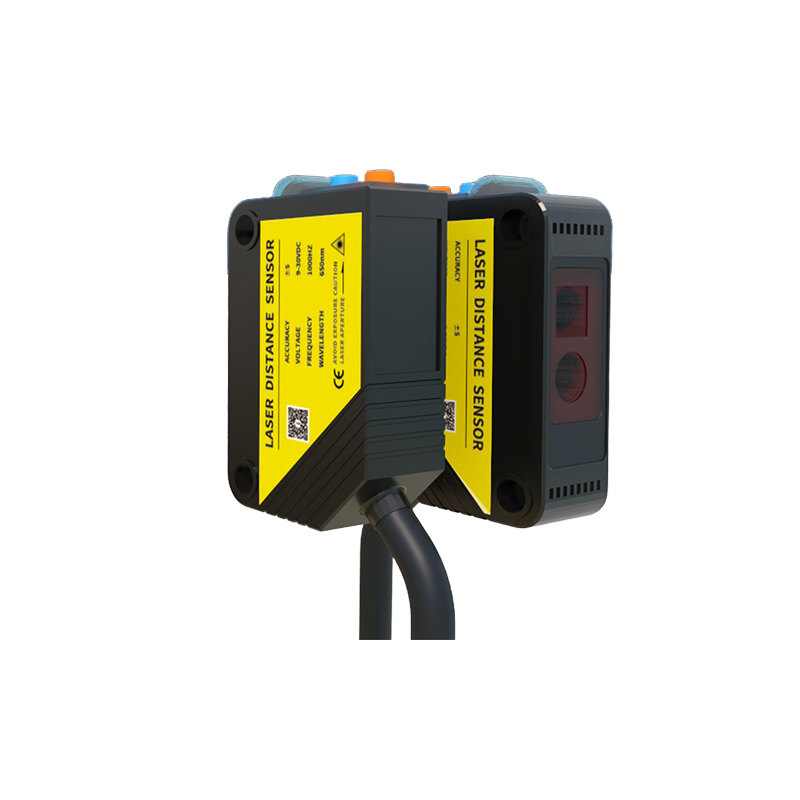
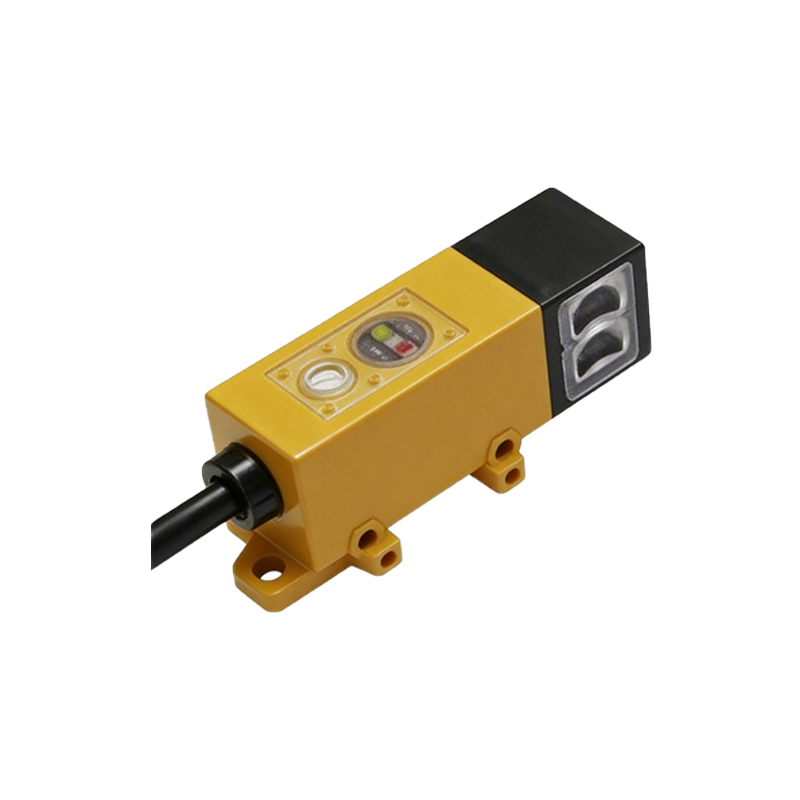
Retroreflective sensors, sometimes called reflex sensors, integrate both the emitter and receiver into a single housing. They operate by directing a light beam toward a specialized reflector, such as a corner-cube or tape reflector, which returns the light directly to the receiver. Detection occurs when an object blocks the beam path between the sensor and reflector. These sensors offer moderate sensing ranges, typically up to 10-15 meters, and simplify installation compared to through-beam types since only one unit needs wiring and mounting. They are ideal for detecting transparent or shiny objects, but may require filters to avoid false triggers from direct reflections. Industries frequently use them in packaging lines, elevator positioning, and palletizing systems where space is limited.
Diffuse Reflective Sensors
Diffuse reflective sensors, often referred to as proximity-mode or diffuse sensors, combine the emitter and receiver in one device and detect objects by measuring light reflected directly from the target's surface. The sensor emits a beam, and the receiver analyzes the scattered reflection. Sensing range is shorter, usually under 2 meters, and depends heavily on the object's color, texture, and reflectivity—lighter colors yield longer ranges. These sensors are cost-effective and easy to install due to their single-unit design, making them suitable for applications like detecting fill levels in containers, counting products on assembly lines, or identifying presence in robotic cells. However, they may struggle with dark or absorbent materials, requiring careful calibration.
Background Suppression Sensors
Background suppression sensors are a specialized subset of diffuse sensors designed to ignore reflections from distant backgrounds, focusing only on objects within a preset range. They utilize triangulation or time-of-flight principles to measure distance precisely, allowing detection based on position rather than reflectivity. Commonly named BGS sensors or distance-measuring sensors, they excel in applications where objects must be distinguished from backgrounds, such as detecting components on a conveyor belt against a wall or ensuring proper placement in machining centers. Their ability to ignore interfering surfaces reduces false readings, enhancing accuracy in complex environments like automotive manufacturing or logistics sorting.
Fiber Optic Photoelectric Sensors
Fiber optic photoelectric sensors employ flexible fiber optic cables to transmit light between the sensor amplifier and the sensing point. The amplifier contains the emitter and receiver electronics, while the cable guides light to and from the target area. These sensors are often called fiber optic sensors or light guides and are valued for their small sensing heads, which can access tight spaces, high resistance to electrical noise, and suitability in extreme temperatures or hazardous conditions. They come in through-beam, retroreflective, and diffuse versions, enabling detection in challenging setups like semiconductor fabrication, chemical processing, or medical device assembly. Their modular design allows customization but may involve higher initial costs.
Laser Photoelectric Sensors
Laser photoelectric sensors use a focused laser beam instead of standard LED light, providing high precision and long sensing ranges with minimal beam dispersion. They are termed laser sensors or laser measurement sensors and are ideal for detecting small objects, precise positioning, or measuring exact distances. The concentrated beam allows for accurate detection even in bright ambient light or over distances up to several hundred meters. Applications include alignment in printing machinery, thickness gauging in metal production, and quality inspection in electronics manufacturing. While offering superior performance, laser sensors require careful handling due to safety regulations and typically come at a premium price compared to conventional types.
Color Mark Sensors
Color mark sensors, also known as color registration or contrast sensors, are designed to detect specific color differences or marks on surfaces. They emit light and analyze the reflected wavelength to distinguish between colors or contrasts, such as black marks on white packaging. These sensors are critical in printing, labeling, and textile industries for ensuring accurate registration and quality control. They often include adjustable sensitivity to adapt to various materials and lighting conditions, providing reliable detection in high-speed production lines. By focusing on chromatic response, they enable automation tasks like cut-to-length operations or sorting based on color codes, enhancing efficiency in customized manufacturing processes.
Ultrasonic and Photoelectric Hybrid Sensors
While not purely photoelectric, hybrid sensors combine photoelectric and ultrasonic technologies to overcome limitations of each. These devices, sometimes called multi-technology sensors, use light for precise detection and ultrasound for penetrating dust, fog, or transparent materials. They offer versatility in challenging environments where traditional photoelectric sensors might fail, such as in dirty mining operations or detecting clear glass bottles. By integrating multiple sensing principles, they provide robust solutions for complex industrial tasks, though they may require advanced configuration and maintenance. Engineers often select them for applications demanding high reliability under variable conditions, like waste management or agricultural automation.
Conclusion and Selection Guidelines
The diversity in photoelectric sensor names—from through-beam to laser sensors—reflects their adaptability in modern industry. Key factors for selection include sensing range, environmental conditions (e.g., dust, moisture), target material properties, and installation constraints. For long-range, reliable detection, through-beam sensors are optimal; for compact spaces, diffuse or retroreflective types suffice; and for precision tasks, laser or background suppression sensors excel. Understanding these categories ensures efficient system integration, reduces downtime, and supports automation goals. As technology evolves, innovations like smart sensors with IO-Link connectivity continue to expand possibilities, making photoelectric sensors indispensable for Industry 4.0 advancements.