Laser sensors are a cornerstone of modern automation, measurement, and safety systems. Their ability to provide precise, non-contact detection and measurement makes them indispensable across numerous industries. Understanding the different types of laser sensors is crucial for selecting the right technology for a specific application. This guide explores the primary categories based on their operating principle and function.
One fundamental classification is based on the method of detection. Triangulation laser sensors are among the most common for precise distance and displacement measurement. They work by projecting a laser spot onto a target. The reflected light is focused onto a position-sensitive detector (like a CCD or PSD) at an angle. As the target's distance changes, the position of the reflected spot on the detector shifts. By calculating this shift through trigonometric principles, the sensor determines the exact distance. These sensors offer high resolution and accuracy for short to medium ranges and are widely used in quality control, wafer inspection, and part profiling.
In contrast, time-of-flight (ToF) laser sensors measure distance by calculating the time it takes for a laser pulse to travel to a target and back. The formula Distance = (Speed of Light × Time) / 2 is applied. These sensors are ideal for long-range measurements, from several meters to hundreds of meters. They are less precise than triangulation sensors over short distances but excel in applications like vehicle lidar (Light Detection and Ranging), aerial surveying, and bulk level measurement in large silos. Modern ToF sensors often use phase-shift measurement for improved accuracy at shorter ranges.
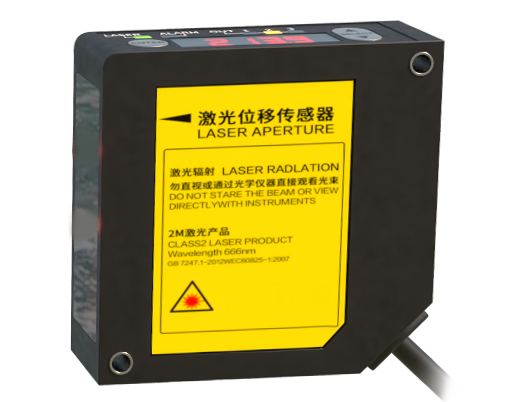
Another critical type is the laser contrast sensor. These are designed to detect differences in surface color, texture, or material. They evaluate the intensity of the reflected laser light. A dark mark on a light background, for instance, will reflect less light than the background itself. By setting a threshold, the sensor can reliably identify marks, labels, or material edges. They are essential in packaging, printing, and assembly line sorting tasks.
Laser profile sensors (or laser line scanners) extend the principle of triangulation from a single point to an entire line. They project a laser line onto a target and use a camera to capture the deformation of that line. This data is processed to create a detailed 2D or 3D profile of the object. This technology is powerful for inspecting cross-sectional dimensions, surface defects, weld seams, and for robotic guidance, providing a complete contour rather than just a single point measurement.

For applications requiring extreme precision in positioning or vibration analysis, laser interferometer sensors are used. They operate on the principle of interference between two laser beams: a reference beam and a measurement beam reflected from the target. Changes in the target's position cause shifts in the interference pattern (fringes), allowing for measurements with nanometer-level accuracy. These are primarily used in calibration labs, semiconductor manufacturing equipment, and precision machine tool alignment.
Beyond measurement, laser safety sensors form a vital category. These are often configured as safety light curtains or laser scanners. They create a two-dimensional protective field of infrared laser beams around hazardous machinery. If an object or person breaks this invisible field, a signal is immediately sent to stop the machine, preventing accidents. They are key components in robotic work cells, press brakes, and automated guided vehicles (AGVs) for area monitoring.
Choosing the right laser sensor depends on key parameters: required measurement range, accuracy, resolution, response speed, target surface properties (color, reflectivity), environmental conditions (dust, light interference), and of course, cost. For instance, a shiny metal surface might require a specialized sensor with diffuse reflection technology to avoid specular reflection errors, while a dusty warehouse environment would need a sensor with high resistance to ambient light.
From the factory floor to advanced research laboratories, the diversity of laser sensor technologies enables solutions for an ever-widening array of challenges. As technology advances, we see trends towards miniaturization, higher speeds, integrated intelligence (like built-in IO-Link communication), and multi-functional sensors that combine distance measurement with contrast detection or profile analysis in a single unit. This evolution continues to push the boundaries of what is possible in automation and precision engineering.