Introduction to Noise in Photoelectric Sensors
Photoelectric sensors are widely used in industrial automation, safety systems, and precision measurement due to their non-contact detection capabilities. However, their performance can be significantly degraded by various noise sources, which introduce unwanted signals that interfere with accurate sensing. Noise in these sensors arises from both internal components and external environmental factors, leading to reduced signal-to-noise ratios, false triggers, or missed detections. Understanding these noise sources is crucial for engineers to design robust systems and implement effective mitigation techniques. This article explores the primary noise types affecting photoelectric sensors, their origins, and practical strategies to minimize their impact.
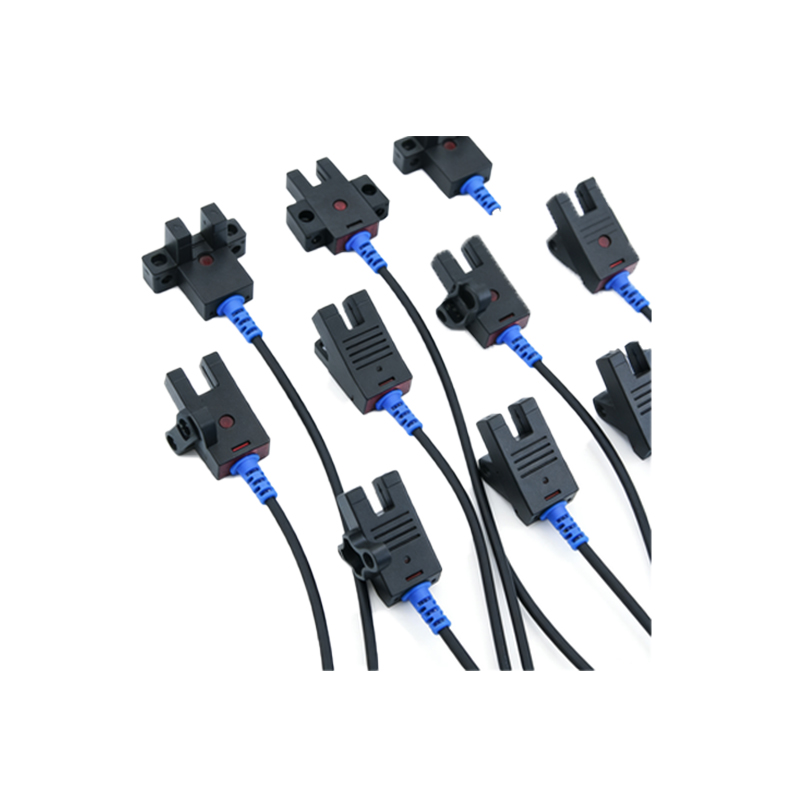
Shot Noise from Photodetectors
Shot noise is a fundamental quantum mechanical phenomenon inherent to photodetectors, such as photodiodes or phototransistors, within photoelectric sensors. It results from the discrete nature of charge carriers (electrons or holes) generated by incident light or thermal effects. Even under constant illumination, the random arrival of photons and subsequent carrier generation produces fluctuations in the output current. Shot noise follows a Poisson distribution, with its magnitude proportional to the square root of the signal current. In low-light conditions, shot noise becomes particularly dominant, limiting the sensor's sensitivity and accuracy. To reduce shot noise, engineers can increase the optical power (within safe limits), use cooled detectors to minimize thermal carrier generation, or employ signal averaging techniques over time.
Thermal Noise in Sensor Circuits
Thermal noise, also known as Johnson-Nyquist noise, originates from the random thermal motion of charge carriers in resistive components, such as amplifiers, resistors, and wiring in the sensor's electronic circuitry. This noise is present regardless of the applied voltage and increases with temperature and resistance. It manifests as a broadband white noise spectrum, affecting the sensor's output across all frequencies. In photoelectric sensors, thermal noise can obscure weak signals, especially in high-gain amplification stages. Mitigation strategies include selecting low-resistance components, minimizing circuit operating temperatures through heat sinks or cooling, and using low-noise amplifiers with optimized bandwidth. Additionally, operating sensors in controlled environments can help manage thermal fluctuations.
Ambient Light Interference
Ambient light interference is a common external noise source for photoelectric sensors, particularly in industrial settings with variable lighting conditions. Sunlight, fluorescent lamps, or other artificial light sources can introduce stray photons that reach the photodetector, causing signal distortion or saturation. This interference is especially problematic for sensors operating in the visible or near-infrared spectrum. To combat ambient light noise, engineers often employ modulated light sources (e.g., pulsed LEDs) with synchronous detection, which filters out constant or slowly varying light. Optical filters that match the sensor's emission wavelength can also block unwanted frequencies. Additionally, proper housing and shielding of the sensor can reduce exposure to external light.
Electrical and Electromagnetic Noise
Electrical noise, including electromagnetic interference (EMI) and radio-frequency interference (RFI), arises from external sources such as motors, power lines, or wireless devices. These noises can couple into sensor circuits through conduction (via power supplies or cables) or radiation (through the air), leading to erratic outputs. In photoelectric sensors, long cable runs or unshielded connections are particularly susceptible. To mitigate electrical noise, use shielded cables with proper grounding, implement twisted-pair wiring to cancel induced currents, and install ferrite beads or filters on power lines. Keeping sensor circuits away from high-power equipment and using differential signaling can further enhance immunity. Compliance with electromagnetic compatibility (EMC) standards is essential for reliable operation.
Mechanical and Environmental Vibrations
Mechanical vibrations and environmental factors, such as temperature fluctuations or humidity, can introduce noise by affecting sensor alignment, component stability, or optical paths. Vibrations from machinery may cause relative motion between the light source and detector, leading to signal modulation or false readings. Temperature changes can alter the performance of electronic components and light sources, while humidity may cause condensation on optical surfaces. To address these issues, mount sensors on stable, vibration-damped platforms, use ruggedized enclosures, and select components with low thermal coefficients. Environmental controls, like temperature regulation and sealing against moisture, are also effective in harsh industrial environments.
Conclusion and Best Practices
Noise in photoelectric sensors is an inevitable challenge, but through systematic analysis and design, its impact can be minimized. Key practices include selecting high-quality components with low noise characteristics, implementing proper shielding and filtering, and optimizing sensor placement away from interference sources. Regular calibration and maintenance ensure long-term performance. By understanding and addressing major noise sources—shot noise, thermal noise, ambient light, electrical interference, and environmental factors—engineers can enhance the reliability and accuracy of photoelectric sensing systems, enabling their effective use in demanding applications.