Introduction and Experimental Objectives
This experiment report details the comprehensive analysis of a retro-reflective photoelectric sensor's operational characteristics. The primary objectives were to validate the fundamental principles of photoelectric sensing, quantify key performance parameters such as sensing range and response time, and evaluate the sensor's behavior under varying environmental and target conditions. Understanding these factors is critical for the proper selection and deployment of photoelectric sensors in industrial automation, packaging, and material handling applications, where reliability and precision are paramount.
Theoretical Background and Operating Principle
Photoelectric sensors operate on the principle of converting light signals into electrical signals. The specific unit under test is a retro-reflective type, which consists of an emitter and a receiver housed in a single device. The emitter projects a modulated beam of light, typically from an LED source. A specialized reflector, often a corner-cube reflector, returns the light beam directly to the receiver. The presence of an opaque object within the sensing field interrupts this beam, causing the sensor's output state to change. This report focuses on measuring the effective sensing distance, the impact of target properties, and the sensor's response to external light interference.

Experimental Setup and Equipment
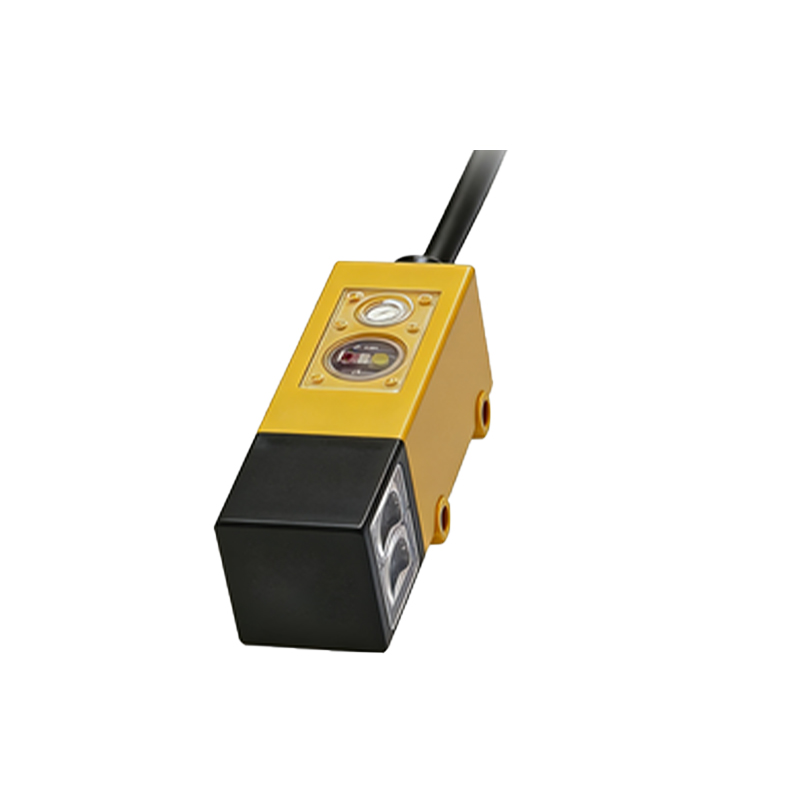
The experimental apparatus included a retro-reflective photoelectric sensor (24V DC), a corresponding corner-cube reflector, a programmable logic controller (PLC) for output monitoring, a digital oscilloscope, a calibrated measuring tape, and various test objects differing in color (white, black), material (metal, plastic, cardboard), and surface finish (matte, glossy). A variable-speed conveyor simulator was used to test dynamic response. The sensor was mounted on a stable optical bench, aligned precisely with the reflector. Power was supplied via a regulated DC power supply, and the output signal was connected to both the PLC input module and the oscilloscope for simultaneous observation.
Procedure for Static Characteristic Measurement
The initial phase involved determining the sensor's rated sensing distance. The reflector was positioned at the manufacturer's specified maximum range, and the sensor's alignment was fine-tuned for a stable output. The distance was gradually decreased, confirming consistent detection. Subsequently, the maximum reliable sensing range was found by incrementally moving the reflector beyond the rated distance until the sensor failed to maintain a stable "object absent" state. This established the practical operational limit. Hysteresis, the difference between the switch-on and switch-off points, was measured by slowly moving an object into and out of the beam path, noting the precise distances at which the output changed state.
Analysis of Target Material and Color Dependence
A critical performance factor is a sensor's sensitivity to different target properties. Using test objects of identical size but varying characteristics, the experiment quantified this dependence. A matte white object was detected at the full rated range. A glossy black plastic object, however, required a significantly closer proximity for reliable detection, often reducing the effective range by 30-40%. This is attributed to the low reflectivity of dark colors and the specular reflection of glossy surfaces, which can deflect the beam away from the receiver. This finding underscores the necessity of considering target surface properties during sensor selection.
Dynamic Response and Environmental Interference Tests
The sensor's dynamic performance was evaluated by passing objects on the conveyor simulator at varying speeds. The oscilloscope captured the response time—the delay between the beam interruption and the output signal transition. This was found to be well within the datasheet specification (typically<1 ms). Furthermore, the experiment tested for immunity to ambient light interference. A high-intensity incandescent lamp was shone directly at the receiver. The modulated light source of the sensor proved largely immune to this steady-state interference, though rapid fluctuations from sources like strobe lights could cause false triggering, highlighting the importance of a stable lighting environment or sensors with advanced modulation techniques.
Experimental Results and Data Interpretation
The collected data presented clear trends. The practical maximum sensing range was approximately 90% of the rated distance under ideal conditions (clean reflector, high-reflectivity target). Hysteresis was measured at 2% of the sensing distance, a desirable feature preventing output chatter when an object is positioned at the detection boundary. The response time data confirmed the sensor's suitability for high-speed counting applications. The most significant deviation from ideal behavior was the strong dependence on target color and finish, as detailed in the previous section. These results provide a practical performance envelope for this sensor model.
Conclusion and Application Recommendations
This experiment successfully characterized the operational parameters of a retro-reflective photoelectric sensor. The device demonstrated high reliability for standard detection tasks within its specified range, with excellent response speed and good immunity to steady ambient light. The key limitation identified is its reduced effectiveness with low-reflectivity or specular targets. For such applications, a diffuse-reflective or through-beam sensor configuration may be more appropriate. It is recommended that engineers always conduct similar real-world validation tests, considering specific target properties and environmental conditions, to ensure robust system integration and avoid operational failures in automated systems.