Introduction to Photoelectric Sensors and Color Sensitivity
Photoelectric sensors are fundamental components in industrial automation, utilizing light beams to detect the presence, absence, or distance of objects. Their operation hinges on the emission of light—typically from an LED—and the reception of its reflection or interruption. A critical, yet often underestimated, factor in their performance is the color of both the target object and the background. Unlike the human eye, which perceives color in a complex way, photoelectric sensors respond to specific wavelengths of light. The color of an object directly influences its reflectance properties at these wavelengths, thereby impacting the sensor's ability to reliably detect it. Understanding this relationship is paramount for engineers designing robust sensing solutions. The core principle is that darker colors absorb more light, while lighter colors reflect more. However, the specific hue and the sensor's light source color create a more nuanced interaction that dictates sensing range, accuracy, and stability.
The Science of Light Reflection and Absorption
At the heart of color influence lies the physics of light. A photoelectric sensor's emitter projects a beam of light at a particular wavelength. Common source colors include red, green, blue, and infrared. When this beam strikes an object, several things can happen: reflection, absorption, or transmission. The color we perceive is the wavelength of light the object reflects most strongly. A red object, for instance, reflects red wavelengths (around 630-700 nm) and absorbs most others. If a sensor with a red LED is used to detect a red object, the signal received will be strong because the object reflects that specific wavelength efficiently. Conversely, if the same red-light sensor tries to detect a blue object, which absorbs red light, the reflected signal will be weak, potentially causing a detection failure. This wavelength-specific interaction is why sensor selection must account for target color.
Impact on Sensing Range and Reliability
Color directly dictates the effective sensing range. Manufacturers specify a standard sensing range based on a white, high-reflectivity target (often Kodak 90% white). For a darker-colored target, the usable range can be drastically reduced. For example, a sensor rated for 10 meters with a white target may only achieve 2 meters with a dark gray target and less than 1 meter with matte black. This reduction occurs because less light is reflected back to the receiver. Furthermore, reliability suffers. A sensor operating near its limit with a low-reflectivity color may produce inconsistent readings due to minor environmental changes like dust, humidity, or slight target position variations. Engineers must derate the nominal sensing range significantly when applying sensors to dark targets to ensure a sufficient signal margin for reliable operation.
Challenges with Color Contrast and Background
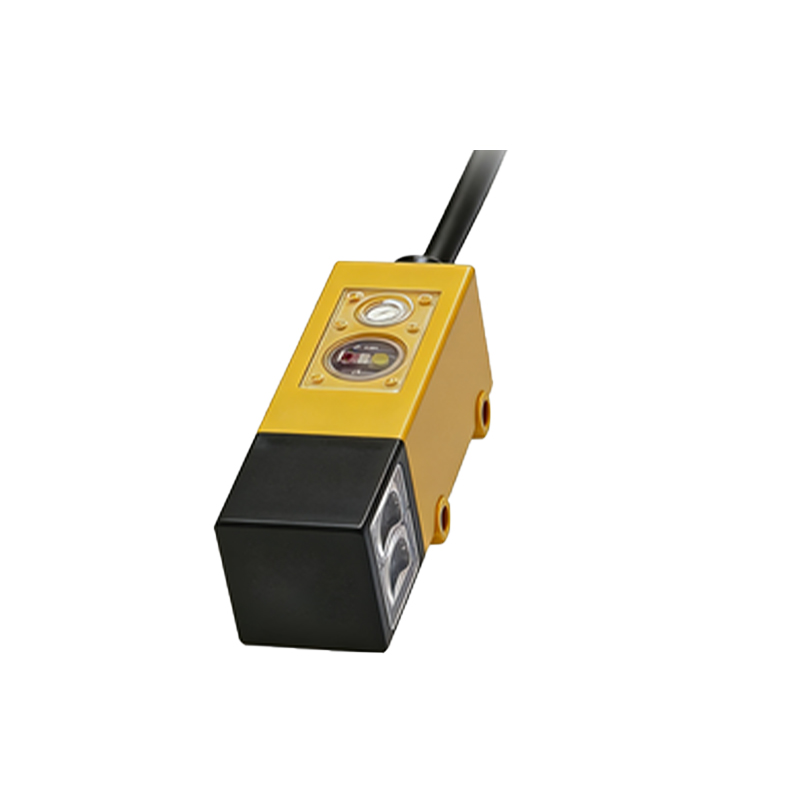
It is not only the target color that matters, but also its contrast against the background. A retro-reflective or diffuse sensor must distinguish the target from its surroundings. If a dark target moves against a similarly dark background, the change in reflected light may be too subtle for the sensor to detect. Conversely, a highly reflective background can cause false triggers. Advanced sensors with background suppression technology help mitigate this by focusing on a specific distance, but color contrast remains a key design consideration. For instance, detecting a black wire on a black conveyor belt is notoriously difficult and may require a polarized sensor or a different sensing technology, such as ultrasonic, altogether.
Selecting the Right Sensor and Light Source Color
Choosing the appropriate sensor type and emitter color is a strategic decision. For general-purpose applications, red LED sensors are common and cost-effective. For detecting specific colors, color-mark sensors with red, green, and blue LEDs can distinguish color differences. To minimize the impact of target color, infrared sensors are often preferred. Infrared light is less visible and tends to be absorbed and reflected differently by colors, sometimes offering more consistent performance on varied surfaces, though it is not immune to color effects. For the most challenging applications involving low contrast or glossy surfaces, laser-based sensors provide a focused, intense beam that improves signal strength on dark colors. The rule of thumb is to test the actual target under real conditions whenever possible.
Practical Application Tips for Engineers
To ensure success, follow these practical guidelines. First, always obtain a sample of the actual target material and background. Test multiple sensor types (diffuse, retro-reflective, through-beam) and light colors against it. Second, apply a substantial safety factor to the sensing range; a 50-70% reduction from the catalog rating for dark colors is not uncommon. Third, consider environmental light immunity. Some colors may be more susceptible to interference from ambient light, such as sunlight or factory lighting. Sensors with modulated LED light and synchronous detection circuits are essential in such environments. Finally, for precision tasks like edge detection or small part positioning, the color's effect on the beam spot size and shape should be evaluated, as absorption can scatter the light pattern.
Conclusion and Technological Advancements
In summary, color is a decisive variable in photoelectric sensor application, influencing range, stability, and selection. Ignoring its effects can lead to system failures and costly downtime. The industry continues to innovate to address these challenges. Smart sensors with teach-in functions can automatically adapt to the target's reflectivity. True Color sensors that emulate human color perception are becoming more accessible for complex sorting tasks. Furthermore, the integration of vision sensors and photoelectric sensors in hybrid systems provides a powerful solution where color and precise shape detection are both critical. For the modern engineer, a deep understanding of the interplay between light, color, and sensor technology remains a cornerstone of effective automation design.