Laser displacement sensors represent a cornerstone of modern precision measurement technology. Their non-contact operation, high accuracy, and rapid response make them indispensable across industries ranging from automotive manufacturing to electronics assembly. The core principle governing their design is optical triangulation. In this method, a laser diode emits a focused beam of light onto the target surface. The reflected or scattered light is then captured by a position-sensitive detector, typically a CMOS or CCD linear array. The position of the light spot on this detector shifts proportionally to the distance of the target. Sophisticated onboard electronics and algorithms calculate this shift to determine the exact displacement or distance with micron-level precision.
The design architecture of a laser displacement sensor is a careful integration of several key components. First, the laser source itself must be selected for stability, wavelength, and spot size. Red laser diodes are common for general-purpose applications, while blue lasers offer advantages for measuring shiny or transparent surfaces due to their shorter wavelength. The emitted light passes through a collimating lens to create a tight, consistent beam. The receiving optics, including a high-quality lens, focus the reflected light onto the detector array. The choice of detector is critical; its resolution, sensitivity, and speed directly influence the sensor's performance specifications. Furthermore, advanced sensors incorporate temperature compensation circuits to mitigate thermal drift, ensuring stable readings in varying environmental conditions.
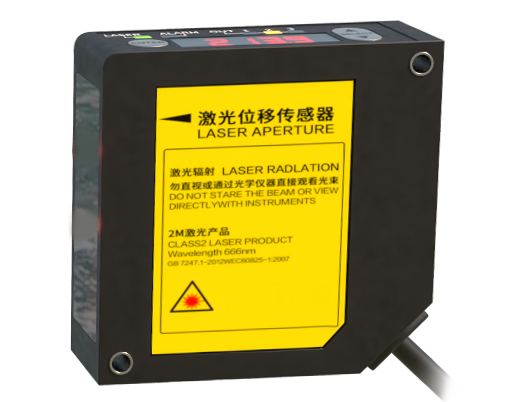
Signal processing is the intelligent core of the sensor design. The analog signal from the detector is converted, filtered, and analyzed by a dedicated microprocessor. Modern designs implement complex algorithms to handle challenging surface conditions—such as varying colors, textures, or materials—by dynamically adjusting gain and threshold levels. This digital processing enables features like peak-hold for transparent objects, which captures the reflection from the rear surface, or first-return mode for penetrating surface contaminants like dust or oil mist. The processed data is then output via industry-standard interfaces like analog voltage/current, digital I/O, or high-speed communication protocols such as Ethernet/IP or PROFINET.

The application scope for laser displacement sensors is vast and continually expanding. In industrial automation, they are deployed for precise thickness measurement, vibration analysis, and coplanarity checks of electronic components. Robotics systems rely on them for guidance and positioning. In quality control, they perform 100% inline inspection of part dimensions, detecting warpage, gaps, and profile deviations in real-time. Beyond the factory floor, they are used in research and development for material testing and reverse engineering. The design must, therefore, be robust, often featuring IP67-rated housings for resistance to dust and water ingress, ensuring reliable operation in harsh industrial environments.
Future design trends are pushing the boundaries of capability. The integration of multi-point or line laser profiles enables 2D and 3D scanning from a single sensor head. Developments in CMOS technology allow for faster sampling rates, exceeding 100 kHz, to measure highly dynamic processes. There is also a growing emphasis on miniaturization and smart sensor features, such as embedded web servers for easy configuration and diagnostics. As the demand for higher precision and smarter manufacturing grows, the design of laser displacement sensors will continue to evolve, incorporating more advanced optics, faster processors, and intelligent software to solve increasingly complex measurement challenges. Their role as a fundamental tool for non-contact metrology remains firmly established, driven by relentless innovation in their core design principles.