In industrial automation and control systems, proximity sensors play a crucial role in detecting the presence or absence of objects without physical contact. Among the various configurations, the normally closed (NC) proximity sensor is a fundamental design that offers specific operational advantages. Understanding its working principle, wiring, and typical applications is essential for engineers and technicians.
A normally closed proximity sensor, in its resting state (when no target is detected), maintains a closed electrical circuit. This means the output signal line is electrically connected to the common or power line, allowing current to flow. When a target object enters the sensor's detection range, the internal switching mechanism is triggered, opening the circuit and interrupting the current flow. This change in state—from closed to open—is used to signal the presence of the object to a controller like a PLC (Programmable Logic Controller).
The core technology behind these sensors can be inductive, capacitive, or photoelectric. Inductive NC sensors are most common for metal detection. They contain an oscillator circuit that generates an electromagnetic field. When a metallic target approaches, it causes eddy currents in the target, which dampens the oscillator's amplitude. This damping is detected by the sensor's circuitry, which then commands the solid-state switch (like a transistor) to change state, opening the normally closed connection.
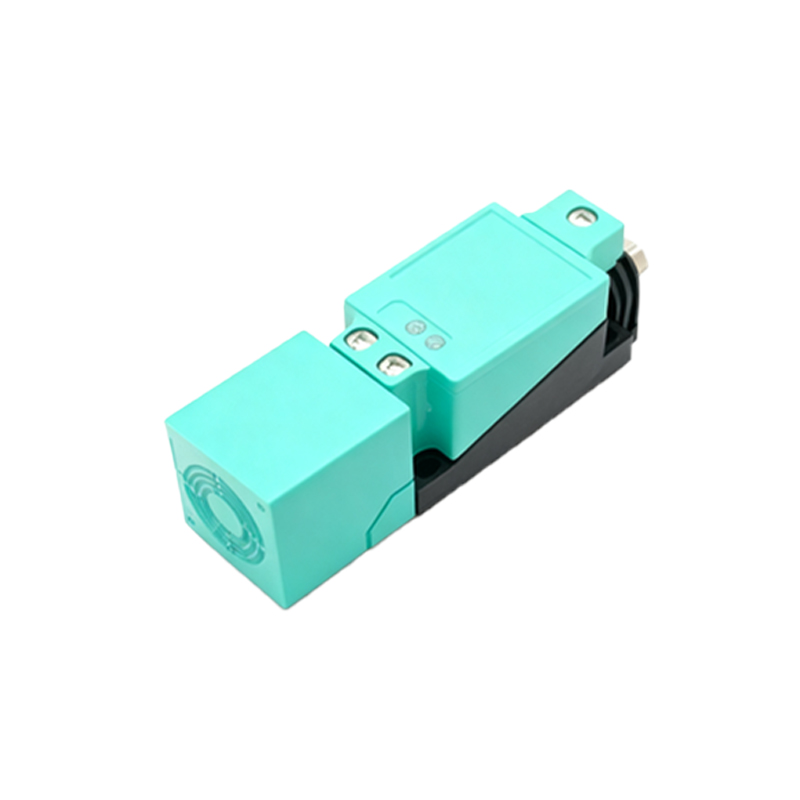
Wiring a normally closed sensor is straightforward but requires attention. Typically, a three-wire DC sensor will have brown (positive), blue (negative/neutral), and black (output signal) wires. In the NC configuration, with no target present, there is continuity between the black (output) and the blue wire. When a target is detected, this continuity breaks. It is critical to consult the datasheet, as wiring it incorrectly into a PLC input card expecting a normally open (NO) signal can cause logic errors. Many modern sensors offer configurable NO/NC outputs via wiring or programming to increase flexibility.
The choice to use a normally closed configuration is often driven by safety and fail-safe design principles. A key advantage is inherent safety in wire break scenarios. If the wire connecting the sensor to the controller is severed or disconnected, the circuit opens, mimicking the "target detected" state. In safety-critical applications—such as a guard door monitor or a machine over-travel limit—this is desirable. A broken wire or loss of power will cause the machine to stop safely, rather than continuing to operate under an undetected fault condition. This "fail-safe" philosophy prioritizes safety in the event of a failure.
Another significant application is in emergency stop (E-stop) circuits and safety interlocks. These systems are traditionally designed using normally closed contacts wired in series. When any E-stop button is pressed or a safety gate is opened, the NC contact opens, breaking the circuit and commanding an immediate stop. Using NC proximity sensors in such chains allows for non-contact monitoring of safety perimeters or machine components while maintaining this reliable fail-safe characteristic.
Beyond safety, NC sensors are used in routine process control. For example, they can monitor for the absence of material on a conveyor. An NC sensor positioned to detect material would open its circuit when material is present. If the material flow stops, the sensor's circuit closes, signaling a "fault" or "empty" condition to the control system, which can then trigger an alarm or stop related processes. This logic can be simpler and more direct for certain monitoring tasks.
When selecting between normally open and normally closed sensors, the system's default state and fault response must be considered. An NO sensor is active (on) only when a target is present. An NC sensor is active (on) in its resting, non-detected state. The decision impacts PLC programming logic; an input from an NC sensor will typically need to be logically inverted in the software to interpret it correctly if the program is written for NO sensor logic.
Maintenance and troubleshooting also differ. Diagnosing an NC sensor often involves checking for continuity when the target is absent. A lack of continuity in this state suggests a faulty sensor or wiring issue. Understanding this expected behavior speeds up diagnostics.
In conclusion, the normally closed proximity sensor is a vital component that provides reliable, fail-safe operation in countless industrial settings. Its defining trait—a closed circuit at rest that opens upon detection—makes it the preferred choice for safety interlocking, fault detection, and applications where a broken wire must result in a safe system shutdown. By correctly integrating these sensors into control system design, engineers enhance both the safety and reliability of automated equipment.