Introduction to Angled Through-Beam Sensors
In the complex landscape of industrial automation, reliable object detection is non-negotiable. Among the various sensing technologies, the through-beam photoelectric sensor stands out for its long-range and high-reliability performance. A specialized variant, the angled through-beam sensor, addresses unique installation and detection challenges that standard axial models cannot. This article delves into the design, operational principles, and critical applications of these sensors, providing a technical overview for engineers and system integrators.
Fundamental Operating Principle
At its core, an angled through-beam sensor operates on the same fundamental principle as a standard through-beam type. It consists of two separate units: a transmitter and a receiver. The transmitter emits a focused beam of light, typically from an LED or laser diode. The receiver, positioned opposite the transmitter, continuously monitors for this light signal. An object is detected when it interrupts the beam path, causing the receiver's output state to change. The defining characteristic of the angled version is that the optical axes of the emitter and receiver are not aligned in a straight line but are pre-angled within their respective housings. This built-in offset allows the units to be mounted parallel to each other while still creating a crossing beam path.
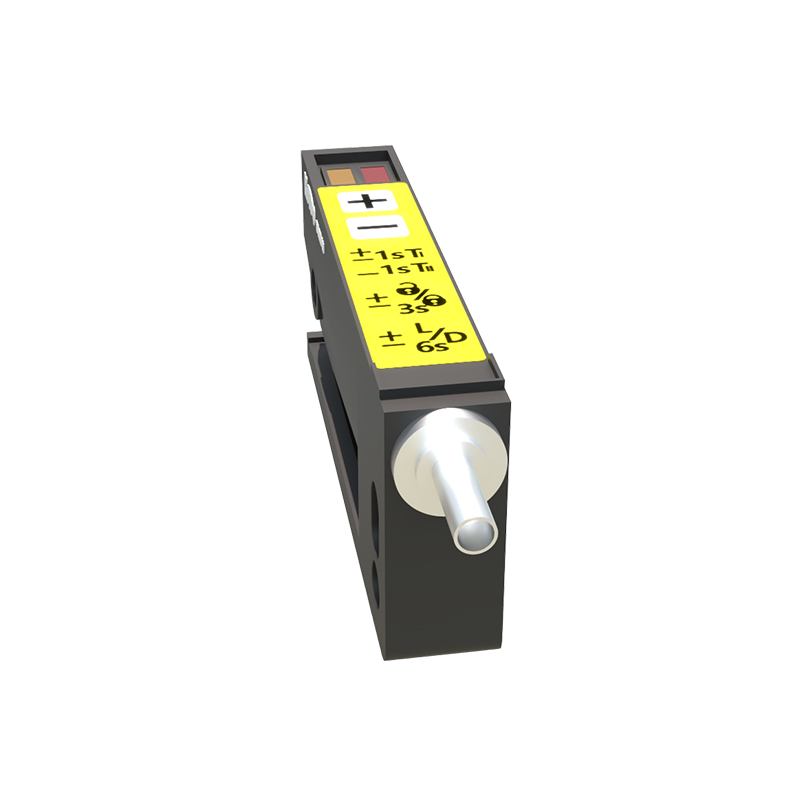
Key Design and Configuration Features
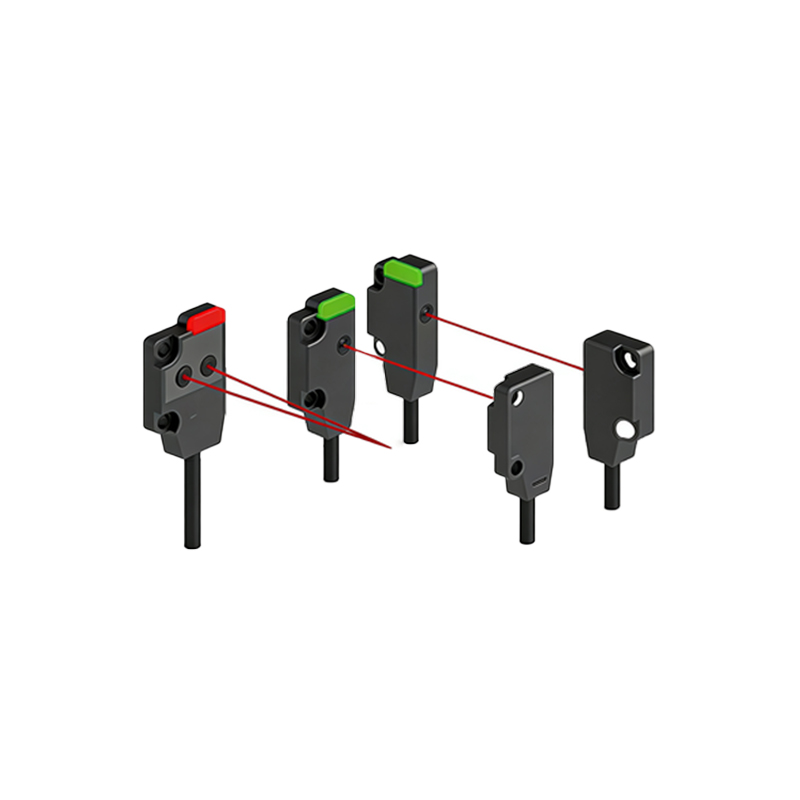
The primary design feature is the fixed angle integrated into the sensor housing, commonly 20°, 45°, or 90°. This angle determines the crossing point of the beams, which defines the effective sensing window. Engineers must carefully calculate the mounting distance and alignment to ensure the beams intersect precisely at the desired detection point. Many models incorporate precise alignment aids such as visible red light beams or laser spots, and some advanced versions feature dual digital displays showing signal strength for both alignment and diagnostic purposes. The housing is typically robust, rated at IP67 or higher, to withstand harsh industrial environments involving dust, moisture, and mechanical vibration.
Advantages Over Standard Axial Models
The angled configuration offers several distinct advantages. First, it simplifies installation in space-constrained applications where mounting the emitter and receiver directly opposite each other is physically impossible due to machinery框架 or other obstructions. Second, it enables the detection of very small objects. Because the beams cross at a point, an object only needs to be large enough to interrupt that specific intersection, allowing for detection resolutions smaller than the sensor's lens diameter. Third, it provides exceptional resistance to optical interference from ambient light or reflections from shiny objects, as the receiver is only tuned to the specific beam coming from the angled transmitter.
Typical Industrial Applications
Angled through-beam sensors find their niche in demanding applications. In packaging machinery, they are indispensable for detecting the presence of small items on high-speed conveyor belts, such as pills, capacitors, or bottle caps. In the automotive assembly sector, they verify the precise placement of tiny components or the threading of screws. They are also crucial in wafer handling within semiconductor fabrication, where detecting the edge of a fragile silicon wafer without contact is paramount. Another common use is in web-guiding systems for paper, film, or foil, where they monitor the edge position by detecting the presence or absence of the material at a very precise lateral location.
Critical Considerations for Implementation
Successful implementation requires careful planning. The selection of the appropriate beam angle and sensing distance is the first critical step, dictated by the available mounting space and the size of the target object. Alignment, though facilitated by built-in aids, must be precise; even a slight misalignment can shift the beam crossing point and cause detection failures. Environmental factors like heavy dust, steam, or oil mist can attenuate the light beam, necessitating sensors with higher power output or specific wavelengths (e.g., green laser for enhanced visibility in red-rich environments). Finally, mechanical stability of the mounting structure is essential to maintain alignment over time amidst machine vibrations.
Maintenance and Troubleshooting Guidelines
While known for durability, these sensors require periodic maintenance. Lenses should be kept clean from dust and grime to prevent signal loss. Regular checks of the alignment and signal strength, using the sensor's indicators or a dedicated monitor, are recommended. Common issues include missed detections due to misalignment, unstable output from a dirty lens, or false triggers caused by an object reflecting light into the receiver (less common with through-beam but possible in highly reflective setups). Understanding the installation geometry and having clear alignment references are key to efficient troubleshooting.
Future Trends and Conclusion
The evolution of angled through-beam sensors continues, with trends pointing towards miniaturization, increased use of laser diodes for finer beams and longer ranges, and the integration of IO-Link communication for advanced diagnostics, parameter setting, and condition monitoring. In conclusion, the angled through-beam photoelectric sensor is a powerful and specialized tool in the automation engineer's arsenal. Its ability to provide reliable detection of small objects in challenging spatial configurations makes it an optimal solution for a wide range of precision industrial applications, ensuring process reliability and enhancing overall system performance.